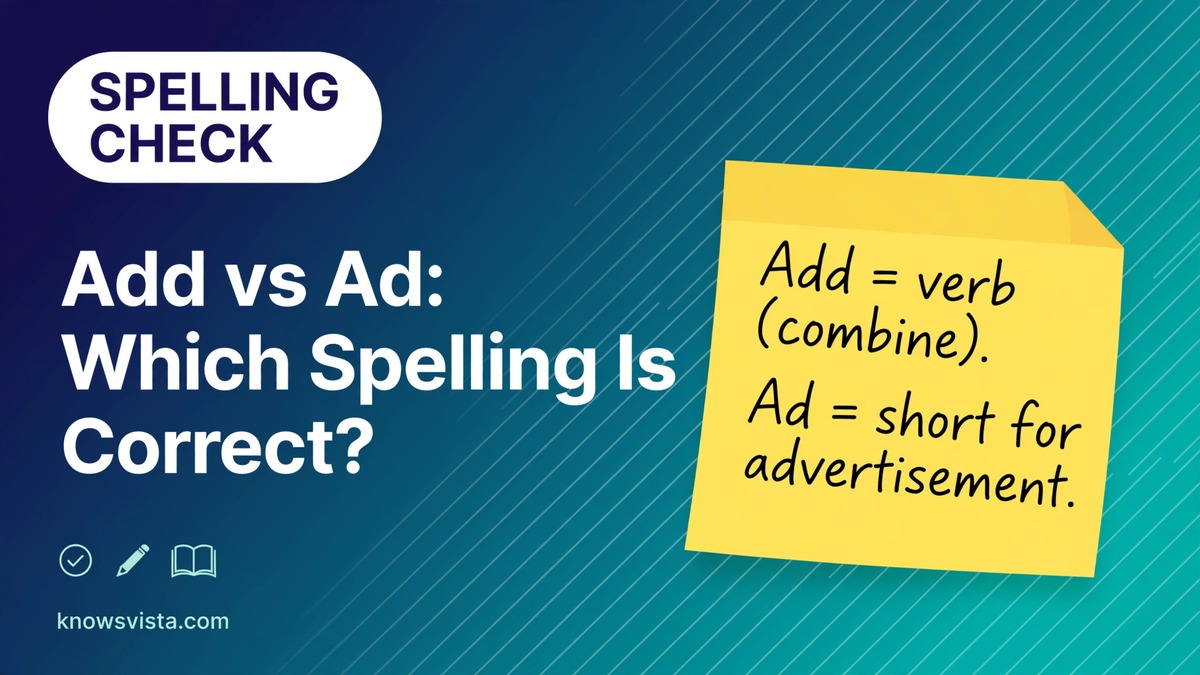
Add vs Ad: Which Spelling Is Correct?
The add vs ad mix-up is a single-letter trap with completely different meanings. Add is a verb, to combine, join, or increase. Ad is a noun, a shortened form of advertisement. They sound identical, which is why spellcheckers and fast typists keep swapping them. This guide gives you the part-of-speech test, the one-sentence trick that uses both words, and a memory aid so the extra D never lands in the wrong place. For another doubling trap that fools writers, see our putting vs puting guide.
⚡ Quick answer
Add (verb, two D’s) = to combine or increase: “Add two numbers.” Ad (noun, one D) = an advertisement: “a TV ad.” One sentence uses both correctly: “Add a photo to the ad.”
🧠 Memory trick: Add gets an extra D because you’re adding more. Ad is the short form of advertisement, so it takes the short spelling.
Add: the verb that combines
Use add for any action of joining, increasing, or including: numbers, names, comments, ingredients, people. It conjugates as add / adds / added / adding, always with two D’s. If your sentence describes something being done, you need add.
Please add more sugar to my coffee.
Can you add my name to the guest list?
Let’s add up the grocery bill.
Add a comment before you send the draft.
She added three new photos to the album.
The chef added a pinch of salt at the end.
Would you like to add anything to the discussion?
Ad: the noun that advertises
Use ad only for a promotional message, TV ads, online ads, newspaper ads, podcast ads. It is the standard shortened form of advertisement, acceptable in all but the most formal writing. Because it starts with a vowel sound, it takes “an”: “an ad,” never “a ad.”
The ad played three times during the game.
She clicked the ad for the new phone.
They launched a clever ad campaign in March.
The newspaper ad listed the job opening.
I keep seeing ads for that airline.
He works at an ad agency downtown.
This episode is brought to you by our sponsors, ad break over.
✗ Avoid: “I saw an add for the concert.” (a thing can’t be a verb)
✓ Right: “I saw an ad for the concert.”
The tricky exceptions
“Ad” as a describing word: ad campaign, ad blocker
An ad can sit in front of another noun as an attributive noun: “ad campaign,” “ad revenue,” “ad blocker,” “ad spend.” It still means advertisement, its position doesn’t turn it into a verb. Never write “add campaign.” The usage guide at writingtips.org’s ad vs add page lists more of these fixed phrases.
The ad blocker hid every banner on the page.
Their ad spend doubled this quarter.
Uppercase AD is a different word entirely
Capital AD usually means Anno Domini (“in the year of the Lord”) in dates: “AD 1066.” It can also abbreviate other terms, like assistant director or active duty. If the letters are capitalized, read it as an abbreviation, it has nothing to do with advertisements.
The manuscript dates to AD 900.
The assistant director (AD) called for quiet on set.
Add vs ad at a glance
| Add | Ad | |
|---|---|---|
| Correct? | Yes, the verb | Yes, the noun |
| Part of speech | Verb (adds, added, adding) | Noun (plural: ads) |
| Meaning | To combine, join, or increase | Short for advertisement |
| Spelling | Two D’s (a-d-d) | One D (a-d) |
| Example | Add your name to the list. | Skip the ad to start the video. |
| Trick | Extra D for extra action | Short word for a short form |
Quick practice
Choose the right form:
- Please __________ your signature to the form.
- I skipped the __________ before the video started.
- __________ the total before you pay the cashier.
- Can you __________ a caption to the __________?
Answer key:
- 1. add (an action is being performed)
- 2. ad (a promotional message before a video)
- 3. Add (combining numbers = the verb)
- 4. add, ad (“Add a caption” = action; “the ad” = the advertisement)
Frequently Asked Questions
Is “ad” short for advertisement?
Yes. Ad is the accepted short form of advertisement (and sometimes advertising), meaning a public message that promotes something. It is standard in everyday and business writing.
Is it “add to cart” or “ad to cart”?
Add to cart, it’s an action, so it needs the verb. The same test works everywhere: if you can replace it with “include” or “combine,” spell it add.
Why do people mix up “add” and “ad”?
Both are pronounced /æd/, so ears can’t tell them apart, only context and spelling can. Fast typing and autocorrect finish the job. The part-of-speech test (verb vs noun) resolves every case.
Can “ad” be plural?
Yes, ads: “TV ads,” “online ads.” The plural is a quick proof of the noun: verbs don’t take an -s plural, but ad does, because it’s a thing, not an action.
Is “ad” acceptable in formal writing?
Mostly yes, ad is widely accepted, though academic writing prefers the full advertisement. When in doubt, write the full word. For another pair where formality changes the spelling, see our nevermind or never mind guide.
What does “ad hoc” mean?
Ad hoc is a Latin phrase meaning “for this purpose”, as in “an ad hoc committee” formed for one specific task. Note the single D: it uses the Latin ad (meaning “to”), not the verb add.
Final thoughts
The add vs ad question is really a grammar test in disguise: add is the verb that combines, and ad is the noun that advertises. Two D’s for action, one D for promotion, and both can live in one sentence. Keep practicing spelling traps, try our putting vs puting guide or our nevermind or never mind guide, and test yourself on the spelling quiz and the free grammar checker.
Leave a Reply