Category: Word Meanings & Vocabulary

Definitions, origins and examples of interesting words.

  • Smaragdine Meaning: Definition, Origin and Examples Explained

    Smaragdine Meaning: Definition, Origin and Examples Explained

    Smaragdine Meaning: Definition, Origin and Examples Explained

    Smaragdine meaning is one of the English dictionary’s best-kept secrets. Older dictionaries define it as “emerald-green; of or relating to emeralds”, a rare, poetic word you meet mostly in crosswords, poetry, and vocabulary lists. This guide gives you the real definition, the ancient origin, and how to use it correctly. For more rare-word deep dives, visit the KnowsVista homepage.

    โšก Quick answer

    Smaragdine is a rare adjective meaning emerald-green, of, relating to, or resembling an emerald. It names the deep, glowing green of the gemstone itself. Pronounced smuh-RAG-din.

    ๐Ÿง  Memory trick: Smaragdine hides smaragd, the old word for emerald. If it glows the green of an emerald, the fancy word is smaragdine.

    What does smaragdine mean?

    The definition of smaragdine is beautifully simple. Historical dictionaries such as Webster’s Revised Unabridged (1913) list it plainly:

    Smaragdine (adjective): of or pertaining to emerald; of an emerald green.

    Picture a Colombian emerald under a jeweler’s lamp, that deep, vivid green. Smaragdine turns that exact shade into a word. Writers reach for it when plain green feels too flat.

    โœ“ “Morning light turned the harbor water a smaragdine blue-green.”

    โœ“ “She wore a smaragdine silk gown to the evening gala.”

    โœ“ “The forest canopy glowed smaragdine in the filtered sunlight.”

    โœ“ “His eyes held a strange smaragdine flash by the firelight.”

    Origin of smaragdine

    Smaragdine crossed three ancient languages to reach English. The trail begins with Greek smaragdos, meaning a green gemstone. Latin borrowed it as smaragdus and built the adjective smaragdinus, “relating to emerald.” English adopted that adjective as smaragdine.

    The word emerald grew from the very same root, through Old French esmeraude, so smaragdine and emerald are ancient cousins. The word’s most famous moment is the Smaragdine Table of Hermes Trismegistus, the legendary emerald-green tablet said to carry the precepts of alchemy.

    “Smaragdine comes from Latin smaragdinus, from smaragdus, from Greek smaragdos, a green gemstone.”

    “The Smaragdine Table of Hermes Trismegistus is the word’s most famous literary appearance.”

    How to use smaragdine correctly

    Use smaragdine as an adjective, before or after a noun. It belongs in poetry, fantasy, and art writing, everyday prose usually prefers emerald-green. Unsure about your sentence? Run it through our free Grammar Checker.

    โœ“ “The poet praised her smaragdine eyes in the opening verse.”

    โœ— “The museum displayed a rare smaragdine.” โ†’ โœ“ “The museum displayed a rare emerald.” (Smaragdine is an adjective, it cannot name a thing.)

    โœ“ “Smaragdine vines climbed the monastery’s ancient stone walls.”

    โœ— “She painted the door a smaragdine color.” โ†’ โœ“ “She painted the door smaragdine.” (The color is already in the word.)

    The tricky confusions

    Smaragdine vs emeraldine, which is the real word?

    Both are real, but they live in different worlds. Emeraldine belongs to chemistry, it names a form of the polymer polyaniline. It is not a general word for emerald-green. For the color, smaragdine is the word you want. And be honest: smaragdine is absent from Merriam-Webster and Cambridge online, it survives in historical dictionaries and word lists. Merriam-Webster does list emerald as an adjective meaning “of a rich green color”; see Merriam-Webster’s entry for “emerald”.

    โœ— “The lake shimmered an emeraldine green.” โ†’ โœ“ “The lake shimmered a smaragdine green.” (Emeraldine is a chemistry term, not a color word.)

    โœ“ “The lab studied the emeraldine salt of polyaniline.” (The word’s real home, chemistry.)

    Don’t mix up smaragdine with “smaragd” the noun

    In Middle English, smaragd was a noun, an old word for the emerald stone itself. The endings look alike, but the jobs differ: smaragd names the gem, smaragdine describes the color. Near-miss pairs like this are a specialty, see our insure or ensure guide for another one.

    โœ— “She inherited a flawless smaragdine from her grandmother.” โ†’ โœ“ “She inherited a flawless emerald from her grandmother.” (The noun is smaragd, not smaragdine.)

    โœ“ “Medieval jewelers called the green gemstone a smaragd.”

    Smaragdine at a glance

    SmaragdineEmeraldEmeraldine
    MeaningEmerald-green; of or relating to emeraldsOf a rich green color, like the gemA form of polyaniline
    Part of speechRare adjectiveAdjective (noun = the gemstone)Noun, technical
    RootLatin smaragdinus โ† Greek smaragdosOld French esmeraude โ† Latin smaragdusFrom “emerald” + -ine
    StatusHistorical dictionaries; poetic useStandard modern wordChemistry labs only

    Quick practice

    Fill in the blank with the right word:

    1. “The lagoon glowed a deep __________ green at sunset.” (a) smaragdine (b) smaragd
    2. “The chemist analyzed the __________ salt of polyaniline.” (a) smaragdine (b) emeraldine
    3. “A medieval merchant might have sold you a __________.” (a) smaragd (b) smaragdine
    4. “The __________ Table of Hermes is alchemy’s most famous artifact.” (a) Smaragdine (b) Emeraldine

    Answer key:

    • 1. (a) smaragdine, the adjective names the color
    • 2. (b) emeraldine, the chemistry term
    • 3. (a) smaragd, the old noun for the gemstone
    • 4. (a) Smaragdine, the legendary emerald-green tablet

    Frequently Asked Questions

    What is the meaning of smaragdine?

    Smaragdine means “emerald-green” or “of or relating to emerald.” It is a rare adjective used in poetry and literary writing for the rich green of emeralds.

    How do you pronounce smaragdine?

    Say smuh-RAG-din, stress the middle syllable. It rhymes roughly with a flag green, a handy reminder of its meaning.

    What is the origin of smaragdine?

    It comes from Latin smaragdinus (“relating to emerald”), from smaragdus, from Greek smaragdos (“green gemstone”). English emerald grew from the same root via Old French. For another word with a storied origin, see Sink or Swim: Meaning, Origin, Spelling & Usage.

    Final thoughts

    Smaragdine meaning is a jewel of a word: emerald-green, ancient, and poetic. Use it as an adjective, keep it for literary moments, and gloss it for readers meeting it the first time. Rare words reward the curious, explore Frescade Meaning: Origin, Usage & Common Confusion Explained next, or test yourself in our Spelling Quiz.

  • Cacophony Meaning: Definition, Examples, and Correct Usage

    Cacophony Meaning: Definition, Examples, and Correct Usage

    Cacophony Meaning: Definition, Examples, and Correct Usage

    Cacophony meaning is exactly what the word sounds like: a harsh, jarring mixture of sounds. From honking traffic to a badly tuned orchestra, it names any “bad sound” that assaults the ears, and writers love it as a literary device too. This guide covers the definition, origin, and correct usage with 12+ examples. For more vocabulary deep dives, visit the KnowsVista homepage.

    โšก Quick answer

    Cacophony is a noun meaning a harsh, discordant mixture of sounds, for example, a cacophony of car horns. It comes from Greek kakos (bad) + phone (sound), so it literally means “bad sound.” Its opposite is euphony (pleasant sound).

    ๐Ÿง  Memory trick: Cacophony starts with caco-, the Greek root for “bad”, the same root hiding in cacography (bad handwriting). Bad + sound = cacophony.

    What does cacophony mean?

    A cacophony is not just any loud noise, it is a mixture of harsh, clashing sounds heard together. Dictionaries define it as “harsh discordance of sound; dissonance.” One barking dog is loud; a kennel of barking dogs, a ringing phone, and a blaring TV at once is a cacophony. The plural is cacophonies, and the adjective form is cacophonous.

    โœ“ “The street was filled with a cacophony of honking horns.”

    โœ“ “Amid the cacophony of voices, he struggled to be heard.”

    โœ“ “The classroom erupted into a cacophony of laughter.”

    โœ“ “The cacophony of sirens echoed through the night.”

    โœ“ “The orchestra’s warm-up was a cacophony of tuning strings.”

    โœ“ “Rush hour turned the station into a cacophony of announcements and brakes.”

    Origin and history of cacophony

    Cacophony entered English in the mid-16th century, probably through French cacophonie, from a Latinized form of Greek kakophonia. Its parts are kakophonos (“harsh-sounding”), built from kakos (“bad, evil”) + phone (“voice, sound”). The musical sense, “discordant sounds in music”, is recorded from 1789. Related words from the same roots include telephone, symphony, and megaphone.

    “Cacophony: 1650s, ‘harsh or unpleasant sound,’ from Greek kakophonia, from kakos ‘bad’ + phone ‘voice, sound.’”, etymology record

    โœ“ “Stravinsky’s The Rite of Spring uses deliberate cacophony to create tension.”

    โœ“ “Lewis Carroll packed Jabberwocky with cacophonous clashing sounds.”

    โœ“ “The debate dissolved into a cacophony of competing opinions.” (metaphorical use)

    โœ“ “The pet shop at feeding time is pure cacophony.”

    How to use cacophony correctly

    Use cacophony when you need a formal or mock-serious label for a combination of ugly sounds. It is typically countable (“a cacophony of…”) but can also be uncountable (“the room filled with cacophony”). In literature and rhetoric, writers deploy it deliberately to evoke chaos or discomfort, the opposite of the soothing effect called euphony. For another figure-of-speech word, compare motif vs theme.

    โœ“ “A cacophony of construction noise greeted us at dawn.” (countable)

    โœ“ “The market buzzed with cacophony.” (uncountable, no article needed)

    โœ— “The single cacophony of the alarm woke me.” โ†’ โœ“ “The single wail of the alarm woke me.” (one sound is not a cacophony)

    The tricky points about cacophony

    Cacophony vs cacophonous: noun vs adjective

    Cacophony is the noun (the thing): a cacophony of horns. Cacophonous is the adjective (the description): a cacophonous street. Keep them straight the same way you keep other word pairs straight, see peek or peak for another lookalike lesson. Merriam-Webster’s dictionary entry for “cacophony” lists both forms.

    โœ— “The street was cacophony.” โ†’ โœ“ “The street was cacophonous.”

    โœ“ “We escaped the cacophony of the market.” (noun, the mixture itself)

    The spelling trap: it’s “cacophony,” not “cacaphony”

    The middle syllable is -pho-, from Greek phone (sound), the same ph you see in telephone and symphony. Spellers often write cacaphony or cacofony; both are wrong. Remember the phone inside the noise: caco-PHON-y.

    Cacophony at a glance

    CacophonyEuphonyHarmony
    MeaningHarsh, discordant mixture of sounds (“bad sound”)Pleasant, melodious arrangement of sounds (“good sound”)Sounds that blend beautifully together
    RootGreek kakos (bad) + phone (sound)Greek eu (good) + phone (sound)Greek harmonia (agreement)
    Examplea cacophony of car alarmsthe euphony of Keats’s versethe harmony of the choir
    ToneNegative, assaults the earsPositive, soothes the earsPositive, blends and pleases

    Quick practice

    Choose the correct option:

    1. “The construction site was pure __________.” (a) cacophony (b) euphony
    2. “The __________ choir filled the hall with blended voices.” (a) cacophonous (b) harmonious
    3. Cacophony literally means: (a) bad sound (b) loud music

    Answer key:

    • 1. (a) cacophony, harsh, clashing noise
    • 2. (b) harmonious, blended, pleasing voices (cacophonous would clash)
    • 3. (a) bad sound, Greek kakos + phone

    Frequently Asked Questions

    What is an example of cacophony?

    A classic example: a cacophony of car horns during rush hour, many harsh sounds clashing at once. Others: a badly tuned orchestra warming up, or a kennel of barking dogs.

    Is cacophony a noun or an adjective?

    Cacophony is a noun. The adjective form is cacophonous: a cacophonous street, but a cacophony of traffic.

    What is the opposite of cacophony?

    The direct opposite is euphony (pleasant sound). In general terms, harmony is also the opposite, sounds that blend instead of clash.

    Final thoughts

    Cacophony meaning is beautifully self-describing: bad sound, from the Greek roots that built the word itself. Use it for a mixture of harsh sounds, reach for cacophonous when you need the adjective, and spell it with the ph of phone. Master this one and literary vocabulary gets much friendlier, next, try Sink or Swim: Meaning, Origin, Spelling & Usage for another phrase with deep roots.

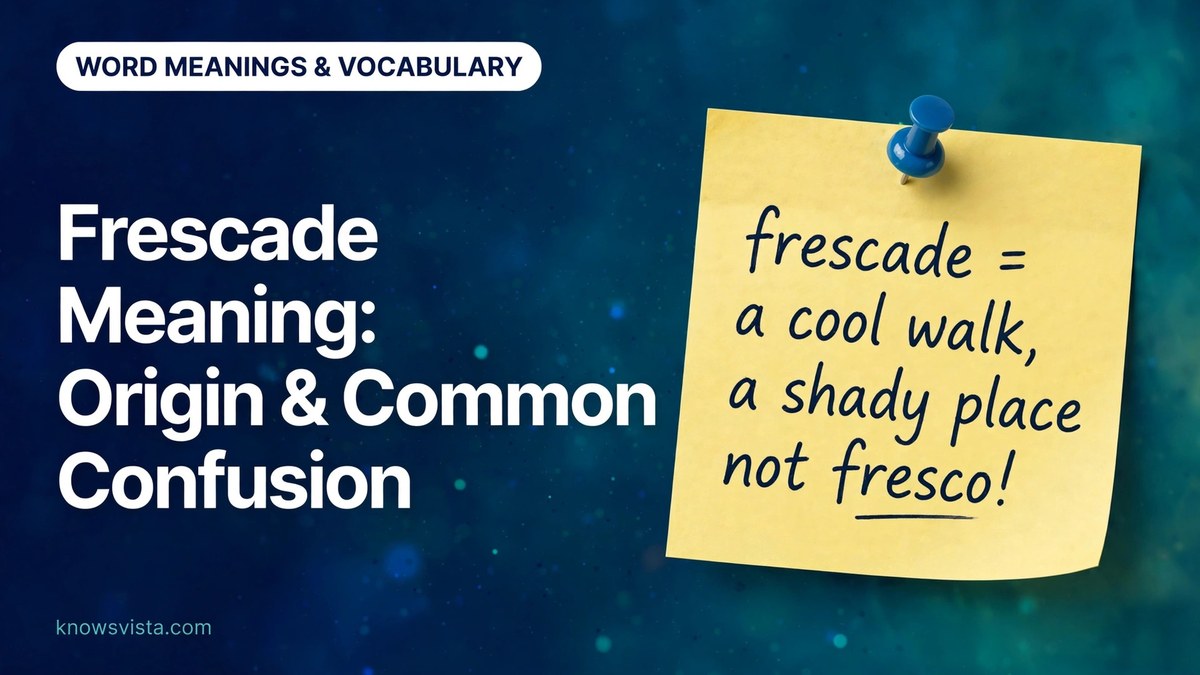
  • Frescade Meaning: Origin, Usage & Common Confusion Explained

    Frescade Meaning: Origin, Usage & Common Confusion Explained

    Frescade Meaning: Origin, Usage & Common Confusion Explained

    Frescade meaning is one of the dictionary’s best-kept secrets. Older English dictionaries define it as “a cool walk; a shady place”, a rare, beautiful word most people meet only in crossword puzzles or vocabulary lists. But it is also one of the most confused words online, mixed up with fresco and frescada. This guide gives you the real definition, the origin, and how to use it correctly. For more rare-word deep dives, visit the KnowsVista homepage.

    โšก Quick answer

    Frescade is a rare English noun meaning a cool walk or a shady place, a shaded path where you stroll out of the sun. It is not the same as fresco (a wall-painting technique) or frescada (a Spanish word). Pronounced fres-KADE.

    ๐Ÿง  Memory trick: Frescade starts like fresh, and both are about coolness. A frescade is where you go to feel fresh.

    What does frescade mean?

    The definition of frescade is refreshingly simple. Historical dictionaries such as Webster’s Revised Unabridged (1913) list it plainly:

    Frescade (noun): a cool walk; a shady place.

    Picture a tree-lined avenue on a hot afternoon, where the branches meet overhead and the path below stays cool. That shaded promenade is a frescade. It names the place and the act of walking there in the cool shade.

    โœ“ “After lunch they took a slow stroll along the frescade behind the villa.”

    โœ“ “The old garden was designed around a long frescade of plane trees.”

    โœ“ “We escaped the midday heat into the frescade of the cloister.”

    โœ“ “Every Mediterranean courtyard seems to hide a little frescade somewhere.”

    Origin of frescade

    Frescade is related to the Italian fresco, meaning “fresh” or “cool”, the same root behind alfresco (literally “in the fresh/cool air”). The -ade ending suggests a place or action associated with coolness, much like promenade names a place for walking. It belongs to a family of English words borrowed from Romance languages that describe pleasant outdoor spaces: veranda, pergola, piazza.

    The word also survives as a place name. Venice has a Rio Frescada, a small canal street whose name preserves the same “cool, shady” idea. Like many rare dictionary words, frescade fell out of everyday speech but never left the record, which is why it keeps appearing in vocabulary quizzes and crossword clues.

    “Frescade is kin to Italian fresco (cool, fresh) and alfresco (in the open air).”

    “Venice’s Rio Frescada keeps the old ‘cool, shady place’ sense alive as a street name.”

    The tricky points about frescade

    Frescade is not “fresco”

    This is the #1 confusion. A fresco is a painting technique, pigment applied to wet plaster, as in the Sistine Chapel. A frescade is a cool, shady walk. They share the fres- root (cool/fresh) but name completely different things. Merriam-Webster’s entry for “fresco” covers the painting sense in detail. Similar near-miss confusions include insure or ensure, same family of lookalike words.

    โœ— “The chapel walls were covered in frescades.” โ†’ โœ“ “The chapel walls were covered in frescoes.”

    โœ“ “The artist painted a fresco; the visitors cooled off in the frescade outside.”

    Frescade is not “frescada” either

    Spanish frescada is a different word entirely, it can mean a strawberry smoothie, or it is the feminine past participle of fresar. Dropping the final a changes the language, the meaning, and the part of speech. Watch your vowels when you type it.

    โœ— “Quiero una frescade de fresa.” โ†’ โœ“ “Quiero una frescada de fresa.” (Spanish: a strawberry smoothie)

    You won’t find frescade in modern dictionaries

    Be honest with your readers: frescade is absent from Merriam-Webster, Cambridge, and Oxford online. It lives in historical dictionaries and word lists. That makes it perfect for vocabulary quizzes and wordplay, but risky in formal writing, your spellchecker will flag it. If you use it, a quick gloss (“a cool, shady walk”) keeps readers with you. For another word with a rich origin story, see Sink or Swim: Meaning, Origin, Spelling & Usage.

    Frescade at a glance

    FrescadeFrescoFrescada
    MeaningA cool walk; a shady placeWall painting on wet plasterStrawberry smoothie (Spanish)
    Part of speechEnglish noun (rare)English nounSpanish noun / participle
    Examplethe frescade behind the villathe frescoes of the chapeluna frescada de fresa
    StatusHistorical dictionaries onlyStandard modern wordStandard Spanish word

    Quick practice

    Choose the correct word:

    1. “They escaped the heat in the __________ of the courtyard.” (a) frescade (b) fresco
    2. “Michelangelo’s __________ covers the chapel ceiling.” (a) frescade (b) fresco
    3. Frescade is related to the Italian word meaning: (a) fresh/cool (b) fast/loud

    Answer key:

    • 1. (a) frescade, a cool, shady walk
    • 2. (b) fresco, the painting technique
    • 3. (a) fresh/cool, from Italian fresco

    Frequently Asked Questions

    What is the meaning of frescade?

    Frescade means “a cool walk; a shady place”, a shaded path or spot where you stroll out of the sun. It is a rare English noun recorded in historical dictionaries.

    Is frescade the same as fresco?

    No. A fresco is a painting technique (pigment on wet plaster); a frescade is a cool, shady walk. They share an Italian root meaning “fresh/cool” but are different words.

    How do you pronounce frescade?

    Pronounce it fres-KADE, stress on the second syllable, with the final e silent, rhyming with arcade.

    Final thoughts

    Frescade meaning is a small treasure: a cool walk, a shady place, a word English almost forgot. Keep it separate from fresco and frescada, gloss it when you use it, and you will sound both precise and poetic. Words like this reward the curious; for more, read Motif vs Theme: What’s the Difference? next.

  • Trayed Meaning: Definition, Origin, Examples, and Correct Usage

    Trayed Meaning: Definition, Origin, Examples, and Correct Usage

    Trayed Meaning: Definition, Origin, Examples, and Correct Usage

    Trayed meaning depends on where you meet the word. In older dictionaries it is the past tense of tray, meaning “to betray or deceive.” Online, it is modern slang for getting publicly exposed or embarrassed, “he got trayed” after his messages were screenshotted. This guide covers both senses, the word’s origin, and how to use it correctly. For more words with double lives, visit the KnowsVista homepage.

    โšก Quick answer

    Trayed has two meanings: (1) an old, rare word meaning betrayed or deceived (past tense of the verb tray); (2) modern internet slang meaning publicly exposed or embarrassed, “she got trayed” means she was caught out or roasted in front of everyone.

    ๐Ÿง  Memory trick: Think of trayed as be-trayed with the be- knocked off, both the old meaning and the slang sense circle back to being betrayed.

    Trayed meaning #1: betrayed (the old dictionary sense)

    The verb tray appears in older dictionaries with a blunt definition: “to betray; to deceive.” Its past tense is trayed, and its present participle is traying. You will almost never see this form in modern writing, but it is the word’s legitimate dictionary root, and it explains where the modern slang came from.

    “Tray, verb: to betray; to deceive.”, older dictionary definition

    โœ“ (archaic) “He felt trayed by his closest ally.”, meaning he felt betrayed

    โœ“ (archaic) “The spy trayed the plans to the enemy.”, meaning the spy betrayed the plans

    โœ“ (archaic) “She trayed his trust with a single lie.”, meaning she deceived him

    Trayed meaning #2: exposed or roasted (the modern slang sense)

    Online, “trayed” is a playful twist on betrayed that took off on social media and in gaming communities. To get trayed means to be caught out, exposed, or publicly embarrassed, usually by your own words or actions coming back to haunt you. The image behind it: being served up on a tray for everyone to see.

    โœ“ “He got trayed after his old tweets resurfaced.”, he was publicly exposed

    โœ“ “She trayed him in the group chat with the screenshots.”, she exposed him

    โœ“ “I got trayed when my teammate switched sides mid-game.”, I was betrayed/caught off guard

    โœ“ “Don’t flake on the plan, you’ll get trayed in the group chat.”

    โœ“ “That comeback trayed the whole lobby.”, it embarrassed everyone there

    โœ“ “He tried to deny it, but the receipts trayed him instantly.”

    The tricky points about trayed

    “Trayed” is not in major modern dictionaries

    Here is the honest truth: trayed does not appear in Merriam-Webster, Cambridge, or Oxford as a headword. The old verb tray (“to betray”) survives only in historical dictionaries, and the slang sense lives on social media. If you search a dictionary, look up Merriam-Webster’s entry for “betrayed” instead, the word trayed is understood is a spin on. Never use trayed in formal or academic writing.

    Trayed vs betrayed: register matters

    Betrayed is the standard, serious word, use it in essays, emails, and news. Trayed is casual slang with a meme-like flavor, suitable for chats, gaming, and social posts. Swapping them is a register error, not a grammar error. Similar slang-born spelling puzzles include diddo or ditto and emcee or MC.

    โœ— “The whistleblower felt trayed by the corporation.” (formal, use betrayed) โ†’ โœ“ “The whistleblower felt betrayed by the corporation.”

    โœ“ “The whistleblower felt betrayed by the corporation.” (formal register)

    โœ“ “Bro got trayed in the replies ๐Ÿ˜‚” (casual register, slang fits)

    Trayed at a glance

    Trayed (old sense)Trayed (slang sense)
    MeaningBetrayed; deceivedPublicly exposed; roasted
    RegisterArchaic / historical dictionariesInformal; social media and gaming
    ExampleHe felt trayed by his ally.He got trayed after the screenshots leaked.
    Use in formal writing?No, use betrayedNo, use exposed or betrayed

    Quick practice

    Choose the correct word:

    1. In a history essay, “The general was __________ by his officers” needs: (a) trayed (b) betrayed
    2. In a gaming chat, “I got __________ when my duo switched teams” fits: (a) trayed (b) betrayed
    3. The slang “trayed” is best understood as a playful form of: (a) traded (b) betrayed

    Answer key:

    • 1. (b) betrayed, formal register requires the standard word
    • 2. (a) trayed, casual register; the slang sense fits perfectly
    • 3. (b) betrayed, “trayed” is “be-trayed” with the be- dropped

    Frequently Asked Questions

    Is “trayed” a real word?

    Half-real. The verb tray (“to betray, deceive”) appears in older dictionaries, and trayed is its past tense. The slang sense, “publicly exposed”, is internet-born and not in major modern dictionaries. Both are real usage; only betrayed is standard in formal writing.

    What does “got trayed” mean?

    It means someone was publicly exposed, embarrassed, or caught out, usually by their own messages or actions. Think screenshots shared in a group chat or a comeback that silenced the whole lobby.

    Is it “trayed” or “betrayed”?

    Use betrayed in formal writing, it is the standard word. Reserve trayed for casual slang contexts like social media and gaming chats, where its playful tone fits.

    Final thoughts

    Trayed meaning is really two stories in one: an old dictionary verb meaning “betrayed,” and a modern slang term for getting publicly exposed. Know which room you are in, a history essay calls for betrayed, a group chat welcomes trayed, and you will use it correctly every time. For more slang-to-standard puzzles, compare bad rap or bad rep next.

  • Tennyson Meaning: Origin, History, Symbolism, and Modern Usage

    Tennyson Meaning: Origin, History, Symbolism, and Modern Usage

    Tennyson Meaning: Origin, History, Symbolism, and Modern Usage

    Tennyson meaning goes far beyond one famous poet. This English name means “son of Dennis,” carries a medieval history, and today works as both a surname and a stylish given name. Whether you met it in a literature class, a baby-name list, or a character roster, this guide covers its origin, history, symbolism, and correct usage. For more name and word histories, explore the KnowsVista homepage.

    โšก Quick answer

    Tennyson is an English patronymic name meaning “son of Dennis.” Tenny was a medieval diminutive of Dennis, which traces back to the Greek god Dionysius. It is used as a surname and a masculine given name, and it is most famous through Alfred, Lord Tennyson, the great Victorian poet.

    ๐Ÿง  Memory trick: Read it as Tenny-son, literally “the son of Tenny.” The “-son” ending always signals “son of” in English surnames, just like Johnson and Anderson.

    What does Tennyson mean?

    At its core, Tennyson is a patronymic, a name built from a father’s name. Break it into two parts: Tenny + son. Tenny was a medieval pet form of the name Dennis, and -son means “son of.” So the literal Tennyson meaning is “son of Dennis” (or, in some heraldic sources, “Denys’s son”).

    The chain runs deeper. Dennis comes from Dionysius, the name of the Greek god of wine and revelry. So a Tennyson is, poetically speaking, a descendant of a name rooted in celebration. That classical thread is one reason the name feels both literary and grounded.

    “The Tennyson family name appeared early in the Holderness region of East Yorkshire, later spreading into Lincolnshire.”

    “Tennyson, Tenny-son, follows the same patronymic pattern as Johnson, the son of John.”

    “Medieval Tenny was a diminutive of Dennis, which descends from the Greek Dionysius.”

    “Today Tennyson is used both as a family surname and as a masculine given name.”

    Origin and history of Tennyson

    The surname Tennyson first appears in medieval England, concentrated in the Holderness region of East Yorkshire before spreading into Lincolnshire in the East Midlands. Before spelling was standardized, families wrote the name as they heard it, so historical records show variants like Tennison, Tenison, and Tenneson. Archbishop Thomas Tenison (1636-1715) carried one such variant form.

    The name’s immortal fame arrived with Alfred, Lord Tennyson (1809-1892), Poet Laureate of Great Britain for over 40 years during Queen Victoria’s reign. His poems, “The Charge of the Light Brigade,” “In Memoriam,” and “The Lady of Shalott”, made the name famous far beyond England. As Britannica’s biography of Alfred, Lord Tennyson records, his work defined Victorian poetry, and his surname became a byword for literary craft itself.

    “Alfred, Lord Tennyson served as Poet Laureate of Great Britain for more than four decades of Queen Victoria’s reign.”

    “His poem ‘The Charge of the Light Brigade’ remains one of the most recited works in English literature.”

    “Historical spelling variants include Tennison, Tenison, and Tenneson, common before spelling was standardized.”

    “The name traveled with English settlers to the United States, Canada, and Australia, though it remains uncommon.”

    Symbolism and modern usage of Tennyson

    Symbolically, Tennyson carries a literary, distinguished aura. Parents choosing it as a first name today are usually drawn to its poetic heritage, it suggests creativity, eloquence, and quiet confidence. It pairs naturally with classic middle names and works in full or shortened to the friendly nickname Tenny.

    In modern usage, Tennyson is predominantly masculine and more familiar as a surname than a first name. It has never ranked among top baby-name lists, which is exactly its appeal: recognizable, easy to pronounce, but refreshingly uncommon. In fiction, the name is best known through Benjamin “Ben” Tennyson, the hero of the animated series Ben 10, whose surname nods to the poet.

    โœ“ “They named their son Tennyson, after the Victorian poet his mother admired.”

    โœ“ “Tennyson’s poetry still appears in school anthologies around the world.”

    โœ“ “Call him Tenny for short, Tennyson is a bit formal for a toddler.”

    โœ“ “A Tennyson in the credits always makes a period drama feel more authentic.”

    The tricky points about Tennyson

    Spelling: Tennyson vs Tennison vs Tenison

    The standard modern spelling is Tennyson, with the -y-. Tennison and Tenison are historical variants you will meet in old records, and in one famous case, Archbishop Thomas Tenison of Canterbury. When writing about the poet or using it as a modern given name, always use Tennyson. The same “which spelling is correct” question applies to many names; see Chris’s or Chris’ for another proper-noun puzzle.

    Capitalize it, and don’t confuse it with “Tension”

    Tennyson is always capitalized as a proper noun. A common typo drops the middle syllable and produces Tenson, or a spellchecker “corrects” it toward tension. Because the name carries its -son ending, pronounce all three syllables, TEN-ih-sun, to keep the spelling straight.

    Tennyson at a glance

    MeaningTypeExample
    Tennyson“Son of Dennis”English patronymic; surname or masculine given nameAlfred, Lord Tennyson
    Tennison / TenisonSame meaningHistorical spelling variantsArchbishop Thomas Tenison
    TennyPet form of DennisNickname“Just call him Tenny.”
    Dennis / DionysiusFrom the Greek god of wine and revelryRoot name behind TennysonDennis the Menace

    Quick practice

    Choose the correct option:

    1. Tennyson literally means “son of __________.” (a) Dennis (b) Daniel (c) David
    2. The most famous Tennyson was a __________ . (a) novelist (b) poet (c) playwright-turned-king
    3. Which is the standard modern spelling? (a) Tennyson (b) Tenneson (c) Tennyson (double s)

    Answer key:

    • 1. (a) Dennis, Tenny was a medieval diminutive of Dennis
    • 2. (b) poet, Alfred, Lord Tennyson, Poet Laureate for 40+ years
    • 3. (a) Tennyson, with a single s after the y

    Frequently Asked Questions

    What does Tennyson mean as a name?

    It means “son of Dennis.” It is an English patronymic surname that is also used as a masculine given name, carrying a literary, distinguished feel thanks to Alfred, Lord Tennyson.

    Is Tennyson a first name or a last name?

    Both. It originated as a surname in medieval England and remains most common in that role, but modern parents also use it as a masculine first name, often shortened to Tenny.

    How do you pronounce Tennyson?

    Pronounce it TEN-ih-sun, three syllables, stress on the first. The -y- sounds like a short i, and the final -son rhymes with sun.

    Final thoughts

    Tennyson meaning is simple at the root, “son of Dennis”, but rich in history: a medieval surname, a Victorian literary giant, and now a distinctive modern given name. Spell it with the -y-, capitalize it, and remember the -son ending that makes the meaning obvious. If you enjoy words with stories behind them, read Sink or Swim: Meaning, Origin, Spelling & Usage next for another name-like phrase with deep roots.