Category: US vs UK English

Color or colour? Traveled or travelled? Explained.

  • Whisky or Whiskey: Why Are There Two Spellings in 2026?

    Whisky or Whiskey: Why Are There Two Spellings in 2026?

    Whisky or Whiskey: Why Are There Two Spellings in 2026?

    Whisky or whiskey: which spelling is correct? Both spellings are correct, and the country where the spirit is made decides which one to use. Whisky without an e is the spelling in Scotland, Canada, and Japan, while whiskey with an e is the spelling in Ireland and the United States. The extra letter changes nothing about the taste or the recipe. It is a marker of place and tradition, not a marker of quality. Test your sentence with our free Grammar Checker and Spelling Quiz, and use the country test below when the two forms feel equal.

    The rule follows the same pattern as our theatre or theater guide: British spelling keeps one form and American spelling keeps another, and the audience you write for decides which form looks right. Once you learn that whisky points to Scotland and whiskey points to Ireland and America, the two spellings stop causing trouble, because only the origin of the bottle decides the letter.

    Quick answer

    Use whisky without an e for Scotch whisky, Canadian whisky, and Japanese whisky. Use whiskey with an e for Irish whiskey and American whiskey such as bourbon, rye, and Tennessee whiskey. Never write “Scottish whiskey” for Scotch, because Scotch whisky is a legally protected name and the spelling without an e is part of that name.

    ๐Ÿง  Memory trick: In the 1800s Irish distillers added the e for excellence, to sell their whiskey as finer than Scottish blends. Think “whiskey with an e for excellence” and the Irish and American spelling appears on its own.

    When to use whisky without an e

    Use whisky without an e when you write about Scotch whisky, Canadian whisky, or Japanese whisky. Scotland has used this spelling for centuries, and the Scotch Whisky Regulations 2009 protect the name “Scotch Whisky” in law, so a genuine Scotch product always carries the spelling without an e. Canada follows the same spelling, and Japan adopted it from the Scottish tradition when Japanese distilling began. Modern Whisky’s whisky or whiskey guide states the same split: whisky without an e belongs to Scotland, Canada, and Japan, while whiskey with an e belongs to Ireland and the United States, and the spelling tells you where the spirit was born.

    โœ“ He poured a glass of single malt Scotch whisky after dinner.

    โœ“ The shop stocks Canadian whisky from three distilleries.

    โœ“ Japanese whisky won top prizes at the tasting.

    โœ“ She collects bottles of Islay Scotch whisky.

    โœ“ The label reads “Scotch Whisky” in large letters.

    โœ“ Our guide lists the best Japanese whisky bars in Tokyo.

    The spelling without an e is also the default in most other whisky making countries, including Australia, India, France, and New Zealand. Writers outside Ireland and the United States should use whisky as the safe default, because it matches the spelling most of the world uses. If you are unsure about the origin of a bottle, check the label first, because the label always shows the spelling the maker chose. Our aluminum or aluminium guide shows the same country split for another word where the spelling follows the place, not the meaning.

    โœ“ Australian whisky is gaining fans around the world.

    โœ“ The Indian whisky on the shelf won a gold medal.

    โœ“ French whisky makers follow the Scottish style.

    โœ“ New Zealand whisky is small in scale but high in quality.

    When to use whiskey with an e

    Use whiskey with an e when you write about Irish whiskey or American whiskey. Irish distillers adopted the spelling in the 1800s to set their smooth triple distilled spirit apart from Scottish blends, and the spelling travelled to the United States with Irish immigrants. Today bourbon, Tennessee whiskey, and American rye whiskey all use the spelling with an e, and Irish whiskey labels do the same. The e is a mark of the Irish and American tradition, not a sign of a different drink.

    โœ“ Jameson is the best known Irish whiskey in the world.

    โœ“ Bourbon is an American whiskey made mostly from corn.

    โœ“ Tennessee whiskey is filtered through maple charcoal.

    โœ“ He ordered a glass of Irish whiskey with water.

    โœ“ Rye whiskey gives the cocktail a spicy note.

    โœ“ The distillery in Kentucky makes small batch whiskey.

    The spelling with an e is so tied to Ireland and America that readers expect it in those contexts, and using the other spelling there looks like a mistake. A menu that lists “Irish whisky” will look wrong to most readers even though Ireland’s own technical file permits both forms. In writing, match the spelling to the country every time, and your reader will trust the detail. Our catalog or catalogue guide shows the same rule for another word where the American form differs from the British form.

    โœ“ The bar menu lists ten Irish whiskeys by name.

    โœ“ She prefers American whiskey over Scotch whisky.

    American whiskey also covers rye, wheat, and corn styles, and each one keeps the e on the label. Bourbon must be made from at least 51 percent corn and aged in new charred oak, Tennessee whiskey adds the Lincoln County charcoal filtering step, and rye whiskey must be made from at least 51 percent rye grain. The rules differ by style, yet the spelling stays the same across all of them, so once you learn the American form you can use it for every bottle from the United States.

    The tricky exceptions

    Maker’s Mark and other famous exceptions

    Some American makers break the rule on purpose. Maker’s Mark bourbon from Kentucky spells its product “whisky” without an e as a nod to its Scottish heritage, and a few craft distillers in the United States do the same. These are branding choices, not spelling errors, so copy the spelling from the label when you name a specific brand. When you write about American whiskey in general, keep the e.

    โœ“ Maker’s Mark labels its bourbon as “whisky” without an e.

    โœ“ The craft distillery spells its spirit “whisky” to honour its Scottish founder.

    The plural changes with the spelling

    The plural follows the spelling you choose. Whisky becomes whiskies and whiskey becomes whiskeys, so the two plurals can appear in the same sentence when you compare bottles from different countries. Keep the pair matched: never write “whiskies” for American bottles or “whiskeys” for Scotch bottles, because the plural must match the singular form.

    โœ“ The shelf holds Scotch whiskies and Irish whiskeys side by side.

    โœ“ She tasted three whiskies from Japan and two whiskeys from Ireland.

    Whisky is not a quality label

    The spelling tells you nothing about flavour or quality. A cheap Scotch whisky and a rare Japanese whisky share the same spelling, and a fine Irish whiskey and a plain bourbon share the other spelling. Smoky, smooth, peaty, or sweet are matters of recipe and ageing, not of the letter e. Judge the bottle by its maker and its age statement, and use the spelling only to show where it comes from. Our curb or kerb guide shows the same idea for another pair where the spelling marks the place and nothing else.

    โœ“ The spelling does not tell you if the whisky is smoky.

    โœ“ A whiskey with an e can be light or full bodied.

    The e test for menus and labels

    When you write a menu, a shop sign, or a drinks list, the e test takes seconds: read the label on the bottle and copy the spelling exactly. Menus that mix the two forms look careless, so pick the spelling from the country of origin and keep it through the whole list. A Scotch section uses whisky, an Irish section uses whiskey, and a world whisky section uses whisky as the default. If a bottle comes from a country you do not know, search the brand name first, because craft makers sometimes choose the spelling of their heritage rather than the spelling of their home country. The label is the final judge, and copying it beats guessing every time.

    โœ“ The drinks list spells Scotch as whisky and bourbon as whiskey.

    โœ“ The label on the bottle shows the spelling the maker chose.

    โœ“ The world whisky shelf uses whisky as the default spelling.

    Whisky vs whiskey at a glance

    FormUsed inExamples
    whiskyScotlandScotch single malt, blended Scotch
    whiskyCanadaCanadian whisky, rye whisky
    whiskyJapanJapanese single malt
    whiskeyIrelandIrish whiskey, Jameson
    whiskeyUnited StatesBourbon, Tennessee whiskey, rye whiskey
    whiskyMost other countriesAustralian, Indian, French whisky

    Quick practice

    Choose the correct form for each sentence:

    1. The bar in Edinburgh serves the finest Scotch ___ in the city. (whisky / whiskey)
    2. Jameson is a famous Irish ___ known around the world. (whisky / whiskey)
    3. Bourbon is an American ___ made mostly from corn. (whisky / whiskey)
    4. The plural of Scotch whisky is ___. (whiskies / whiskeys)

    Answer key:

    • 1. whisky (Scotch always drops the e)
    • 2. whiskey (Irish spelling keeps the e)
    • 3. whiskey (American whiskey keeps the e)
    • 4. whiskies (the plural follows the spelling without an e)

    Frequently Asked Questions

    Is it whisky or whiskey?

    Both are correct. Use whisky without an e for Scotland, Canada, and Japan, and whiskey with an e for Ireland and the United States.

    Why does Scotch whisky have no e?

    Scotland has always spelled it whisky, and the Scotch Whisky Regulations 2009 protect “Scotch Whisky” as the legal name, so the spelling is part of the law.

    Is “Scottish whiskey” correct?

    No, “Scottish whiskey” is a mistake. The correct term is Scottish whisky or Scotch whisky, always without an e.

    Final Thoughts

    Whisky and whiskey are the same word with two spellings, and the country of origin makes the call: Scotland, Canada, and Japan drop the e, while Ireland and the United States keep it. The spelling marks a tradition and a place, not a flavour or a level of quality. Match the spelling to the bottle, watch for brand exceptions such as Maker’s Mark, and remember the plural rule, since whisky becomes whiskies and whiskey becomes whiskeys.

  • Acclimatize vs Acclimatise: The Difference Most Writers Get Wrong

    Acclimatize vs Acclimatise: The Difference Most Writers Get Wrong

    Acclimatize vs Acclimatise: The Difference Most Writers Get Wrong

    Acclimatize vs acclimatise looks like a meaning question, but it is really a spelling question: the two words mean exactly the same thing, to get used to a new climate or new conditions. The difference is regional, because acclimatize with a z is the American spelling and acclimatise with an s is the British spelling. Test your sentence with our free Grammar Checker and Spelling Quiz, and use the audience check below when the two forms feel equal.

    Both spellings come from the same verb, and both are correct, so the mistake writers make is not choosing the wrong word but mixing the two spellings in one document. Pick the spelling that matches your readers and stick to it. The same audience first habit guides our mold or mould guide, where the region decides the spelling, not the meaning.

    Quick answer

    Use acclimatize with a z in American English and acclimatise with an s in British English. Both mean to adjust to a new climate or new conditions: It took a week to acclimatize to the high altitude. Never mix the two spellings in one document.

    ๐Ÿง  Memory trick: The z in acclimatize matches the z in American spelling habits such as organize and realize, while the s in acclimatise matches the s in British habits such as organise and realise. Match the letter to the country.

    When to use acclimatize

    Use acclimatize with a z when you write for an American audience or follow American style guides. It is the standard spelling in the United States, and it appears in American dictionaries as the headword, with the s spelling listed as the British variant. WikiDiff’s acclimatise versus acclimatize page states plainly that acclimatise is the British spelling and acclimatize is the American spelling of the same word. The z form also pairs with the noun acclimatization in American writing.

    โœ“ Hikers need time to acclimatize before climbing above 10,000 feet.

    โœ“ The team took three days to acclimatize to the desert heat.

    โœ“ New employees must acclimatize to the night shift schedule.

    โœ“ The plants slowly acclimatized to the dry soil.

    American English also uses the shorter verb acclimate, which means the same thing and is very common in the United States, especially for social or workplace adjustment. Acclimatize is the fuller form, and it is more common when the change is physical, such as altitude, heat, or cold.

    โœ“ She acclimatized to the cold winters within a year.

    โœ“ Acclimatization to high altitude takes several days.

    When to use acclimatise

    Use acclimatise with an s when you write for a British, Australian, or New Zealand audience, or when you follow British style guides. It is the preferred spelling outside North America, and it follows the same ise pattern as organise, realise, and recognise. Our theatre or theater guide makes a similar region first split for another word that changes only by country.

    โœ“ It took a month to acclimatise to the London winter.

    โœ“ The runners had to acclimatise to the humid conditions.

    โœ“ She acclimatised quickly to her new school in Sydney.

    โœ“ Acclimatisation is vital before a high altitude trek.

    The s spelling carries through the whole word family in British English: acclimatised, acclimatising, and acclimatisation all take an s. Keep the family consistent, because a single z in a British document stands out to an editor at once.

    โœ“ The crew is still acclimatising to the night shifts.

    โœ“ He acclimatised to the heat faster than his brother.

    The tricky exceptions

    Oxford spelling uses z even in British English

    Oxford spelling, used by Oxford University Press, keeps the z in words such as acclimatize, organize, and realize even in British English, because the z reflects the Greek root. So a British document can still show acclimatize if it follows Oxford spelling, and that is not an error. The key is to follow one house style: if your publisher uses Oxford spelling, use z everywhere, and if it uses standard British spelling, use s everywhere.

    โœ“ Oxford spelling: The climbers had to acclimatize before the summit push.

    โœ“ Standard British spelling: The climbers had to acclimatise before the summit push.

    Acclimate is the shorter American cousin

    Acclimate is a separate verb with the same meaning, and it is the more common choice in American English, especially for social change such as a new job or a new city. Acclimatize is more common for physical change such as climate or altitude, but the two overlap freely. Do not treat acclimate as a mistake, and do not mix it with acclimatise in British writing, where it sounds American.

    โœ“ It took him a month to acclimate to the new office culture.

    โœ“ The team acclimated to the time zone after two days.

    Do not mix z and s forms in one document

    The most common real mistake is inconsistency: acclimatize in one paragraph and acclimatised in the next, or acclimatization beside acclimatising. Readers may not notice one spelling, but editors and spellcheckers will catch the mix. Our inquire or enquire guide shows the same rule in action: pick the regional family and keep every related word in it.

    โœ— She had to acclimatize, but her acclimatisation was slow. โ†’ โœ“ She had to acclimatize, but her acclimatization was slow.

    โœ— He acclimatised fast, yet his acclimatization stalled. โ†’ โœ“ He acclimatised fast, yet his acclimatisation stalled.

    Acclimatize vs acclimatise at a glance

    AcclimatizeAcclimatiseAcclimate
    SpellingWith a zWith an sShorter form, no z or s ending
    RegionAmerican English, plus Oxford spellingBritish, Australian, New Zealand EnglishChiefly American English
    MeaningAdjust to a new climate or conditionsSame meaningSame meaning
    Noun formAcclimatizationAcclimatisationAcclimation
    Best forPhysical change, altitude, heat, coldSame, for British readersSocial or workplace change
    Exampleโœ“ Time to acclimatize to altitude.โœ“ Time to acclimatise to altitude.โœ“ Time to acclimate to the new job.

    Quick practice

    Choose acclimatize or acclimatise for each sentence, matching the audience in brackets:

    1. The US hiking guide says to ______ slowly to the altitude. [American]
    2. The London school asked pupils to ______ to the cold pool. [British]
    3. Our Sydney office helps staff ______ to shift work. [Australian]
    4. The New York report warns that ______ takes days. [American, noun form]

    Answer key:

    • 1. acclimatize (American English uses z)
    • 2. acclimatise (British English uses s)
    • 3. acclimatise (Australian English follows British spelling)
    • 4. acclimatization (American noun form keeps the z)

    Frequently Asked Questions

    Is acclimatize or acclimatise correct?

    Both are correct. Acclimatize with a z is the American spelling, and acclimatise with an s is the British spelling. They mean the same thing, so choose the one that matches your readers.

    What is the difference between acclimatize and acclimate?

    They mean the same thing, to adjust to new conditions. Acclimate is shorter and more common in American English, especially for social change, while acclimatize is more common for physical change such as climate or altitude.

    Is acclimatise spelled with an s or a z in the UK?

    Standard British spelling uses an s: acclimatise, acclimatised, acclimatisation. The exception is Oxford spelling, which keeps the z even in British English, so check your publisher’s house style first.

    Can I mix acclimatize and acclimatise in one document?

    No. Mixing the z and s forms in one document is the most common mistake with this pair. Pick one regional family and keep every form, including the noun, in the same family.

    What is the noun form of acclimatize?

    The noun is acclimatization in American English and acclimatisation in British English. The shorter verb acclimate gives the noun acclimation, which is common in American scientific writing.

    Final Thoughts

    Acclimatize and acclimatise are the same word in two regional coats, and most writers get the pair wrong only by mixing the coats: use the z form for American readers, the s form for British readers, keep the noun in the same family, and remember that acclimate is the shorter American cousin for social change. Check your audience first, then let the spelling follow, and this pair stops causing trouble. For the next spelling pair where the region decides the letter, our mold or mould guide applies the same check in the same way.

  • Benefitting or Benefiting: Which Spelling Is Correct in 2026?

    Benefitting or Benefiting: Which Spelling Is Correct in 2026?

    Benefitting or Benefiting: Which Spelling Is Correct in 2026?

    The benefitting or benefiting question trips up even confident writers, because both spellings look right, and in a sense, both are. Benefiting (one t) is the standard American form and the safest choice worldwide. Benefitting (two ts) is the traditional British form. The difference comes from one spelling rule: whether English doubles a final consonant when the last syllable is stressed. Check any sentence with the free Grammar Checker on the KnowsVista homepage.

    โšก Quick answer

    Use benefiting in American English: The students are benefiting from the new library. In British English, benefitting is traditional but benefiting is now widely accepted too, so when in doubt, use benefiting everywhere.

    ๐Ÿง  Memory trick: Say the word out loud: BEN-e-fit. The stress is on the first syllable, not the last, and an unstressed last syllable never doubles its consonant in American spelling. Think: no stress, no extra letter.

    When to use benefiting

    Benefiting follows the standard doubling rule. You double a final consonant before -ing only when the verb ends in one vowel plus one consonant and the final syllable is stressed, as in begin โ†’ beginning and regret โ†’ regretting. In benefit, the stress falls on the first syllable (BEN-e-fit), so the t is not doubled. Merriam-Webster’s benefit entry lists benefited and benefiting as the verb forms.

    โœ“ The company is benefiting from the new policy.

    โœ“ Students are benefiting from the additional study resources.

    โœ“ Is she benefiting from the exercise program?

    โœ“ Local shops benefited from the summer tourism boom.

    โœ“ The charity has benefited thousands of families this year.

    โœ— The Boston report claimed clients were benefitting from the change. โ†’ โœ“ The Boston report claimed clients were benefiting from the change.

    In American writing, benefiting is never wrong, it is the only standard form. The same stress rule explains our putting or puting guide: put is one stressed syllable, so it doubles, while benefit does not.

    When to use benefitting

    Benefitting is the traditional British spelling. British English often doubles a final consonant even when the last syllable is unstressed, the same habit behind travelling (US: traveling) and cancelling (US: canceling). You will still see benefitting in British newspapers, but modern UK style guides increasingly prefer the single-t form, so benefiting is now safe in the UK as well.

    โœ“ The charity is benefitting from the donations. (traditional UK style)

    โœ“ Many people are benefitting from the government’s new healthcare plan. (traditional UK style)

    โœ“ Are children benefitting from the new curriculum? (traditional UK style)

    โœ“ The town benefitted from the new railway station. (traditional UK past tense)

    โœ“ The workers benefitted after the reforms. (traditional UK past tense)

    โœ— A US college essay wrote “students are benefitting.” โ†’ โœ“ A US college essay should write “students are benefiting.”

    The key point: benefitting is a regional variant, not a typo, but it marks your text as British, and it is fading even there. This “traditional vs modern” pattern also appears in our totaling or totalling guide.

    The tricky exceptions

    Stressed final syllables DO double: begin, regret, submit

    Do not overcorrect and stop doubling everywhere. When the stress is on the final syllable, doubling is required in both US and UK English: begin โ†’ beginning, regret โ†’ regretting, submit โ†’ submitting, prefer โ†’ preferred. The rule is about stress, not about the letter t. Test it by saying the word: if you punch the last syllable, double the consonant.

    โœ“ She is beginning a new job on Monday. โœ“ He regretted sending the email. โœ— He benefited is right; he benefitted is only traditional UK style.

    Do not pattern “benefit” on “fit”

    The most common cause of benefitting in American writing is copying fit โ†’ fitting. But fit is a one-syllable word, and one-syllable words ending in one vowel plus one consonant always double: fit โ†’ fitting, run โ†’ running, stop โ†’ stopped. Benefit has three syllables with stress on the first, so a different rule governs it. Similar traps: visit โ†’ visiting and offer โ†’ offered, never visitting or offerring.

    โœ“ The team is fitting new windows. โœ“ The team is benefiting from the grant. โœ— The team is benefitting from the grant. (US)

    “Beneficiary” and “beneficial” never double anything

    Only the -ed and -ing forms of the verb are in question. Related words keep a single t and a single f in every variety: beneficiary, beneficial, benefit itself. There is no benefitting hiding inside beneficial, the t there belongs to a different syllable pattern entirely.

    โœ“ She is the main beneficiary of the trust. โœ“ Regular exercise is beneficial for heart health.

    Benefitting vs benefiting at a glance

    BenefitingBenefitting
    SpellingOne tTwo ts
    Used inUS (standard); modern UK (accepted)Traditional UK (still seen)
    Past tensebenefitedbenefitted
    WhyStress on first syllable (BEN-e-fit), so no doublingUK habit of doubling even unstressed consonants
    Safe defaultYes, use everywhere when unsureNo, marks text as British
    ExampleThey are benefiting from tutoring.They are benefitting from tutoring.

    Quick practice

    Fill in the blank with benefiting or benefitting:

    1. The Chicago students are __________ from free meals. (US)
    2. She is __________ from extra tutoring this term. (safe worldwide default)
    3. He is __________ a new job on Monday. (stressed final syllable, different verb!)
    4. The village __________ from the new road last year. (traditional UK past tense)

    Answer key:

    • 1. benefiting (US standard, one t)
    • 2. benefiting (the safe default in every variety)
    • 3. beginning (begin has a stressed final syllable, so it doubles, unlike benefit)
    • 4. benefitted (traditional UK past tense, two ts)

    Frequently Asked Questions

    Is benefitting a real word?

    Yes, benefitting is a real, accepted spelling in traditional British English. It is not a typo, but it is not the American form, and modern UK guides increasingly prefer benefiting.

    Which is correct: benefitting or benefiting?

    Both are accepted, but benefiting is the standard American form and the safest worldwide default. Use benefitting only when you deliberately follow traditional British style.

    Is it “benefited” or “benefitted”?

    Same rule as the -ing form: benefited is American and modern standard; benefitted is traditional British. Keep the same choice for both forms in one document.

    Why do people write benefitting with two t’s?

    Two reasons: British doubling habits, and copying one-syllable fit โ†’ fitting. Neither applies to the American standard, because benefit is stressed on its first syllable.

    Does spellcheck flag benefitting?

    American spellcheckers usually flag benefitting as an error, while British spellcheckers accept both. If your audience is American, always use benefiting.

    Final thoughts

    Benefiting wins on every tiebreak: it follows the stress rule, it is the American standard, and it is now accepted in modern British English too. Reserve benefitting for traditional UK style, and never mix the two in one document. Remember no stress, no extra letter, and you will spell it right every time. Lock the rule in with the free Spelling Quiz.

  • Realise or Realize: Which Spelling Is Correct in 2026?

    Realise or Realize: Which Spelling Is Correct in 2026?

    Realise or Realize: Which Spelling Is Correct in 2026?

    The realise or realize question has a refreshingly simple answer: both spellings are correct, and they mean exactly the same thing. Realize is the standard spelling in American English, while realise is the preferred spelling in British English. The verb means to become aware of something, or to make something real, to achieve a dream, a profit, or a plan. The only real skill is matching your spelling to your reader. Check any sentence with the free Grammar Checker on the KnowsVista homepage.

    โšก Quick answer

    Use realize in American English: She realized her mistake. Use realise in British English: She realised her mistake. In the US, realise is always wrong; in the UK, realize is acceptable in Oxford style but realise is the everyday choice.

    ๐Ÿง  Memory trick: Realise ends in -ise, like its British cousins organise, recognise, and apologise. American English swaps the s for a z: organize, recognize, apologize, realize. Think: z = American zip, s = British standard.

    When to use realize

    Realize (with a z) is the only correct spelling in American English, and it is also the standard spelling in Canadian English. Merriam-Webster’s realize entry defines it as to conceive vividly as real, to bring into concrete existence, and to obtain as a result of effort. In the US, realise with an s will look like a spelling mistake to most readers and will be flagged by American spellcheckers.

    โœ“ I did not realize how late it was until the clock struck midnight.

    โœ“ After years of hard work, she finally realized her dream of becoming a doctor.

    โœ“ The company realized a profit for the first time in three years.

    โœ“ He realized that he had made a mistake and apologized at once.

    โœ“ Do you realize what this opportunity could mean for your career?

    โœ— The New York editor wrote that she realised the error too late. โ†’ โœ“ The New York editor wrote that she realized the error too late.

    In American writing, realize is never wrong, it is the default. The same -ize pattern shows up in our theatre or theater guide’s discussion of American spelling reform.

    When to use realise

    Realise (with an s) is the preferred spelling in British English, Australian English, and most other Commonwealth varieties. It means exactly the same as realize and is pronounced the same way. In British newspapers such as The Guardian, realise is roughly ten times as common as realize, so for a UK audience it is the natural, expected choice.

    โœ“ She realised that she had left her keys at home.

    โœ“ He realised he needed to make some changes in his life.

    โœ“ They realised they had a lot in common after just one meeting.

    โœ“ The team realised its full potential in the second half of the season.

    โœ“ I hope you realise how much your help meant to us.

    โœ— The London tutor told her pupil to realize his potential in a school essay. โ†’ โœ“ The London tutor told her pupil to realise his potential in a school essay. (In everyday UK writing, realise is the expected form.)

    The key point: in the UK, realise is the everyday preference, but realize is not an error there, see the Oxford exception below. This “preferred, not exclusive” pattern also appears in our cosy or cozy guide.

    The tricky exceptions

    Oxford style actually prefers “realize” in the UK

    Here is the twist most guides skip: Oxford University Press style recommends realize with a z, because the ending comes from the Greek suffix -izein. The -ize spelling is older than -ise in English and was the preferred British form before about 1875. So a British academic paper using realize is following Oxford style, not making an American mistake. For school essays and newspapers, though, realise remains the safer UK choice.

    โœ“ Oxford journal: “The authors realize the limitations of the study.” UK newspaper: “The authors realise the limitations of the study.” Both are correct in the UK.

    Every derived form follows the same pattern

    Whichever spelling you choose, use it consistently across the whole word family. American: realizing, realized, realization. British: realising, realised, realisation. Mixing them, realise in one paragraph and realization in the next, is the most common real-world error with this word.

    โœ— She came to the realization that she should have realised sooner. โ†’ โœ“ She came to the realisation that she should have realised sooner. (UK) / She came to the realization that she should have realized sooner. (US)

    Canada follows the US for “-ize” words

    Canadian English usually follows UK spelling, but for verbs ending in -ize or -yze it follows American spelling. So Canada uses realize, organize, and analyze, not realise, organise, and analyse. If you write for a Canadian audience, realize is the standard choice.

    โœ“ The Toronto firm realized gains after the merger. (Canadian standard)

    Realise vs realize at a glance

    RealizeRealise
    MeaningBecome aware; make real; achieveBecome aware; make real; achieve
    Used inUS (only correct form); Canada (standard)UK, Australia, Commonwealth (preferred)
    Present participlerealizingrealising
    Past formrealizedrealised
    Noun formrealizationrealisation
    ExampleShe realized her dream.She realised her dream.

    Quick practice

    Fill in the blank with realize or realise:

    1. The Chicago reporter did not __________ the story was false.
    2. The Manchester teacher hoped her pupils would __________ their potential.
    3. After the merger, the Toronto company __________ a large profit.
    4. She came to the __________ that she needed more sleep. (UK newspaper style)

    Answer key:

    • 1. realize (Chicago = US spelling)
    • 2. realise (Manchester = UK spelling)
    • 3. realize (Canada follows the US for -ize words)
    • 4. realisation (UK newspaper style uses -ise throughout the word family)

    Frequently Asked Questions

    Is realise a real word?

    Yes, realise is a real, standard word in British English. It is simply the British spelling of realize. It only looks unusual to American readers because the US never uses it.

    Which is correct: realise or realize?

    Both are correct. Use realize in American and Canadian English and realise in everyday British English. Oxford style in the UK also accepts realize.

    Is it “realised” or “realized”?

    Match your base spelling: realised goes with realise (UK), and realized goes with realize (US). Never mix the two within one document.

    What is the noun form: realisation or realization?

    Realisation is the British noun form and realization is the American noun form. Both mean the act of becoming aware of something, or of making something real.

    Can I use realise in American English?

    No, not if you want to look correct to an American audience. In the US, realise is treated as a misspelling. Always use realize for US readers.

    Final thoughts

    Realise and realize are the same verb wearing two regional spellings: realize for the US and Canada, realise for everyday British English, with Oxford style as the honourable UK exception. Pick one spelling, carry it through every derived form, and your reader will never trip over it. Lock the rule in with the free Spelling Quiz.

  • Learned or Learnt: Which Spelling Is Correct? (+ Easy Examples)

    Learned or Learnt: Which Spelling Is Correct? (+ Easy Examples)

    Learned or Learnt: Which Spelling Is Correct? (+ Easy Examples)

    The learned or learnt question is really two questions in one: which past tense of learn should you use, and when does learned mean something else entirely? As the past tense and past participle of learn, both spellings are correct, learned is standard in American English, while learnt is standard in British English. But learned is also an adjective meaning “scholarly,” and that adjective is always spelled learned, even in the UK. This guide untangles all of it. Check any sentence with the free Grammar Checker on the KnowsVista homepage.

    โšก Quick answer

    Use learned for the past tense in American English: She learned to swim. Use learnt for the past tense in British English: She learnt to swim. As an adjective meaning “scholarly,” always use learned, never learnt, in every variety of English.

    ๐Ÿง  Memory trick: Learnt ends in -t, like its British cousins burnt, dreamt, and spelt. American English prefers the regular -ed ending: burned, dreamed, spelled, learned. Think: -t = traditional British, -ed = American regular.

    When to use learned

    Learned (pronounced lurnd, one syllable, as a verb) is the past tense and past participle of learn in American English, and it is also the accepted form in British English, just less common there. Merriam-Webster’s learned entry lists both the verb form and the adjective form. In the US, learned is the only natural choice for the verb, and learnt will look like a mistake to many American readers.

    โœ“ I learned to ride a bike when I was seven.

    โœ“ She has learned three languages since high school.

    โœ“ We learned the truth about the project yesterday.

    โœ“ He had never learned to cook before college.

    โœ“ The students learned about the Great Depression in class.

    โœ— The Boston teacher said her class learnt fast. โ†’ โœ“ The Boston teacher said her class learned fast.

    In American writing, learned is never wrong for the verb, it is the default. The same American preference for the regular -ed form shows up in our totaling or totalling guide.

    When to use learnt

    Learnt is the standard past tense and past participle of learn in British English, Australian English, and other Commonwealth varieties. It means exactly the same as learned the verb, and it is pronounced the same way (lurnt). In the UK it is the traditional, expected form, though learned is also widely accepted there, especially in formal writing.

    โœ“ I learnt to drive last summer.

    โœ“ She has learnt to be more patient over time.

    โœ“ The children learnt their lesson after the exam.

    โœ“ He learnt French at school in Manchester.

    โœ“ We had learnt the safety rules before the trip.

    โœ— The London tutor said her pupil learned quickly. โ†’ โœ“ The London tutor said her pupil learnt quickly. (Both are accepted in the UK, but learnt is the traditional British form.)

    The key point: in the UK, learnt and learned are both acceptable for the verb, but learnt is the distinctively British choice. This “both accepted, one preferred” pattern also appears in our precede vs proceed guide’s discussion of regional preferences.

    The tricky exceptions

    “Learned” the adjective is always spelled learned

    When learned means “scholarly” or “knowledgeable,” it is an adjective pronounced with two syllables, LUR-nid, and it is always spelled learned, even in British English. There is no adjective learnt in this sense. “A learnt professor” is simply wrong.

    โœ“ The learned professor spoke about ancient Rome for an hour.

    โœ— The learnt professor spoke about ancient Rome. โ†’ โœ“ The learned professor spoke about ancient Rome.

    “Learned helplessness” can be spelled either way

    In the psychology term learned helplessness, the word means “acquired by learning,” not “scholarly,” so it is pronounced with one syllable, and it can be spelled either learned or learnt. The standard form in textbooks is learned helplessness, even in the UK.

    โœ“ Learned helplessness develops after repeated failure with no control.

    “Learnt” looks like an error to American readers

    In the United States, learnt is rare enough that many readers, and most spellcheckers, flag it as a mistake. If your audience is American, always use learned for the verb. Save learnt for British, Australian, and other Commonwealth audiences, where it is fully standard.

    โœ“ US essay: “I learned a lot this semester.” UK essay: “I learnt a lot this term.”

    Learned vs learnt at a glance

    LearnedLearnt
    Verb meaningPast tense / participle of learnPast tense / participle of learn
    Used inUS (standard); also accepted in the UKUK, Australia, Commonwealth (standard)
    Verb pronunciationlurnd (1 syllable)lurnt (1 syllable)
    Adjective “scholarly”Yes, LUR-nid (2 syllables), always this spellingNo, never used for the adjective
    Related formsburned, dreamed, spelled (US pattern)burnt, dreamt, spelt (UK pattern)
    ExampleShe learned to code.She learnt to code.

    Quick practice

    Fill in the blank with learned or learnt:

    1. The Chicago student __________ to swim this summer.
    2. The __________ scholar published a new book on Shakespeare.
    3. Her class in Leeds __________ the poem by heart.
    4. They had __________ their lesson after failing the first test.

    Answer key:

    • 1. learned (Chicago = US verb form)
    • 2. learned (the adjective “scholarly” is always learned)
    • 3. learnt (Leeds = UK verb form)
    • 4. learned or learnt (past participle, either is correct; pick your region’s form)

    Frequently Asked Questions

    Is learnt a real word?

    Yes, learnt is a real, standard word in British English. It is the past tense and past participle of learn, exactly like learned. It only looks unusual to American readers because the US almost never uses it.

    Which is correct: learned or learnt?

    Both are correct for the verb. Use learned in American English and learnt in British English. For the adjective meaning “scholarly,” only learned is correct.

    How do you pronounce learned?

    It depends on the meaning. As a verb, learned is one syllable: lurnd. As an adjective meaning “scholarly,” it is two syllables: LUR-nid.

    Is it “learnt lesson” or “learned lesson”?

    Both appear, but the common idiom is “learned my lesson” in the US and “learnt my lesson” in the UK. Pick the form that matches your variety of English.

    Can I use learnt in American English?

    You can, but most American readers will think it is a typo. For a US audience, learned is the safe, standard choice for the verb.

    Final thoughts

    Learned and learnt are the same verb form with different passports: learned for the US, learnt for the UK, but the adjective is always learned (two syllables, scholarly) in every variety. Remember the -t family, burnt, dreamt, learnt, and you will always pick the British form with confidence. Lock the rule in with the free Spelling Quiz.

  • Catalog or Catalogue: Which Spelling Is Correct in 2026?

    Catalog or Catalogue: Which Spelling Is Correct in 2026?

    Catalog or Catalogue: Which Spelling Is Correct in 2026?

    The catalog or catalogue question has a simple answer: both spellings are correct, and they mean exactly the same thing, a systematic list of items, products, books, or courses. Catalog is the standard spelling in American English, while catalogue is the standard spelling in British English and most Commonwealth countries. The word works as both a noun and a verb, and the spelling rule is the same for both. This guide covers when to use each form, the verb spellings, and the exceptions. Check any sentence with the free Grammar Checker on the KnowsVista homepage.

    โšก Quick answer

    Use catalog for American readers: Browse our online catalog. Use catalogue for British, Australian, and Canadian readers: Browse our online catalogue. Both are correct, match your audience and stay consistent.

    ๐Ÿง  Memory trick: Catalogue keeps the French-style -ue ending, like dialogue and analogue in British English. American English drops the -ue: dialog, analog, catalog. Think: -ue = UK, no -ue = US.

    When to use catalog

    Catalog is the standard American spelling for the noun (a list or publication) and the verb (to make such a list). Merriam-Webster’s catalog entry lists it as the main form, with catalogue as a variant. In the US it covers every context: shopping, libraries, university course lists, and software. The verb forms in American English are cataloged and cataloging (single l).

    โœ“ Browse our new fall catalog for holiday gift ideas.

    โœ“ The university catalog lists every course for the year.

    โœ“ She cataloged all 200 books in the school library.

    โœ“ The app is still cataloging your photo collection.

    โœ“ Our online catalog updates every night with new stock.

    โœ— The Chicago store mailed out its autumn catalogue. โ†’ โœ“ The Chicago store mailed out its autumn catalog.

    For American readers, catalog is the safe default in every register, from casual shopping to academic writing. The same “drop the ending” pattern explains other US spellings in our theatre or theater guide.

    When to use catalogue

    Catalogue is the standard spelling in the United Kingdom, Australia, New Zealand, and Canada, for both the noun and the verb. British verb forms double the l in the past and -ing forms: catalogued and cataloguing. The word keeps its French flavour in British English, which is why it still appears in formal contexts such as museum and library catalogues.

    โœ“ The museum’s exhibition catalogue costs ยฃ20 in the gift shop.

    โœ“ Have you seen the new IKEA catalogue?

    โœ“ The librarian catalogued the rare manuscripts over the summer.

    โœ“ We are still cataloguing the archive’s photographs.

    โœ“ The garden centre’s spring catalogue arrived this morning.

    โœ— The Toronto library updated its catalog. โ†’ โœ“ The Toronto library updated its catalogue.

    Note that Canada sides with Britain here, unlike aluminum, where Canada follows the US. Spelling loyalties vary word by word, which is why our cosy or cozy guide is worth a read too.

    The tricky exceptions

    Tech and data always use “catalog”

    In computing, catalog is the global standard even in British English: data catalog, service catalog, product catalog. Software terms were coined in the US, and the short spelling stuck worldwide. Do not “correct” a product’s catalog feature to catalogue, the product name wins.

    โœ“ The team built a data catalog so analysts can find every dataset.

    Verb forms: cataloged vs catalogued

    The verb follows the same regional rule, with one extra twist: British English doubles the l (catalogued, cataloguing), while American English uses a single l (cataloged, cataloging). Mixing them, catalogued in a US document, or cataloged in a UK one, is the most common error with this word.

    โœ“ US: She cataloged the files. UK: She catalogued the files.

    “Catalogue” still appears in formal US writing

    Some American museums, auction houses, and academic publishers keep catalogue for a formal printed volume, exhibition catalogue, as a deliberate style choice. This is an exception, not the rule: unless a house style demands it, American writing uses catalog everywhere.

    โœ“ The auction house published a printed catalogue for the sale. (House style choice, still correct.)

    Catalog vs catalogue at a glance

    CatalogCatalogue
    Used inUnited StatesUK, Australia, New Zealand, Canada
    Spelling clueDrops -ue (American shortening)Keeps -ue (French-style, like dialogue)
    Past tensecataloged (one l)catalogued (two ls)
    -ing formcatalogingcataloguing
    Tech exceptiondata catalog, global standardAlso data catalog in tech, even in the UK
    ExampleOrder from our holiday catalog.Order from our holiday catalogue.

    Quick practice

    Fill in the blank with catalog or catalogue:

    1. The New York retailer mailed its spring __________ yesterday.
    2. The British Museum shop sells the exhibition __________.
    3. She spent the week __________ (verb, UK spelling) the archives.
    4. The software team launched a new data __________ for analysts.

    Answer key:

    • 1. catalog (New York = US spelling)
    • 2. catalogue (British Museum = UK spelling)
    • 3. cataloguing (UK verb form, double l)
    • 4. catalog (tech term, the short spelling is global)

    Frequently Asked Questions

    Which is correct: catalog or catalogue?

    Both are correct. Catalog is standard in American English; catalogue is standard in British, Australian, New Zealand, and Canadian English. The meaning is identical.

    Is catalogue more formal than catalog?

    Not really, the difference is regional, not formal. Catalogue can feel more traditional because it keeps the French-style ending, but a US catalogue is not more formal than a US catalog.

    What is the verb form: cataloged or catalogued?

    American English uses cataloged and cataloging (one l). British English uses catalogued and cataloguing (two ls). Match the verb to the spelling of your region.

    Do Canadians say catalogue or catalog?

    Canadians generally use catalogue, following British spelling, though catalog appears in Canadian tech and business contexts, just as it does in the UK.

    Can catalog be a verb?

    Yes, to catalog or catalogue something means to list it systematically, as in “she cataloged every book in the library.” The noun and verb share the same regional spelling rule.

    Final thoughts

    Catalog is American, catalogue is British, same word, same meaning, different ending. Remember the -ue rule (dialogue, analogue, catalogue in the UK; all shortened in the US), watch the verb forms (cataloged vs catalogued), and keep data catalog short everywhere. Match your audience and stay consistent. Lock the rule in with the free Spelling Quiz.

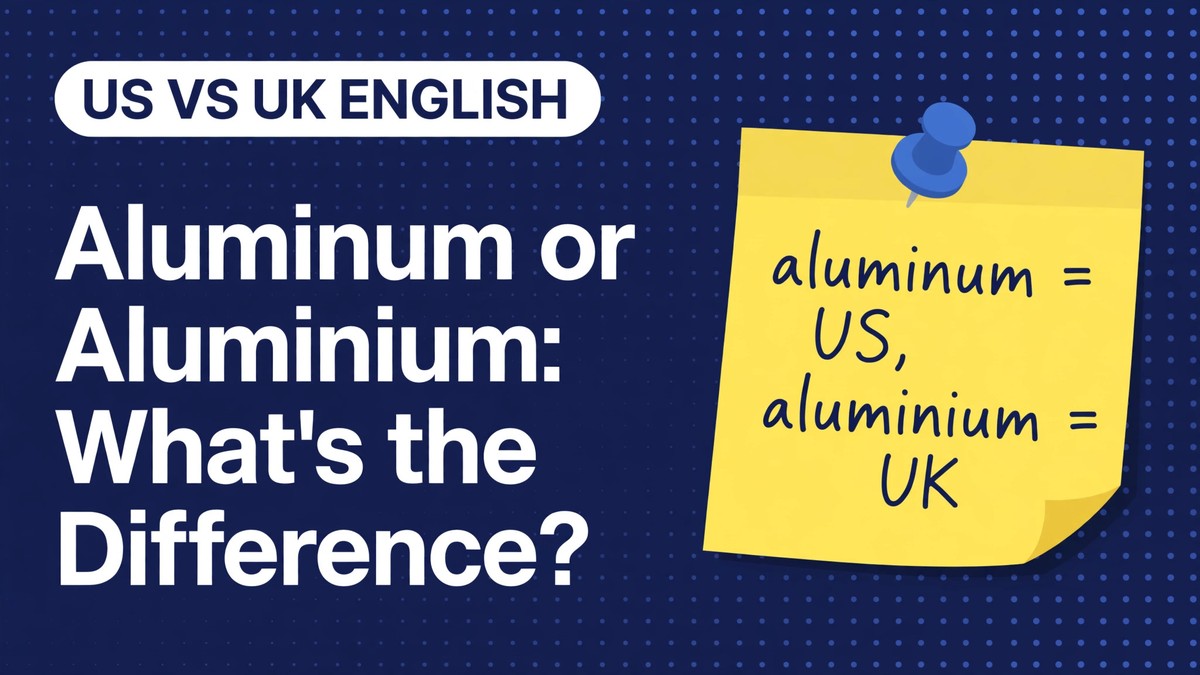
  • Aluminum or Aluminium: Which Spelling Is Correct in 2026?

    Aluminum or Aluminium: Which Spelling Is Correct in 2026?

    Aluminum or Aluminium: Which Spelling Is Correct in 2026?

    The aluminum or aluminium question confuses writers because both spellings are correct, they are simply the American and British spellings of the same lightweight metal, element 13 on the periodic table. Aluminum is the standard spelling in the United States and Canada, while aluminium is the standard spelling in the United Kingdom, Australia, and most of the rest of the English-speaking world. The meaning never changes, only the spelling does. This guide explains the history, the pronunciation difference, and which form to use for your audience. Check any sentence with the free Grammar Checker on the KnowsVista homepage.

    โšก Quick answer

    Use aluminum for American and Canadian readers: The pan is made of aluminum. Use aluminium for British, Australian, and other Commonwealth readers: The pan is made of aluminium. Both spellings are correct, pick the one your audience expects and use it consistently.

    ๐Ÿง  Memory trick: Aluminium ends in -ium, like sodium, potassium, and magnesium, the classic pattern for element names. Aluminum drops the i, the way American spelling often shortens words. Think: -ium = international, -um = US.

    When to use aluminum

    Aluminum is the standard American spelling, used in US industry, trade, science writing, and everyday language. The American Chemical Society officially adopted aluminum in 1925, and Merriam-Webster’s aluminum entry lists it as the chiefly US spelling of the element. If you are writing for an American audience, a US school, business, or website, aluminum is the only natural choice.

    โœ“ The window frames are made of lightweight aluminum.

    โœ“ Please recycle your empty aluminum cans.

    โœ“ Aluminum foil keeps leftovers fresh in the fridge.

    โœ“ The aircraft’s body uses an aluminum alloy for strength.

    โœ“ Aluminum is the most abundant metal in the Earth’s crust.

    โœ— The London shop sells aluminum foil. โ†’ โœ“ The London shop sells aluminium foil.

    The rule is audience-first: an American reader expects aluminum, and the -ium spelling will look like a typo to them. The same audience-first logic settles other US vs UK pairs like mold or mould.

    When to use aluminium

    Aluminium is the standard spelling in the United Kingdom, Ireland, Australia, New Zealand, and most Commonwealth countries, and it is the name preferred by IUPAC, the International Union of Pure and Applied Chemistry. It is also the spelling used in British science, engineering, and everyday writing. If your readers are British or international, aluminium is correct, and aluminum will look like an Americanism.

    โœ“ The factory produces aluminium extrusions for the building trade.

    โœ“ Wrap the sandwiches in aluminium foil before the picnic.

    โœ“ Aluminium is prized for being both light and rust-resistant.

    โœ“ The Australian plant refines bauxite into aluminium.

    โœ“ She bought an aluminium ladder because it is easy to carry.

    โœ— The New York store sells aluminium cans. โ†’ โœ“ The New York store sells aluminum cans.

    Notice that the sentences are identical apart from the spelling, the metal, the meaning, and the grammar never change. That “same word, different spelling” pattern is exactly what our curb or kerb guide shows for another US vs UK pair.

    The tricky exceptions

    Why two spellings exist at all

    The element’s discoverer, Sir Humphry Davy, first called it alumium in 1808, then aluminum in 1812, and British scientists soon settled on aluminium to match the -ium pattern of other elements. In the US, Noah Webster’s 1828 dictionary listed only aluminum, and American industry followed. Neither side made a mistake, history simply split the spelling down the Atlantic.

    โœ“ Davy first named the metal alumium, then aluminum, before aluminium won out in Britain.

    Canada uses aluminum, Australia uses aluminium

    Do not assume every Commonwealth country agrees: Canada follows the US and uses aluminum, while Australia, New Zealand, and South Africa use aluminium. When in doubt, match the spelling of the country you are writing for, not the spelling of its neighbours.

    โœ“ The Canadian supplier lists aluminum siding, while the Australian supplier lists aluminium siding.

    The pronunciation is different too

    Americans say uh-LOO-mih-num (four syllables), while Brits say al-yoo-MIN-ee-um (five syllables). The extra syllable comes from the extra i. This is why the two forms sound like different words even though they name the same metal.

    โœ“ Americans pronounce it “uh-LOO-mih-num”; Brits pronounce it “al-yoo-MIN-ee-um.”

    Aluminum vs aluminium at a glance

    AluminumAluminium
    Used inUnited States, CanadaUK, Ireland, Australia, most Commonwealth countries
    Spelling clueEnds in -um (shorter, American style)Ends in -ium (like sodium, potassium, magnesium)
    Pronunciationuh-LOO-mih-num (4 syllables)al-yoo-MIN-ee-um (5 syllables)
    Official backingAmerican Chemical Society (1925)IUPAC preferred name (1990)
    MeaningIdentical, element 13, a light silvery metalIdentical, element 13, a light silvery metal
    ExampleAluminum cans are easy to recycle.Aluminium cans are easy to recycle.

    Quick practice

    Fill in the blank with aluminum or aluminium:

    1. The Texas factory casts __________ engine parts.
    2. Her London flat has __________ window frames.
    3. Canadian stores stock __________ foil in every aisle.
    4. The Sydney workshop ordered sheets of __________ for the roof.

    Answer key:

    • 1. aluminum (Texas = US spelling)
    • 2. aluminium (London = UK spelling)
    • 3. aluminum (Canada follows the US spelling)
    • 4. aluminium (Sydney = Australian spelling)

    Frequently Asked Questions

    Which is correct: aluminum or aluminium?

    Both are correct. Aluminum is the standard spelling in the United States and Canada; aluminium is the standard spelling in the UK, Australia, and most other English-speaking countries. Use the spelling your audience expects.

    Why do Americans spell it aluminum?

    Noah Webster’s 1828 dictionary listed only aluminum, and the American Chemical Society officially adopted it in 1925. American industry and publishing followed, so aluminum became the fixed US spelling.

    Is aluminium the scientific name?

    IUPAC, the international chemistry body, adopted aluminium as its preferred name in 1990, but it recognises aluminum as an acceptable variant. In practice, American scientific journals still use aluminum.

    How do you pronounce aluminium?

    British pronunciation is al-yoo-MIN-ee-um, with five syllables. American aluminum is pronounced uh-LOO-mih-num, with four syllables.

    Can I mix aluminum and aluminium in one document?

    No, pick one spelling and use it consistently throughout a document. Mixing them looks like careless editing, even though both forms are correct on their own.

    Final thoughts

    Aluminum and aluminium are the same metal with two passports: aluminum for the US and Canada, aluminium for the UK and most of the world. Remember the -ium pattern, sodium, potassium, magnesium, aluminium, and match your spelling to your readers. Get the audience right and you can never get this word wrong. Lock the rule in with the free Spelling Quiz.

  • Aging or Ageing? Which Spelling Is Correct? (Complete Guide)

    Aging or Ageing? Which Spelling Is Correct? (Complete Guide)

    Aging or Ageing? Which Spelling Is Correct? (Complete Guide)

    The aging or ageing question has a one-line answer and a story behind it. Both spellings are correct and mean exactly the same thing: the process of growing older. Aging is the standard spelling in American English; ageing is the standard in British English (and Australia, New Zealand, India, and South Africa). The difference is purely regional, never a matter of meaning. This guide covers the adjective, noun, and verb uses, the spelling-rule story, and 12+ examples, then run any sentence through the free Grammar Checker on the KnowsVista homepage.

    โšก Quick answer

    Use aging in American English and ageing in British English, for the adjective, the noun, and the present participle of age alike. Both are pronounced the same: /หˆeษช.dส’ษชล‹/. Pick one and use it consistently through the document.

    ๐Ÿง  Memory trick: Ageing keeps the E for England. Aging drops it, no E, no fuss, the American way.

    When to use aging and ageing

    Whichever spelling you use, the word works three ways. As an adjective it describes someone or something getting older (an aging actor / an ageing actor). As a noun it names the process itself (aging affects everyone). As the present participle of the verb age it describes something growing older over time (the population is aging rapidly). Cambridge Dictionary’s ageing entry lists the UK form with US aging, defining it as “relating to getting older”, the aging process, an ageing Hollywood actor, ageing machinery. The only decision is your audience.

    โœ“ The country’s aging population is now a major concern. (US adjective)

    โœ“ The ageing chairman was forced to retire. (UK adjective)

    โœ“ Aging affects everyone differently. (US noun)

    โœ“ The ageing of the pipes damaged the walls. (UK noun)

    โœ“ The city’s infrastructure is aging rapidly. (US present participle)

    โœ“ She ages gracefully. (Present tense, identical in both varieties)

    Notice the last example: only the -ing form splits. Base forms like age and ages are spelled identically everywhere, the same limited-scope pattern as totaling or totalling.

    Why the two spellings exist

    The standard English rule says: drop the silent e before adding -ing, age becomes aging, just like love becomes loving. American English follows this rule cleanly. British English treats ageing as an exception, keeping the e to preserve the word’s look and pronunciation. The story goes back to Noah Webster, the American lexicographer of the early 1800s, who pushed simplified American spellings (colour โ†’ color, honour โ†’ honor, ageing โ†’ aging). Fun fact: in older British texts, aging was once common too, ageing only became the British norm over time.

    โœ“ Standard rule: love โ†’ loving, age โ†’ aging. (US spelling follows the rule)

    โœ“ British exception: age โ†’ ageing. (UK spelling keeps the e)

    The same Webster reform wave created the US/UK pairs in our cosy or cozy guide, different letters, same story.

    The tricky exceptions

    Anti-aging vs anti-ageing

    The compound follows the same regional split: anti-aging is the standard form in American skincare, health, and wellness writing, while anti-ageing appears in British publications. Both are accepted in their regions, so match the spelling to the market you are writing for.

    โœ“ US: The market for anti-aging creams keeps growing.

    โœ“ UK: She uses an anti-ageing serum every night.

    Never mix the spellings in one document

    The most common real-world error is inconsistency, aging in one paragraph and ageing in the next. Spellcheckers set to US English will flag ageing, and UK-set spellcheckers will flag aging, so pick one before you start and stick with it. This includes the compounds: anti-aging with aging, anti-ageing with ageing.

    โœ— Our anti-ageing line targets an aging audience. โ†’ โœ“ Our anti-aging line targets an aging audience. (US document, stay consistent.)

    Watch for lookalikes: “ageing” is never “agging” or “ageing the process”

    Learners sometimes produce double letters like ageging or agging, neither exists. The only two forms are aging and ageing. And note that aging/ageing as a noun takes the definite article: the aging process, not just aging process in careful writing.

    โœ“ Scientists study the aging process. (Careful form with the article)

    Spelling traps with silent letters are everywhere in this family, our theatre or theater guide covers another Webster-era split with the same keep-it-consistent moral.

    Aging vs ageing at a glance

    AgingAgeing
    RegionAmerican English (US standard)British English (UK, Australia, India, South Africa)
    MeaningProcess of growing older, identicalProcess of growing older, identical
    Parts of speechAdjective, noun, present participle of ageAdjective, noun, present participle of age
    Rule statusFollows the drop-the-e rule (age โ†’ aging)Exception that keeps the e (age โ†’ ageing)
    Pronunciation/หˆeษช.dส’ษชล‹/, same/หˆeษช.dส’ษชล‹/, same
    Compoundsanti-aginganti-ageing
    Memory cueNo E, no fuss, AmericanE for England

    Quick practice

    Choose aging or ageing (use the spelling for the audience named):

    1. US report: “The __________ population needs more healthcare.”
    2. UK article: “He cares for his __________ mother.”
    3. US headline: “New anti-__________ breakthrough announced.”
    4. UK text: “The __________ infrastructure needs investment.”

    Answer key:

    • 1. aging (American spelling)
    • 2. ageing (British spelling)
    • 3. aging โ†’ anti-aging (US compound)
    • 4. ageing (British spelling)

    Frequently Asked Questions

    Which is correct: “aging” or “ageing”?

    Both are correct. Aging is the standard everyday spelling in American English, while ageing is preferred in British English and most Commonwealth countries, including Australia, India, and South Africa. The difference is purely regional, never a grammar error, pronunciation is identical in both.

    Which spelling do the major dictionaries use?

    Merriam-Webster, the leading American dictionary, lists aging as the primary entry. Oxford and Cambridge list ageing as the British standard, with the American aging shown as the US variant. Both recognize the other form, so neither is “wrong.”

    Does the spelling change the meaning?

    No. The meaning is identical, the process of growing older, whether you write aging or ageing. Only the audience’s spelling convention decides which to use.

    Is it “anti-aging” or “anti-ageing”?

    Anti-aging is standard in American writing (skincare, health, wellness), while anti-ageing is the British form. Match the compound to the spelling you are using elsewhere in the document.

    Can I use “ageing” in an American document?

    You can, but most US spellcheckers will flag it. For a US audience, use aging throughout. Consistency beats correctness debates, lock the habit with the free Spelling Quiz.

    Final thoughts

    There is no deeper trick to aging or ageing, it is geography, not grammar. The US drops the silent e (aging, the rule-following spelling); the UK keeps it (ageing, the historical exception). Both cover the adjective, the noun, and the present participle, both sound identical, and the compounds (anti-aging / anti-ageing) follow suit. The only real error is mixing them in one document. Keep the E for England and drop it for America, and you are done.

  • Inquire or Enquire: American vs British English Explained in 2026

    Inquire or Enquire: American vs British English Explained in 2026

    Inquire or Enquire: American vs British English Explained in 2026

    Inquire or enquire is the US vs UK pair with an extra layer: the spellings are regional and, in British English, slightly formal. Both come from the Latin quaere, “to ask.” In American English, inquire is the only spelling you need. In British English, both exist: enquire for a general question and inquire for a formal or official investigation. This guide gives you the regional rule, the formality rule, 12+ examples, and a quick quiz, then run any sentence through the free Grammar Checker on the KnowsVista homepage.

    โšก Quick answer

    American English: use inquire for everything. British English: use enquire for everyday questions (“enquire about train times”) and inquire for formal or official investigations (“inquire into the complaint”).

    ๐Ÿง  Memory trick: Inquire starts with I, think Investigation (formal). Enquire starts with E, think Everyday question (casual).

    When to use inquire

    Inquire is the universal spelling in American English, it handles every meaning, casual or formal. In British English it is reserved mainly for formal contexts: official investigations, legal proceedings, and systematic examinations. Cambridge Dictionary’s definition of inquire into marks it “formal” and gives the British “also enquire” variant, try to discover the facts about something, as in “the authorities inquired into his background.” Common patterns are inquire about (ask for information), inquire into (investigate), and inquire whether/when + clause.

    โœ“ A woman called to inquire whether we were hiring. (US, general question)

    โœ“ He inquired about the price before buying. (US, general question)

    โœ“ The police will inquire into the cause of the accident. (UK, formal investigation)

    โœ“ The board launched an inquiry into the company’s finances. (UK, official investigation)

    โœ“ She called to inquire when her car would be ready. (US, everyday use)

    โœ“ The detective inquired into the suspect’s alibi. (Formal investigation)

    In American writing, reaching for inquire is always safe, the same “one spelling does everything” pattern that makes our insure or ensure guide valuable.

    When to use enquire

    Enquire is the British spelling for the general, everyday sense of asking, about train times, prices, availability, or opening hours. It is the friendlier-looking, less formal option, and it is mostly absent from American English. Note the asymmetry: British writers use inquire in the casual sense too, but they almost never use enquire for a formal investigation. The nouns follow the same pattern: enquiry (general request, UK) vs inquiry (formal investigation, and the only US noun).

    โœ“ We enquired about the next train to London. (UK, everyday question)

    โœ“ She enquired about your health. (UK, casual asking)

    โœ“ The customer enquired about delivery options. (UK, business, but general)

    โœ“ He enquired politely at the counter. (UK, everyday question)

    โœ“ There is a student who has emailed an enquiry about the term dates. (UK, general request)

    โœ— US business letter: “Thank you for your enquiry.” โ†’ โœ“ US: “Thank you for your inquiry.” (Many Americans read enquire as a typo.)

    If your audience is British and the question is casual, enquire feels natural, the same way British readers expect per se or per say spelled the Latin way.

    The tricky exceptions

    In the US, “enquire” looks like a typo

    This is the most practical exception of the whole pair. Reference guides warn that many Americans treat enquire/enquiry as a spelling mistake, not a British variant. So if you are writing for a US audience, emails, applications, customer support, use inquire even for casual questions. Using enquire there costs you credibility for no benefit.

    “Inquire into” investigates; “inquire about” just asks

    The preposition changes the shade of meaning. Inquire about means to ask for information (“inquire about the price of tickets”). Inquire into means to try to discover the facts about something, an investigation (“the authorities inquired into his background”). Cambridge marks the into construction as formal. Mix them and your sentence reads oddly: “inquire into the price” sounds like a fraud probe, not a shopping question.

    โœ“ Shall I inquire about the price of tickets? (Just asking)

    โœ“ The committee will inquire into the allegations. (Investigating)

    The nouns split the same way

    Everything above applies to the nouns too: inquiry is the formal/official word (and the only American noun), while enquiry is the general-request word used mainly in British English. Their plurals are inquiries and enquiries. The same one-way British formality pattern appears in assure vs ensure, where the region decides which word fits.

    Inquire vs enquire at a glance

    InquireEnquire
    RegionUS EnglishUK English
    US Englishโœ“ The only spelling, all usesโœ— Looks like a typo to many Americans
    UK Englishโœ“ Formal / official investigationsโœ“ Everyday questions and requests
    ToneFormal, systematic, investigativeCasual, general, conversational
    Noun formsInquiry (formal; only US noun)Enquiry (general request; UK)
    Typical patterninquire into = investigateenquire about = ask generally
    Memory cueI = InvestigationE = Everyday question
    ExampleThe police will inquire into the case.She enquired about the train times.

    Quick practice

    Choose inquire or enquire (use the spelling for the audience named):

    1. US email: “I am writing to __________ about the course schedule.”
    2. UK, casual: “They __________ if tickets were still available.”
    3. UK, formal: “The school will __________ into her complaint.”
    4. UK noun: “She sent an __________ about the wedding invitation.”

    Answer key:

    • 1. inquire (US uses inquire for everything)
    • 2. enquired (UK casual question)
    • 3. inquire (UK formal investigation)
    • 4. enquiry (UK general request, in the US this would be inquiry)

    Frequently Asked Questions

    Is “enquire” a misspelling of “inquire”?

    No, enquire is a legitimate spelling, used mainly in British English for general questions. But be careful: many American readers will mistake it for a typo, so avoid it in writing aimed at a US audience.

    What is the past tense: “inquired” or “enquired”?

    Both are regular verbs: the past tense is inquired or enquired, just add -d. Cambridge lists inquired as the past simple and past participle of inquire, and enquired works the same way in British English (“she enquired about the train times”). There is no irregular form to memorize.

    What is the difference between “inquiry” and “enquiry”?

    Inquiry is the formal word, an official investigation, and the only standard noun in American English. Enquiry is the general-request word, used mainly in British English for everyday questions.

    Can I use “enquire” in American English?

    You can, but you probably should not. Americans almost always use inquire for both formal and informal situations, and enquire often reads as an error. Save enquire for British audiences.

    Is it “inquire about” or “inquire into”?

    Inquire about means to ask for information (“inquire about the price”). Inquire into means to investigate (“inquire into the allegations”). The preposition decides the meaning, drill the distinction with the free Spelling Quiz.

    Final thoughts

    The rule has a geography layer and a formality layer. American English: inquire for everything, always. British English: enquire for everyday questions, inquire for formal investigations. The nouns follow suit, inquiry vs enquiry, and the preposition matters too: about asks, into investigates. Hold the memory trick, I for Investigation, E for Everyday question, and this pair stops being a problem.

  • Mold or Mould: Which Spelling Is Correct? (Simple Explanation)

    Mold or Mould: Which Spelling Is Correct? (Simple Explanation)

    Mold or Mould: Which Spelling Is Correct? (Simple Explanation)

    Mold or mould is one of the simplest US vs UK questions in English, and one of the most emailed-to-the-landlord. The answer: both spellings are correct, and they mean exactly the same thing. Mold is the standard spelling in American English; mould is the standard spelling in British English (and in Australia, New Zealand, and most of the Commonwealth). The difference is purely regional, never a matter of meaning. This guide covers all the meanings, the derivative spellings, and 12+ examples, and you can check any sentence with the free Grammar Checker on the KnowsVista homepage.

    โšก Quick answer

    Mold = American English spelling for everything: the fungus, the shaping container, and the verb “to shape.” Mould = British English spelling for the exact same meanings. Pick the spelling your audience uses and stay consistent.

    ๐Ÿง  Memory trick: Mould contains a U, just like the United Kingdom, so mould is the British one. No extra U in mold = American.

    When to use mold (American English)

    In American English, mold is the only standard spelling, and it covers every sense of the word. As a noun it names the fuzzy fungal growth (“black mold”), the hollow container used to shape materials (“a jello mold”), and a distinctive type or character (“a leader in the same mold”). As a verb it means to shape or form something, Merriam-Webster’s mold entry gives verb senses including “to knead or work a material into a desired shape” and “to determine or influence the quality of,” as in “teachers molding young minds.” Derivatives follow the American pattern: molded, molding, moldy.

    โœ“ The landlord fixed the black mold on the bathroom ceiling. (US noun = fungus)

    โœ“ Pour the mixture into a greased cake mold. (US noun = container)

    โœ“ She does not fit the mold of a typical professor. (US noun = type)

    โœ“ The chef molds the rice into neat triangles. (US verb = shape)

    โœ“ The house needs new crown molding in the hallway. (US noun = decorative trim)

    โœ“ The bread went moldy after two weeks. (US adjective)

    Every one of these sentences keeps the short o spelling, mold never gains a u in American writing. The same “short American form” instinct applies to pairs like totaling or totalling, where the US drops a letter the UK keeps.

    When to use mould (British English)

    In British English, mould does exactly the same jobs as American mold, the fungus, the container, the verb, with the u included. The derivatives carry the u too: moulded, moulding, mouldy. Reference guides confirm this pattern carries over to verb inflections (moulded/moulding) and adjectives (mouldy, mouldier) with no change in pronunciation. British publications, from The Guardian to UK building guides, use mould consistently.

    โœ“ The bread was covered in green mould. (UK noun = fungus)

    โœ“ The statue was cast in a bronze mould. (UK noun = container)

    โœ“ He is trying to break the mould of traditional politics. (UK noun = type)

    โœ“ She moulded the clay into a small bowl. (UK verb = shaped)

    โœ“ The damp walls had gone mouldy. (UK adjective)

    โœ— The mold on the ceiling is getting worse. โ†’ โœ“ The mould on the ceiling is getting worse. (UK context, keep the u.)

    For UK readers, mould is the expected, natural form, the same way British readers expect cosy or cozy spelled with an s, not a z.

    The tricky exceptions

    “Mould” was once the more popular spelling in the US too

    The split is not ancient. Etymology guides note that mould was actually the more popular form in both America and Britain until the early 1900s, when mold gained traction in the United States, likely helped along by the printing and popularity of Merriam-Webster’s dictionary publications. So older American texts may show mould; it is not a mistake, just a historical spelling.

    The meanings never change with the spelling

    Some US/UK word pairs shift meaning across the Atlantic, but not this one. Fungus, container, character type, verb “to shape”, every sense works with either spelling. A jello mold and a jelly mould are the same object; molding young minds and moulding young minds are the same action. There is no “mold is the fungus, mould is the container” rule, that is a myth.

    โœ— Myth: “Mold” is the fungus and “mould” is the container. โ†’ โœ“ Both spellings cover both meanings; only the region differs.

    Never mix spellings in one document

    The real mistake with this pair is inconsistency: writing mold in paragraph one and mould in paragraph three. Pick one spelling for the whole document based on your audience and keep it, including the derivatives (moldy or mouldy). This “pick one and stay with it” rule is the same advice our ambience or ambiance guide gives.

    Mold vs mould at a glance

    MoldMould
    RegionAmerican English (US standard)British English (UK, Australia, NZ, Commonwealth)
    MeaningIdentical: fungus, container, type, verb “to shape”Identical: fungus, container, type, verb “to shape”
    Derivativesmolded, molding, moldymoulded, moulding, mouldy
    Pronunciation/moสŠld/, same/moสŠld/, same
    HistoryDominant in the US since the early 1900sOlder form; standard in the UK throughout
    Memory cueNo extra letter = American (shorter, like color)Extra U = United Kingdom

    Quick practice

    Choose mold or mould (use the spelling for the audience named):

    1. American email: “There is black __________ on the ceiling.”
    2. British article: “The statue was cast in a bronze __________.”
    3. American manual: “The decorator added crown __________ to the ceiling.”
    4. British novel: “She __________ the clay with her hands.”

    Answer key:

    • 1. mold (American spelling)
    • 2. mould (British spelling)
    • 3. molding (American derivative of mold)
    • 4. moulded (British derivative of mould)

    Frequently Asked Questions

    Is it “mold” or “mould” in Australia?

    Mould. Australia follows British spelling conventions, so mould, mouldy, and moulding are the standard forms there.

    Is it “mold” or “mould” in Canada?

    Mould. Canada generally follows British spelling conventions, so mould, mouldy, and moulding are the standard Canadian forms, even though Canadian usage can be mixed for some words. If your audience is Canadian, write mould.

    Does “mold” mean fungus and “mould” mean container?

    No, that is a common myth. Both spellings cover every meaning (fungus, container, character type, and the verb). Only the region changes, never the meaning.

    Is “moldy” or “mouldy” correct?

    Both, match the derivative to your spelling. American writing uses moldy; British writing uses mouldy. Mixing them (mold with mouldy) in one document looks careless.

    What is “break the mould”?

    “Break the mould” is the British idiom (American: “break the mold”) meaning to do something in a completely new way. It comes from the “shaping container” sense, breaking the container means the old pattern is gone. Lock the spelling rule in with the free Spelling Quiz.

    Final thoughts

    There is no meaning test for this pair, only a geography test. Writing for Americans? Use mold. Writing for Brits, Australians, or most Commonwealth readers? Use mould. Keep the derivatives matched (molded with mold, moulded with mould), ignore the myth that the two spellings mean different things, and never mix them in one document. The U in mould belongs to the United Kingdom, that single image ends the debate.