Curb or Kerb: Correct Spelling, Meaning, and Examples in 2026
The curb or kerb question is a classic US vs UK spelling split with one sneaky twist: the pavement edge changes spelling across the Atlantic, but the verb meaning “restrain” is spelled curb everywhere. In American English, curb covers both jobs, the concrete edge of the sidewalk and the act of holding something back. In British English, the stone edge is a kerb, while curb keeps its “restraint” meaning. This guide lays out the rule, 12+ examples, and the exceptions, so test every sentence with the free Grammar Checker on the KnowsVista homepage.
⚡ Quick answer
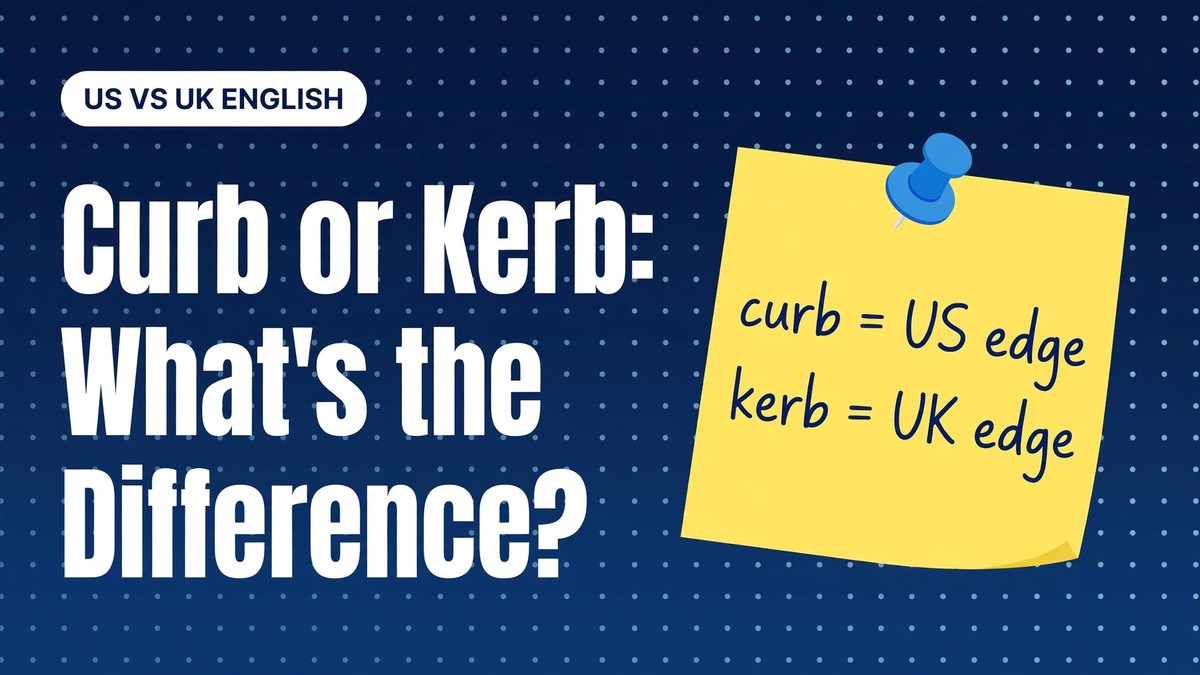
Use curb in American English for the street edge and for restraint or control. Use kerb in British English for the street edge only, kerb is never a verb. The verb to curb (restrain) is spelled curb in every variety of English.
🧠 Memory trick: Kerb has a K, like the King’s English, it is the British pavement edge. Curb with a C is Control, the verb that works everywhere.
When to use curb
Curb is the workhorse spelling. In American English it is the only spelling for the noun naming the raised edge of the street, Cambridge Dictionary’s kerb entry notes kerb is marked British, with US curb. And as a verb meaning “to place a limit on,” curb is the correct spelling in American and British English alike. As a noun, curb can also name a restraint itself (“a curb on spending”) in both varieties.
✓ She accidentally scratched her car’s bumper against the curb while parking. (US noun)
✓ I waited on the curb for the traffic lights to change. (US noun)
✓ We must curb our spending to stay within budget. (Verb, correct everywhere)
✓ Police have increased patrols to curb vandalism. (Verb, correct everywhere)
✓ You need to put a curb on your bad behavior. (Noun = restraint, correct everywhere)
✗ Most vaccines will kerb the risk of infection. → ✓ Most vaccines will curb the risk of infection. (The verb is curb everywhere.)
When you mean restraint, control, or a limit, curb is always right, the same “verb doesn’t change across regions” logic also holds for pairs like cosy or cozy, where only one spelling flexes.
When to use kerb
Kerb is a noun only, and only in British English (plus Australian and other Commonwealth varieties that follow UK spelling). It names the stone or concrete edging around a raised pavement. Cambridge defines it as “an edging, usually of stone, round a raised area, especially a pavement/sidewalk,” and its corpus examples show everyday UK usage like “dropped kerbs,” the lowered sections that help wheelchair users cross streets. Kerb can never be a verb, not in the UK, not anywhere.
✓ I nearly tripped on the kerb while crossing the road. (UK noun)
✓ The cyclist hit the kerb and fell off. (UK noun)
✓ Highway authorities installed dropped kerbs at every crossing. (UK noun)
✓ She stepped off the kerb right in front of a car. (UK noun)
✗ You must kerb your temper. → ✓ You must curb your temper. (There is no verb kerb.)
If you are writing for a British audience and naming the pavement edge, kerb is the natural choice, just as British readers expect theatre or theater spelled their way.
The tricky exceptions
“Kerbed,” “kerbing,” and “kerb your enthusiasm” are always wrong
The most common mistake is treating kerb as the British spelling of the verb. It is not. The verb to curb, to restrain or control, is spelled curb in British English too. So kerbed, kerbing, and phrases like “kerb your enthusiasm” are wrong in every variety of English.
✗ Your comment has kerbed my enthusiasm. → ✓ Your comment has curbed my enthusiasm.
Canada follows the American “curb”
Reference works note that for the roadway-edge noun, Canada follows the US convention: curb. So Canadian writing uses curb for both the edge and the verb, just like American English. If your audience is Canadian, never write kerb.
“Curb” is the older spelling of the pavement edge
Etymologically, curb is the older spelling, and both varieties used it for the street edge for centuries. The kerb spelling emerged in British English to distinguish the noun (stone edge) from the verb (restraint). That is why British English ended up with two spellings for two jobs, while the verb stayed curb everywhere, exactly like the stable halves of ambience or ambiance.
Curb vs kerb at a glance
| Curb | Kerb | |
|---|---|---|
| Region | US (and UK for the verb) | UK (and Australia / Commonwealth) |
| Street edge (noun) | US noun: the curb | UK noun: the kerb |
| Restraint (verb) | ✓ Everywhere: curb spending | ✗ Never a verb |
| Restraint (noun) | ✓ Everywhere: a curb on spending | ✗ Never used |
| Memory cue | C = Control (verb everywhere) | K = King’s English (UK edge) |
| Example | We must curb pollution. | He stepped off the kerb. |
Quick practice
Fill in the blank with curb or kerb (use British English where the question says so):
- New laws will __________ air pollution from cars.
- British English: She tripped over the __________ and hurt her knee.
- American English: He parked the car next to the __________.
- The team was told to __________ its enthusiasm for the risky plan.
Answer key:
- 1. curb (verb = restrain, the verb is curb everywhere)
- 2. kerb (UK noun for the pavement edge)
- 3. curb (US noun for the street edge)
- 4. curb (verb = restrain, never kerb)
Frequently Asked Questions
Is “kerb” just the British spelling of “curb”?
Only for the noun meaning “pavement edge.” Kerb is never the British spelling of the verb to curb (restrain). So the overlap is partial: street edge = curb (US) / kerb (UK); the verb = curb in both.
Why do Brits spell it “kerb” at all?
To tell the noun apart from the verb. Curb is the older spelling, and for centuries both varieties used it for the street edge. British English later adopted kerb for the stone edge so the noun and the verb to curb (restrain) could not be confused. The verb itself never changed, it stayed curb in both varieties.
Is “kerbed” a real word?
No. Kerbed is not an accepted spelling anywhere. The past tense of the verb is always curbed, in British English as well as American English.
Do Americans ever use “kerb”?
No, kerb does not exist in American English at all. Americans write curb for the street edge, and would see kerb as a typo. The same one-way pattern shows up in our theatre or theater guide.
Which spelling should I use in formal international writing?
Match your audience: curb for American readers, kerb (noun) for British readers. For the verb, always curb. And whichever noun you choose, stay consistent through the document, check yourself with the free Spelling Quiz.
Final thoughts
The rule has two halves. For the street edge, match your region: curb in the US, kerb in the UK. For the verb, to restrain, control, or limit, it is curb in every variety of English, so kerbed and kerb your enthusiasm are always wrong. Remember: Kerb = King’s English (the British edge), Curb = Control (the verb that travels everywhere). Nail that and you will never second-guess this pair again.