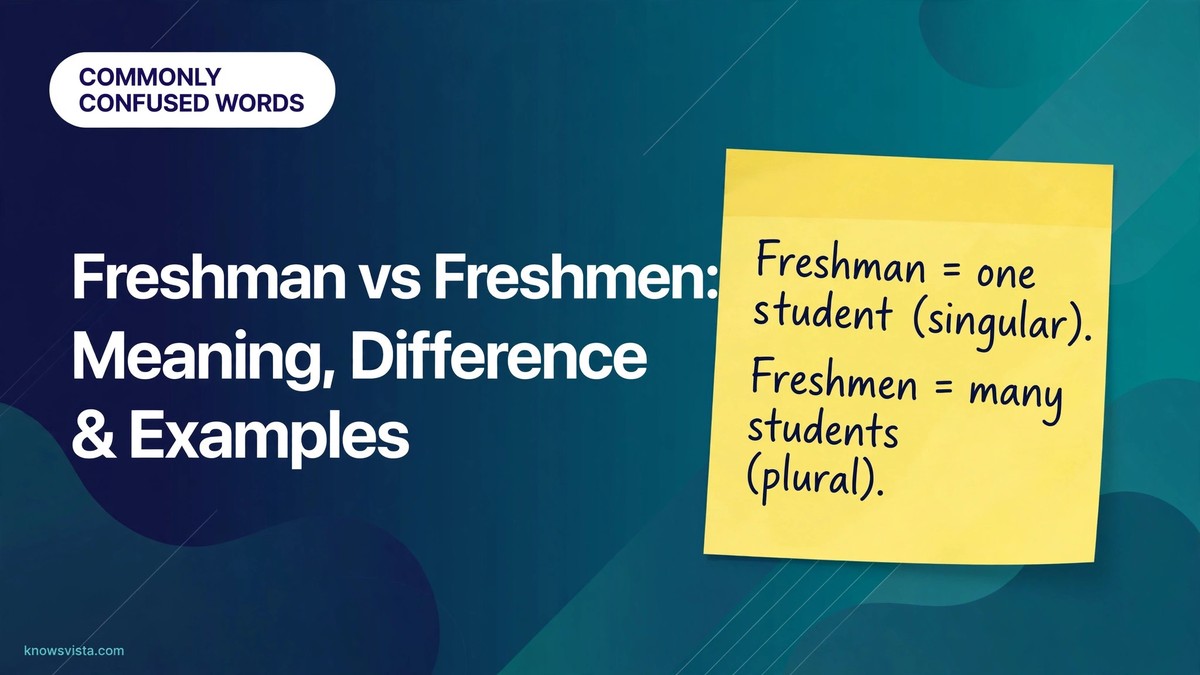
Freshman or Freshmen: Which One Is Correct?
The freshman or freshmen mix-up peaks every September, when new students introduce themselves and inboxes fill with welcome emails. Both forms are correct, they are simply different numbers of the same word. Freshman is the singular noun for one first-year student, and freshmen is the plural for two or more. This guide gives you the rule, the adjective trap (“freshman year,” never “freshmen year”), and a memory trick so you never hesitate. For another irregular plural that confuses writers, see our wifes vs wives guide.
⚡ Quick answer
Freshman is singular: one first-year student (“She is a freshman”). Freshmen is plural: two or more first-year students (“They are freshmen”). As an adjective before another noun, always use the singular form: “freshman year,” “freshman class,” “freshman orientation.”
🧠 Memory trick: Follow the man → men pattern: one man, two men; one freshman, many freshmen. The a becomes an e when the group grows.
The singular noun: freshman
Use freshman when you mean exactly one student in the first year of high school, college, or university. Merriam-Webster defines it as “a student in the first year of high school or college.” It can also describe a beginner in any field, a “freshman lawmaker” is a newcomer, not a student. Pair it with singular verbs: “The freshman is nervous,” never “The freshman are nervous.”
She is a freshman at UCLA this year.
The freshman gave the best speech at orientation.
My roommate is a freshman, but I am a sophomore.
He became a freshman senator after winning the election.
Every freshman takes the same writing seminar.
The freshman quarterback threw three touchdowns.
As a freshman, she found the campus map confusing.
One freshman volunteered to lead the study group.
The plural noun: freshmen
Use freshmen for two or more first-year students. It is the irregular plural of freshman, formed by changing the internal vowel, the same pattern as man → men and woman → women. There is no such word as “freshmans.”
✗ Avoid: “All the freshman arrived early.” (plural subject needs the plural form)
✓ Right: “All the freshmen arrived early.”
The freshmen filled the auditorium for orientation.
The freshmen elected two class representatives.
The tricky exceptions
The adjective is always singular: “freshman year”
Before another noun, use freshman, even when the meaning is plural. “Freshman year,” “freshman dorm,” and “freshman students” all take the singular form, because English modifiers do not take plural endings. Writing “freshmen year” is one of the most common errors with this pair.
Freshman year is an exciting time for every student.
The freshman class raised money for charity.
Many schools now prefer “first-year student”
Because freshman contains the word man, many colleges now use the gender-neutral first-year student in official materials. The meaning is identical, one first-year student, and its plural is simply “first-year students.” This is a style choice, not a grammar rule; freshman and freshmen remain correct everywhere. Check the official definition yourself at Merriam-Webster’s freshman page, where the word is marked “often attributive”, that label confirms the adjective use.
The university’s first-year students moved in on Saturday.
She prefers “first-year” to “freshman” in her emails.
Freshman vs freshmen at a glance
| Freshman | Freshmen | |
|---|---|---|
| Correct? | Yes, the singular noun | Yes, the plural noun |
| Meaning | One first-year student | Two or more first-year students |
| Plural pattern | Base form (like man) | Vowel change a → e (like men) |
| Before another noun | Always use freshman (“freshman year”) | Never, use freshman instead |
| Example | She is a freshman. | They are freshmen. |
| Trick | One man → one freshman | Two men → two freshmen |
Quick practice
Choose the right form:
- She is a __________ at Harvard.
- All the __________ gathered in the gym.
- __________ year flew by for the new students.
- Five __________ joined the debate club.
Answer key:
- 1. freshman (one student = the singular form)
- 2. freshmen (“all the” points to a group = the plural form)
- 3. Freshman (the adjective before a noun always stays singular)
- 4. freshmen (five students = the plural form)
Frequently Asked Questions
Is it “freshman” or “freshmen”?
Both, it depends on the number. Use freshman for one first-year student and freshmen for two or more. “She is a freshman” and “They are freshmen” are both correct.
Is it “freshman year” or “freshmen year”?
Freshman year is correct. As an adjective before another noun, the word always stays singular, “freshman year,” “freshman dorm,” even “freshman students.” “Freshmen year” is a common mistake.
What is the plural of “freshman”?
The plural is freshmen, formed by the vowel change a → e, just like man → men. “Freshmans” is never correct. For another irregular plural that trips writers up, see our wifes vs wives guide.
Can “freshman” describe a beginner who is not a student?
Yes. Merriam-Webster’s second sense is “beginner, newcomer,” especially someone starting a job or activity. A “freshman lawmaker” or “freshman employee” is simply new to the role.
Is “freshman” gender-specific?
The word is used for students of all genders, but because it contains man, many universities now prefer first-year student in official writing. Both are correct; match the style of the institution you are writing for.
Do “freshman” and “freshmen” sound different?
Barely. Both are stressed on the first syllable, and the vowel shift in the second syllable is subtle in fast speech. That is exactly why writers mix them up, the difference lives in spelling, not sound, so check the a vs e when you write.
Final thoughts
The freshman or freshmen question comes down to counting: one student is a freshman, two or more are freshmen, and the adjective before a noun is always freshman. Remember the man → men vowel shift and you will never mix them up. Keep practicing tricky pairs, try our wifes vs wives guide, or test yourself on the spelling quiz and the free grammar checker.
Leave a Reply