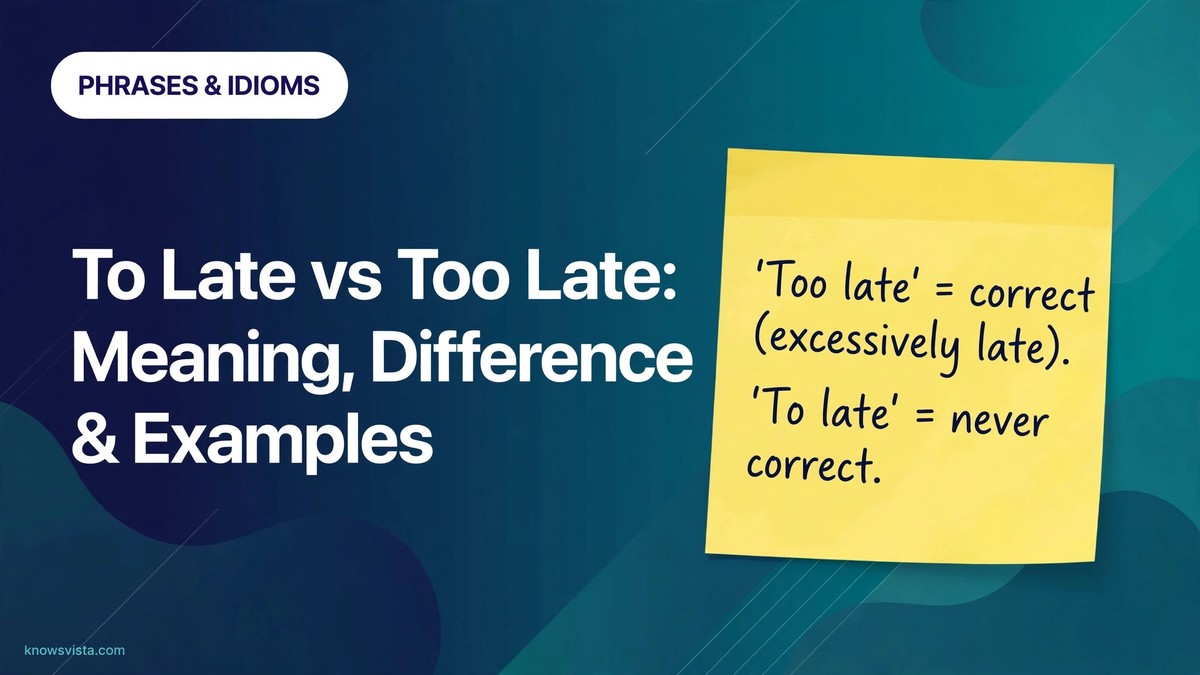
To Late or Too Late: Which Is Correct?
The to late or too late question looks like a typo problem, but it is really a grammar problem. Too late, with two os, means excessively late: the moment has passed and the chance is gone. To late is not a phrase at all; the preposition to can never intensify an adjective. This guide shows you the rule, the one narrow sentence where to and late legally meet, and a memory trick that makes the extra o unforgettable. For another pair separated by a single letter, see our therefor vs therefore guide.
⚡ Quick answer
Too late is always correct when you mean excessively or regrettably late (“We arrived too late”). To late is never correct as a phrase. The word too is an adverb meaning “excessively”; the word to is a preposition that points or connects, and it cannot intensify anything.
🧠 Memory trick: Too has an extra o for “excess”, excess letters for an excessive meaning. If you can swap in very (“very late”), you need too.
The correct phrase: “too late”
Use too late whenever something happens past the right or useful moment, a missed bus, a closed door, a deadline that slipped away. Here too works as an adverb of degree, amplifying late the same way it amplifies cold in “too cold” or long in “too long.” It is the standard phrase in every variety of English.
We arrived too late to catch the train.
It is too late to change the booking now.
She woke up too late for the morning class.
The offer came too late to help the team.
He realized too late that he had left his keys behind.
The applause started a moment too late.
It is never too late to learn a new skill.
The doctor said we caught it just in time, not too late.
Why “to late” is never right
The phrase to late fails basic grammar. To is a preposition: it points toward a place, a person, or an infinitive verb (“to the store,” “to run”). It cannot modify an adjective, so putting it before late leaves the sentence with no intensifier and no meaning, the same broken pattern as “to cold” or “to short.”
✗ Avoid: “I reached the station to late.” (a preposition cannot intensify an adjective)
✓ Right: “I reached the station too late.”
✓ Right: The meeting ended too late for dinner.
✓ Right: You are too late, the doors are closed.
The tricky exceptions
When “to” and “late” meet by accident
There is one narrow case where the two words touch legally: when to is a preposition pointing at a time phrase that happens to start with late. In “The deadline moved to late October,” the words just sit next to each other, they are not a phrase, and you could swap “late October” for “November” without changing the grammar. If you can replace the words after to with a plain date, the sentence is fine.
The wedding was pushed to late September.
They extended the sale to late November.
“Too” has two more jobs: “also” and “very”
Too does three jobs in English. It means “excessively” (“too late”), “also” (“me too”), and, in casual speech, “very” (“not too happy”). Only the first job pairs with late, but knowing all three stops the wider to/too confusion. See the full range yourself at Merriam-Webster’s too page, where “to an excessive degree” sits as the first definition.
I want to come too. (“also”)
The soup is too hot to eat. (“excessively”)
Too late vs to late at a glance
| Too late | To late | |
|---|---|---|
| Correct? | Yes, the standard phrase | No, never correct as a phrase |
| Meaning | Excessively late; the moment has passed | (none, it is an error) |
| Grammar | Adverb too intensifies the adjective late | A preposition cannot intensify an adjective |
| Example | We got there too late. | ✗ We got there to late. |
| The one legal meeting | , | to + late October (word boundary, not a phrase) |
| Trick | If very fits, spell it too | To points or connects, it never intensifies |
Quick practice
Choose the right spelling:
- You are __________, the show has started.
- It is never __________ to apologize.
- The bus left two minutes __________.
- The deadline moved __________ late October.
Answer key:
- 1. too late (excessively late, the show began without you)
- 2. too late (the idiom means a chance is never past saving)
- 3. too late (“very late” fits, so you need the extra o)
- 4. to (the preposition points at “late October”, the words just meet here)
Frequently Asked Questions
Is it “to late” or “too late”?
Too late is always correct. To late is never correct as a phrase, it is one of the most common to/too mix-ups in written English.
Why is “to late” wrong?
To is a preposition, and a preposition cannot intensify an adjective. Only the adverb too, meaning “excessively”, can do that job before late.
Can “to” and “late” ever appear together?
Yes, at a word boundary: “extended to late October” or “pushed to late September.” There to is a normal preposition and late just happens to follow it. One-letter differences trip writers up everywhere, see our therefor vs therefore guide for another.
What does “too” mean in “too late”?
It means “excessively”, the lateness has passed the acceptable point, so the opportunity is lost. That is why “too late” carries a tone of regret or finality.
Is “too late” an idiom?
It works like one. Beyond literal lateness, it marks missed chances and closed doors: “too late to save the deal,” “too late to say sorry.” The meaning is always “past the useful moment.”
How do you remember to vs too?
Try the very test: if very fits in the sentence (“very late”), spell it too. To is the short one that points somewhere, “to the store,” “to run”, and it never describes.
Final thoughts
The to late or too late question has a one-letter answer: too late is correct, and to late is a mistake. Remember that too intensifies, it carries the extra o for “excess”, while to only points or connects. Nail this pair and the next one-letter trap gets easier, try our therefor vs therefore guide, or test yourself on the spelling quiz and the free grammar checker.
Leave a Reply