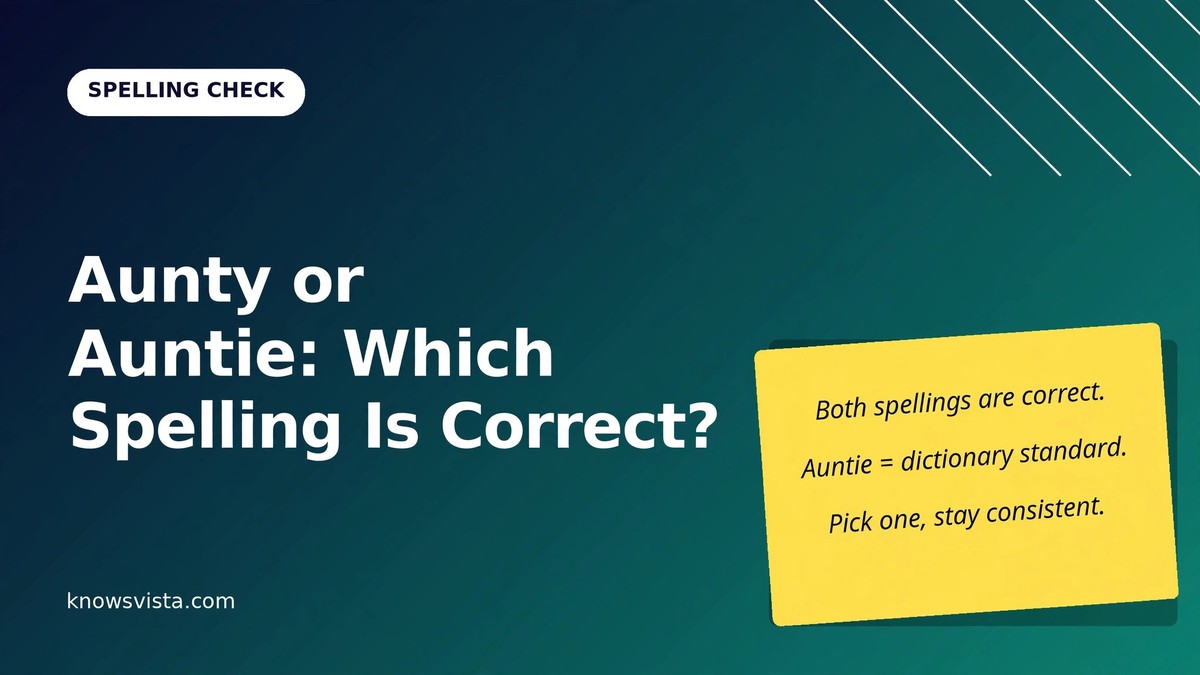
Aunty or Auntie: Which Spelling Is Correct?
You type “happy birthday, aunty” in a family chat, then freeze before sending the work email: is it aunty or auntie? “Aunty or Auntie: Which Spelling Is Correct?” is a friendlier question than most spelling debates, because here there is no villain. Both spellings are real words with the same meaning, but they are not used in exactly the same places. This guide shows you when each spelling fits, which one dictionaries list first, and the exceptions that can make either choice awkward. Find more plain-English spelling guides on the KnowsVista homepage.
⚡ Quick answer
Both are correct. Auntie is the standard dictionary spelling of the affectionate form of aunt, and aunty is a widely used variant, especially common in British, Indian, and Australian English. Pick the spelling the person prefers and stay consistent.
🧠 Memory trick: Think auntIE = dIE-ctIonary standard, and auntY = Your family’s spelling. When in doubt, copy what the family writes.
When to use auntie
Use auntie as your default in formal writing, international contexts, and anywhere you want the safest choice. Cambridge and Merriam-Webster both list auntie as the headword spelling, with aunty shown as the variant. It carries the same warm, affectionate tone and is understood everywhere.
- The children were happy to see their Auntie Mary.
- Thank you for the birthday present, Auntie Louise.
- We are visiting Auntie Sarah this weekend.
- She baked cookies with her auntie every Sunday.
When to use aunty
Use aunty when it is the spelling the person or family already uses, or when writing in a regional voice, it is very common in India, Malaysia, Singapore, Australia, and the UK. In South Asian English it can also address any respected older woman, not just a relative. Match the person’s own spelling on cards, invitations, and family posts.
- The friendly aunty at the food stall waved at us.
- “Call Aunty and tell her we’re running late.”
- This is Aunty Mei Ling, she’s like family.
- The shop aunty gave me an extra serving.
The tricky exceptions
Formal writing wants plain “aunt”
Neither auntie nor aunty belongs in formal or neutral writing, both are informal, affectionate forms. In reports, legal documents, and news articles, use plain aunt: “The child’s aunt attended the meeting.” The informal spelling is not wrong, it is simply too familiar for the tone. This works the same way as other accepted variant pairs, like theatre or theater, where context, not correctness, decides. The Cambridge Dictionary lists auntie as informal, with aunty as the variant spelling, which confirms the register point.
- Formal: “Her aunt signed the school forms.” (neutral)
- Informal: “Her auntie signed the school forms.” (warm, personal)
Names, nicknames, and cultural landmines
Three cases do not follow the “both are fine” rule. First, Auntie Beeb is a fixed nickname for the BBC, do not modernize it. Second, some adults dislike being called auntie or aunty by unrelated people, and in some communities the word can land as a comment on age, so ask before using it with non-relatives. Third, never “correct” someone else’s spelling: if a family writes Aunty on every card, that is the right spelling for them.
- Nicknames: “Auntie Beeb” (the BBC), fixed, keep the spelling
- Respect: ask before calling an unrelated adult aunty/auntie
- Preference: copy the person’s own spelling, it is always “correct” for them
“Aunty or Auntie: Which Spelling Is Correct?”, at a glance
| Auntie | Aunty | |
|---|---|---|
| Status | Standard dictionary spelling | Accepted variant spelling |
| Meaning | Affectionate form of aunt | Affectionate form of aunt |
| Example | My auntie and uncle are visiting. | My aunty and uncle are visiting. |
| Trick | auntIE = dIE-ctIonary standard | auntY = Your family’s spelling |
Quick practice
Choose auntie or aunty (both are spelled correctly, pick the better fit):
- The kids ran to hug ________ Maya at the airport.
- In the formal report: “The child’s ________ attended the meeting.” (which word is too informal?)
- Your Malaysian friend’s family writes “________” on every birthday card. Keep or change it?
- ________ Beeb is the old nickname for the BBC.
- A stranger at the market calls an older vendor “________” in Mumbai. Is that normal there?
Answer key:
- 1. Auntie (safe default for a relative; either would work)
- 2. aunt (both “auntie” and “aunty” are too informal for a report)
- 3. Keep “aunty”, copy the family’s own spelling
- 4. Auntie (fixed nickname: Auntie Beeb)
- 5. Aunty is normal in Indian English as a respectful address
Frequently Asked Questions
Is “aunty” a real word?
Yes. Aunty is a legitimate English spelling, listed by Cambridge and Merriam-Webster as a variant of auntie. It means the same thing and is not a typo.
Which is more common, aunty or auntie?
It depends on where you are. Auntie is the standard dictionary form and the safer choice internationally. Aunty is very common in Indian, Malaysian, Australian, and British English. Follow local and family usage.
Can I call someone’s mother “aunty” if I’m not related?
In many South and Southeast Asian cultures, yes, it is a respectful, warm address for an older woman. In other cultures it can feel presumptuous or age-focused. When in doubt, ask what they prefer to be called.
What’s the difference between aunt and auntie?
Aunt is the neutral, formal noun: a parent’s sister, or an uncle’s wife. Auntie/aunty is the informal, affectionate version, used mostly by children and close family. Use aunt in formal writing.
Final thoughts
“Aunty or Auntie: Which Spelling Is Correct?” has the friendliest possible answer: both. Use auntie as the safe default, aunty when the family or region prefers it, and plain aunt in formal writing. Copy people’s own spellings, respect the cultural context, and stay consistent. It is the same kind of accepted pair as cosy or cozy. No wrong answer, just the right one for the room.
Leave a Reply