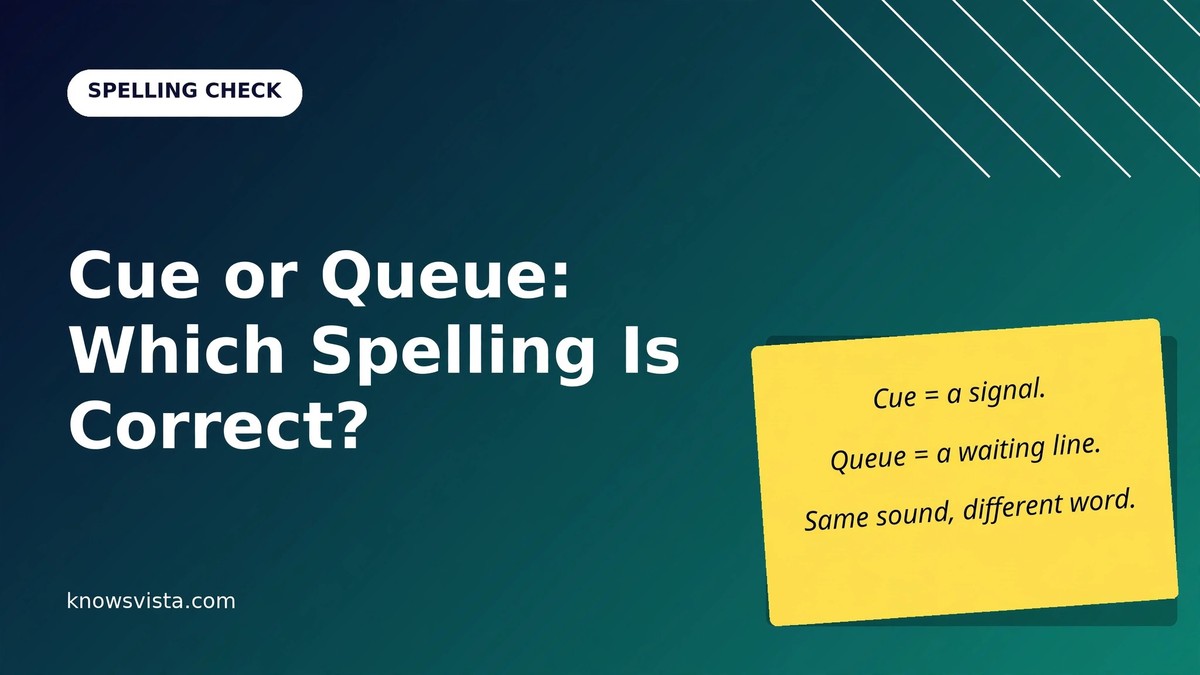
Cue or Queue: Which Spelling Is Correct?
They sound exactly like the letter Q, they share three letters, and they are spelled almost nothing alike. “Cue or Queue: Which Spelling Is Correct?” is really two questions in one: which word means what, and which spelling matches the meaning you want. The answer never depends on pronunciation, it depends on whether someone is waiting or being signaled. This guide shows you when to use each spelling, the meanings most people miss, and the exceptions that catch writers out. Find more plain-English spelling guides on the KnowsVista homepage.
⚡ Quick answer
Cue is a signal or prompt to act. Queue is a waiting line, or an ordered sequence of things waiting their turn. Both are correct words; they are never interchangeable.
🧠 Memory trick: CUE = CLUE, a cue gives you a clue about what to do. QUEUE = waiting, the long spelling is a long line of people.
When to use cue
Use cue for anything that signals, hints, or prompts an action: a director’s signal, an actor’s line prompt, a subtle hint in conversation. As a verb, cue means to give that signal. The spelling is the short one, and the meaning is the active one.
- The stage manager gave the cue, and the lights came up.
- Her raised eyebrow was my cue to stop talking.
- She cued the band to begin the final song.
- His resignation was a cue for intense speculation.
When to use queue
Use queue for a line of people or things waiting in order: a checkout line, a support call queue, a print queue. It is especially common in British English, where queue is what Americans call a line. As a verb, queue means to arrange or form in a line.
- There was a long queue at the checkout counter.
- We had to queue for almost half an hour at the hotel.
- The printer kept switching the items in the queue.
- Top companies will be queuing up to hire her.
The tricky exceptions
Cue sticks, print queues, and “que”
Both words have bonus meanings that do not fit the signal/line rule. A cue is also the long stick used in pool and billiards. A queue is also a braid of hair hanging down the back of the head, and in computing it is the standard word on both sides of the Atlantic (print queue). Meanwhile que is Spanish, not an English word, never use it as a shortcut. Merriam-Webster’s cue vs queue usage guide lists all these senses and repeats the core rule: cue for hints and prompts, queue for things arranged in lines.
- Cue stick: “He picked up his cue and lined up the shot.” (sports equipment)
- Print queue: “The document is stuck in the queue.” (computing)
- Not English: ❌ que, a Spanish word, never a substitute
Verb forms: cueing or cuing, queuing or queueing
The present participles of both verbs come in two spellings, and both are recorded in dictionaries. Cueing and cuing are both correct; queuing and queueing are both correct. Pick one and stay consistent in the document. Note the substitution test that always works: if signal or prompt fits the sentence, write cue; if line fits, write queue. Same idea as other sound-alike pairs like peek or peak.
- “She is cueing (or cuing) the next speaker.”, giving a prompt
- “They are queuing (or queueing) outside.”, forming a line
“Cue or Queue: Which Spelling Is Correct?”, at a glance
| Cue | Queue | |
|---|---|---|
| Usually | Signal, hint, or prompt | Waiting line or ordered sequence |
| Noun | That bell is our cue. | The ticket queue moved. |
| Verb | Cue the lights. (to prompt) | Queue outside. (to line up) |
| Trick | CUE = CLUE (a hint) | The long word = the long line |
Quick practice
Fill in the blank with cue or queue:
- The sound of the gunshot is your ________ to come on stage.
- There was a long ________ for the rollercoaster.
- The director gave the actor a subtle ________ before his entrance.
- We ________ up for movie tickets every Friday night.
- Fix the sentence: “I was waiting for my cue at the supermarket.”
Frequently Asked Questions
Are cue and queue pronounced the same?
Yes. Both are pronounced like the letter Q (/kjuː/). They are homophones, same sound, different spelling, different meaning. Listening alone will never tell you which spelling belongs, so check the meaning first.
Is “que” a correct spelling of either word?
No. Que is a Spanish word, not an English substitute for cue or queue. It is one of the most common search-level mistakes, never use it in English writing.
Which is correct: “cueing” or “cuing”?
Both. Dictionaries record cueing and cuing as participle spellings of the verb cue, just as they record queuing and queueing for queue. Use one consistently within each document.
What does “on cue” mean?
On cue means happening at exactly the expected signal or moment: “The dog barked on cue.” It always takes the cue spelling, because the meaning is a prompt, not a waiting line.
Final thoughts
“Cue or Queue: Which Spelling Is Correct?” always comes down to meaning: cue signals, queue waits. Run the substitution test, signal fits, write cue; line fits, write queue, and the homophone stops being scary. Keep que out of English entirely. The same meaning-first habit fixes other tricky pairs, like add vs ad. One test learned, two words handled.
Leave a Reply