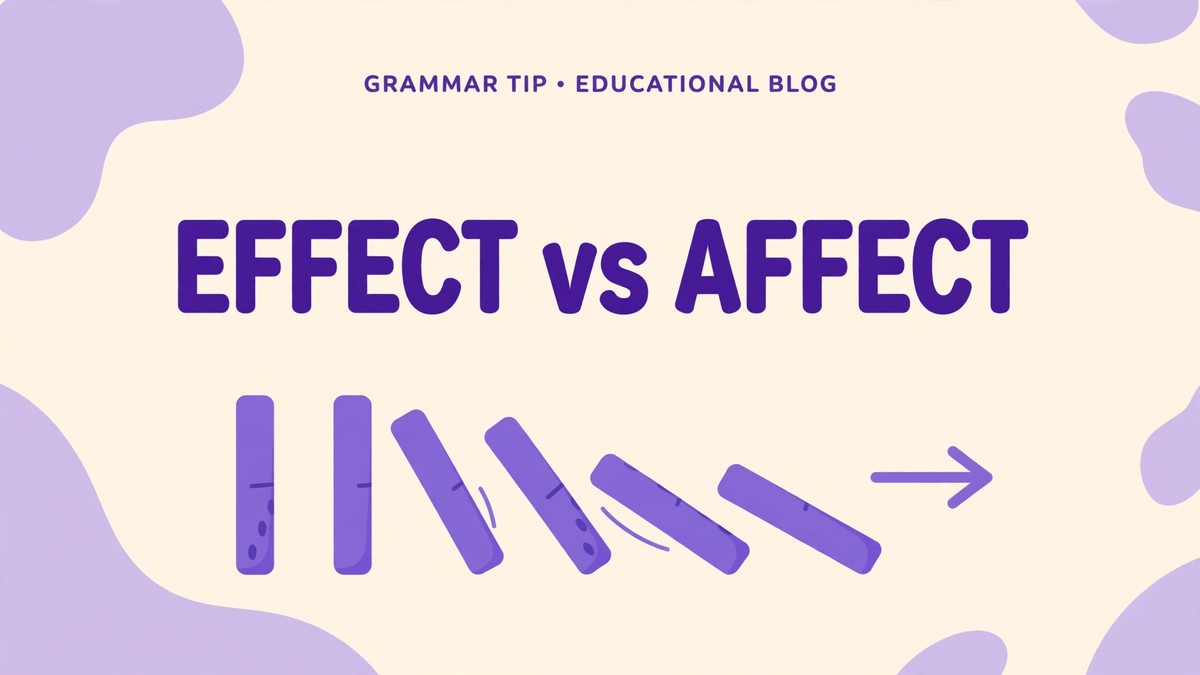
Effect or Affect: What’s the Difference? Easy Guide with Examples
Effect or affect is the most common confused pair in English writing, because the two words sound almost identical and both deal with change. The basic rule is short: affect is usually the verb, meaning to influence something, and effect is usually the noun, meaning the result. If A affects B, then B shows the effect of A. The same action-versus-result logic runs through our some time or sometime guide.
The pair is tricky because both words cross over: effect can be a verb, and affect can be a noun, but only in special cases. Learn the main rule first, then learn the two exceptions, and this mix-up will stop costing you marks, clients, and credibility.
⚡ Quick answer
Use affect as a verb (to influence): Rain affects traffic. Use effect as a noun (a result): Rain had an effect on traffic. If you can swap in “influence,” use affect; if you can swap in “result,” use effect.
🧠 Memory trick: RAVEN, Remember Affect Verb, Effect Noun. Or simpler: Affect = Action, Effect = End result. A for action, E for end result.
When to use affect
Affect is a verb meaning to have an influence on, to change, or to move someone emotionally. It changes form with tense: affect, affects, affected, affecting. LanguageTool’s affect vs effect guide puts it simply: affect is most often a verb meaning “to cause a change or make a difference to someone or something.” If something is doing something to something else, you want affect.
- ✓ Lack of sleep affects concentration.
- ✓ The new rules will affect every student.
- ✓ How will the weather affect our travel plans?
- ✓ She was deeply affected by the film.
- ✓ Stress can affect your heart rate.
- ✗ The medicine had a strong affect on her. → ✓ The medicine had a strong effect on her. (A result needs the noun.)
Affect also has a second verb meaning: to pretend or to adopt artificially, as in “he affected a French accent” or “she affects indifference.” This use is formal and literary, but it is still a verb, so it never breaks the main rule.
When to use effect
Effect is a noun meaning a result, consequence, or outcome. It usually follows an article or an adjective: the effect, an effect, a positive effect, side effects. It also appears in fixed phrases: to take effect (to become active), in effect (in reality), and special effects in film. If you can put the in front of it, or swap in “result,” you want effect.
- ✓ Exercise has a positive effect on mood.
- ✓ The effect of the new law was immediate.
- ✓ The medicine had no side effects.
- ✓ The new rules take effect in January.
- ✓ The film relies on special effects.
- ✗ The weather will effect our plans. → ✓ The weather will affect our plans. (An action needs the verb.)
Watch out for the wordy phrase “will have an effect on”, it can almost always be shortened to “will affect.” Shorter is stronger, and it removes the chance of picking the wrong word. The same swap-in test settles our any more or anymore guide.
The tricky exceptions
Effect as a verb: “to effect change”
Effect can be a verb meaning to bring about or to cause to happen: “The new director effected major changes.” This is formal, business and legal language, you effect a change, a reform, or a settlement. You never “effect” a person or a mood; if the object is being influenced rather than brought into existence, the verb is affect.
- ✓ The committee effected a complete overhaul of the rules. (Brought the overhaul into being.) ✗ The rain effected my mood. → ✓ The rain affected my mood.
Affect as a noun: “flat affect” in psychology
Affect can be a noun in psychology, where it means an observed emotional state or expression: “The patient showed flat affect.” Outside psychology and psychiatry, you will almost never need affect as a noun. If you are not writing a clinical report, and the word follows the or an, you almost certainly want effect.
- ✓ (Clinical) The patient displayed a blunted affect. ✗ (Everyday) The policy had a strange affect. → ✓ The policy had a strange effect.
Pronunciation will not save you
In careful speech, affect is stressed on the second syllable (uh-FEKT) and effect is too, which is why the two are so easy to confuse aloud. Some speakers stress the noun affect (AH-fekt) in psychology, but in everyday speech the pair is effectively homophonic. Never trust your ear here; trust the swap test instead: influence means affect, result means effect.
✓ Say it aloud: “The news affected her.” “The effect of the news was clear.” Same sound, different jobs, let grammar, not sound, decide.
Affect vs effect at a glance
| Affect | Effect | |
|---|---|---|
| Usually | Verb | Noun |
| Meaning | To influence or change | A result or outcome |
| Swap test | “influence” | “result” |
| Memory aid | A = Action | E = End result |
| Rare exception | Noun in psychology (“flat affect”) | Verb meaning “to bring about” (“effect change”) |
| Example | Rain affects traffic. | Rain had an effect on traffic. |
Quick practice
Fill in the blank with affect or effect:
- The new schedule will __________ our meeting times.
- The __________ of the new schedule was immediate.
- The manager __________ a complete change in policy.
- Did the cold weather __________ your decision?
Answer key:
- affect (verb, to influence)
- effect (noun, the result)
- effected (verb, to bring about; the formal exception)
- affect (verb, to influence)
Frequently Asked Questions
What is the difference between affect and effect?
Affect is usually a verb meaning to influence something, and effect is usually a noun meaning a result. The weather affects your mood; the weather has an effect on your mood.
Can effect be a verb?
Yes, in formal writing. To effect change means to bring it about: “She effected a reform of the whole department.” It never means to influence a person or a mood, that verb is always affect.
Can affect be a noun?
Yes, but only in psychology, where affect means an observed emotional state, as in “flat affect.” Outside clinical writing, use effect for the noun.
How do I remember affect vs effect?
Use RAVEN: Remember Affect Verb, Effect Noun. Or use the swap test: if “influence” fits, write affect; if “result” fits, write effect.
Is it “effected” or “affected” by the change?
If someone was influenced by the change, they were affected by it. If someone brought the change into being, they effected it. “She was affected by the reform” and “she effected the reform” mean opposite things.
Final thoughts
Affect is the action and effect is the result, A for action, E for end result, and the two exceptions are rare enough to learn once and keep. Run the swap test, influence for affect and result for effect, and this classic mix-up leaves your writing for good. Keep the rule sharp with our setup or set up guide, the next pair that rewards the same test.
Leave a Reply