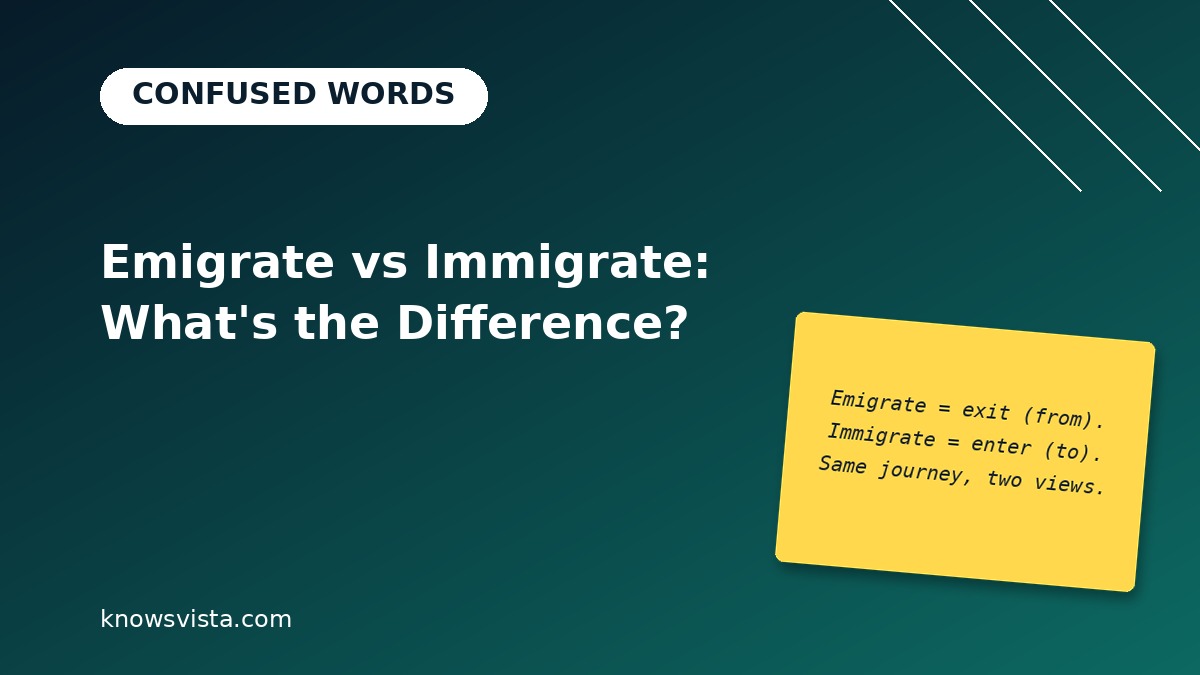
Emigrate vs Immigrate: What’s the Difference? Easy Guide with Examples
Did your grandparents emigrate or immigrate? “Emigrate vs Immigrate: What’s the Difference? Easy Guide with Examples” settles it: the two words describe the same journey from different viewpoints.
Emigrate means to leave a country; immigrate means to enter and settle in one. Get the viewpoint right and the word picks itself. Find more plain-English language guides on the KnowsVista homepage.
Below you’ll learn when to use each word, the tricky exceptions (the nouns, the prepositions, and migrate), a quick practice quiz, and answers to the most common questions.
⚡ Quick answer
Emigrate = to leave your country (pairs with from). Immigrate = to enter a new country and settle there (pairs with to). Same journey, different viewpoint: “She emigrated from Brazil and immigrated to Portugal.”
🧠 Memory trick: Emigrate = Exit. Immigrate = go In. And let the preposition be your final check: from goes with emigrate, to goes with immigrate.
When to use emigrate
Use emigrate when the focus is on leaving, the departure point, the homeland being left behind. It always pairs with from. If your sentence is about saying goodbye to a country, emigrate is the word.
- My father emigrated from Cuba to the United States.
- They emigrated from Ireland in the 1990s in search of better opportunities.
- Albert Einstein emigrated from Germany to the United States.
- After the war, thousands emigrated from Europe.
When to use immigrate
Use immigrate when the focus is on arriving, entering a new country and settling there. It pairs with to. If your sentence is about the destination and the new beginning, immigrate is the word.
The same person can be both: an emigrant in the country they left and an immigrant in the country they entered.
- She plans to immigrate to Amsterdam after her PhD.
- My mother immigrated to the United States from Panama.
- Many families immigrated to Australia for a better life.
- After the war, thousands immigrated to the United States.
The tricky exceptions
The nouns: emigrant vs immigrant
The verbs have matching nouns, and mixing them up is just as common. An emigrant is a person leaving a country; an immigrant is a person arriving in one. The act itself is emigration (departure) or immigration (arrival).
Here’s the twist that confuses people: the same individual is both at once, an emigrant in their homeland’s records and an immigrant in their new country’s census. Grammarly’s guide to immigrate vs emigrate uses the same viewpoint test: leaving or entering?
- emigrant = the person leaving (“The plane was full of emigrants.”)
- immigrant = the person arriving (“She is an immigrant from Panama.”)
- emigration = the act of leaving (“Mass emigration followed the famine.”)
- immigration = the act of arriving (“Immigration policy affects new arrivals.”)
Watch out: “migrate” is the broader word
Don’t confuse the pair with migrate, which is broader and simpler: it just means to move from one place to another, temporarily or permanently. Birds migrate south for winter; workers migrate to cities for jobs.
Unlike emigrate/immigrate, migrate doesn’t require countries or permanence, and it needs no from/to viewpoint test. Confused-word pairs like this reward careful reading; see loose vs lose and insure or ensure for more.
- migrate = move from place to place (birds, workers, families)
- emigrate from = leave a country permanently
- immigrate to = enter a country and settle permanently
- ❌ She emigrated to Canada. → ✅ She emigrated from Brazil. or She immigrated to Canada.
“Emigrate vs Immigrate: What’s the Difference? Easy Guide with Examples”, at a glance
| Emigrate | Immigrate | |
|---|---|---|
| Meaning | Leave your country | Enter a new country |
| Preposition | from | to |
| Focus | The departure point | The destination |
| Example | He emigrated from Spain. | He immigrated to Canada. |
| Noun | emigrant / emigration | immigrant / immigration |
| Trick | E = Exit | I = In |
Quick practice
Choose emigrate or immigrate (and check the preposition!):
- She ________ from Mexico and ________ to Canada.
- Many people ________ from Ireland in the 1800s. (leaving Ireland)
- He ________ to the United States when he was 18. (arriving in the US)
- An ________ is someone leaving a country; an ________ is someone arriving.
- Which sentence is correct: “They immigrated from Brazil” or “They ________ to Brazil”?
Answer key:
- 1. emigrated … immigrated (left Mexico, entered Canada)
- 2. emigrated (the focus is leaving Ireland → from)
- 3. immigrated (the focus is arriving in the US → to)
- 4. emigrant … immigrant (nouns follow the same viewpoint rule)
- 5. “They immigrated to Brazil” (immigrate pairs with to, not from)
Frequently Asked Questions
Can one person be both an emigrant and an immigrant?
Yes. The words describe the same journey from different viewpoints. Your grandmother can be an emigrant in her homeland’s records (she left) and an immigrant in her new country’s records (she arrived).
The label depends on which end of the journey you’re describing.
What preposition goes with emigrate and immigrate?
Emigrate pairs with from: “She emigrated from Kenya.” Immigrate pairs with to: “She immigrated to Germany.” If you catch yourself writing “emigrated to,” you’ve picked the wrong word, switch to immigrated.
What is the difference between migrate, emigrate, and immigrate?
Migrate is the broad word for moving from place to place (birds, workers, families, temporary or permanent). Emigrate and immigrate are the specific pair for permanent moves between countries, split by viewpoint: leaving vs. entering.
Is it “immigrate” or “emigrate” in a job application?
Use immigrate when you’re writing to the country you want to enter: “I plan to immigrate to Canada.” The employer’s country is the destination, so the viewpoint is arrival. For another pair that trips up formal writing, see farther vs further.
Final thoughts
So, “Emigrate vs Immigrate: What’s the Difference? Easy Guide with Examples” comes down to one question: leaving or entering? Emigrate from, immigrate to, E for Exit, I for In.
The nouns follow the same rule (emigrant/emigration vs. immigrant/immigration), and migrate covers everything broader. Pick the viewpoint first, and the word picks itself.
Leave a Reply