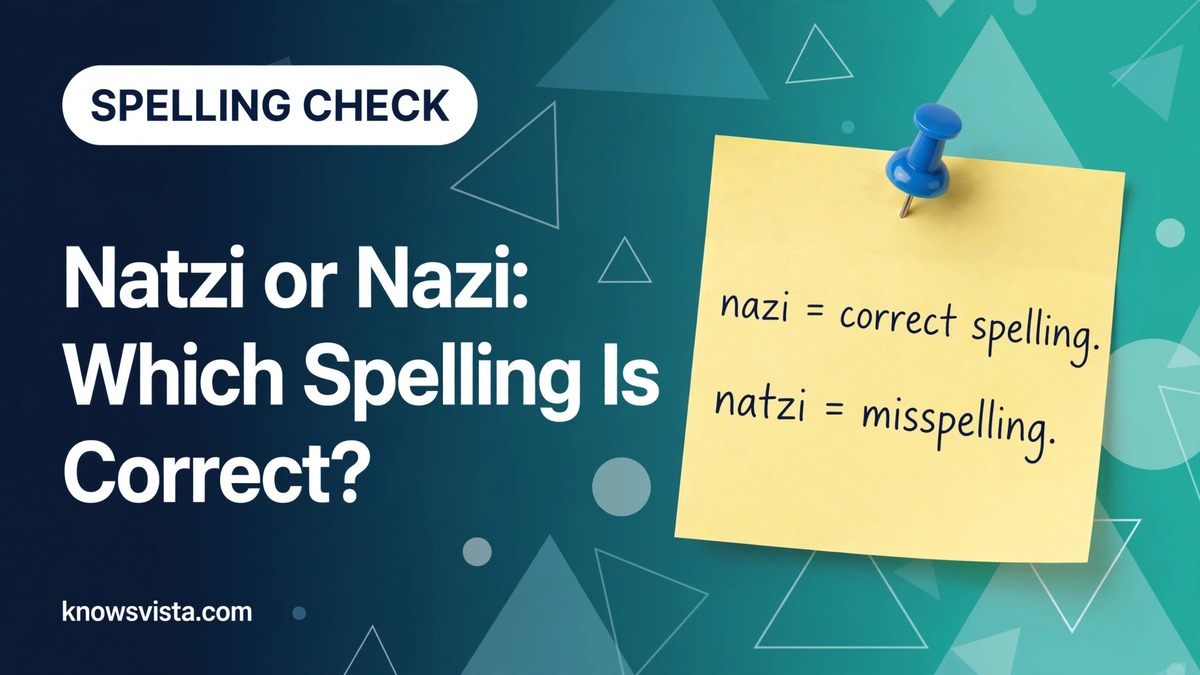
Natzi or Nazi: Which Spelling Is Correct?
The natzi or nazi question is purely a spelling question: one of these forms is in every dictionary, and the other appears in none. There is no debate about meaning here, only about letters. This guide gives you the correct spelling, its pronunciation, where the word comes from, and why the wrong version keeps appearing. For another name spelling that trips people up, see our Chris’s or Chris’ guide.
⚡ Quick answer
Nazi is the correct spelling. Natzi is a misspelling, it appears in no dictionary. The word is pronounced NAHT-see, and the z is never doubled.
🧠 Memory trick: Nazi comes from the German Nationalsozialist via its shortened form Nati (NAH-tee). The dictionary spelling keeps the single z from the middle of Nationalsozialist, no t before it, no double z.
The correct spelling: nazi
Use nazi (capitalized as Nazi when it names the historical term) whenever you write the word. It is a noun, and dictionaries also list the lowercase form for the extended sense of a harshly domineering person, as in the informal “grammar nazi.” The plural is Nazis, formed with a plain s, never -es, and never a doubled z.
The dictionary spells it Nazi, never natzi.
The word Nazi entered English dictionaries in the 1930s.
History textbooks use the spelling Nazi throughout.
She looked up the pronunciation of Nazi in the dictionary.
The entry lists “grammar nazi” as an informal example.
The term comes from the German word Nationalsozialist.
He spelled Nazi correctly in his history essay.
The plural form is Nazis, with a single s.
Why “natzi” is always wrong
The spelling natzi has no entry in any dictionary and no historical source. It usually comes from hearing the word and guessing at its letters, inserting a t before the z to match the hard tz sound. English does have real words with tz, like pretzel and waltz, which makes the guess feel natural. But this word’s letters come from its German root, and spellcheckers flag natzi every time.
✗ Wrong: “The dictionary entry is under natzi.” (no such entry exists)
✓ Right: “The dictionary entry is under nazi.”
✗ Wrong: “He wrote natzis in the plural.”
✓ Right: “He wrote nazis in the plural.”
✗ Wrong: The essay spelled it natzi twice.
✓ Right: The essay spelled it Nazi twice.
The tricky exceptions
Capital N or lowercase n?
Dictionaries list the word both ways, for different jobs. The historical term takes a capital N: Nazi. The extended, informal sense, a person seen as harshly domineering, as in “grammar nazi”, is often written lowercase: nazi. The spelling of the letters never changes; only the capitalization does, depending on which sense you mean.
The museum exhibit described the Nazi party’s symbols.
He jokingly called his friend a grammar nazi.
Don’t let the sound fool you
The tz sound at the start of NAHT-see is what tempts writers to add a t. Remember that English pronunciation and spelling often disagree, the same trap that turns lose into loose. Here, the single z is the whole story. If you want dictionary proof, check Merriam-Webster’s entry for Nazi, which traces the word to German Nationalsozialist.
Pretzel has a tz, but Nazi never does.
The single z comes from the middle of Nationalsozialist.
Natzi vs nazi at a glance
| Nazi | Natzi | |
|---|---|---|
| Correct? | Yes, the only correct spelling | No, a misspelling |
| Dictionary status | Full entry, in use since the 1930s | Not listed anywhere |
| Pronunciation | NAHT-see | Same sound, the spelling is the problem |
| Capitalization | Capital N for the historical term; lowercase for the informal sense | Never correct in any case |
| Example | The entry is under Nazi. | The entry is under natzi. ✗ |
| Trick | From Nati, no t before the z, no double z | If you see tz, it is wrong |
Quick practice
Fill in the blank with the correct spelling:
- The dictionary lists the word under __________.
- __________ is always a misspelling and appears in no dictionary.
- The plural form is __________, with a single s.
- The word is pronounced __________, with a single z sound.
Answer key:
- 1. Nazi (the only dictionary-recognized spelling)
- 2. Natzi (a misspelling born from the tz sound)
- 3. Nazis (plain s plural, the z never doubles)
- 4. NAHT-see (the t in natzi is a spelling error)
Frequently Asked Questions
Is it “natzi” or “nazi”?
Always “nazi”. The spelling natzi is a misspelling that no dictionary recognizes.
How do you pronounce “nazi”?
Say NAHT-see. The pronunciation includes a tz-like sound at the start, which is exactly why writers are tempted to insert a t, resist the urge.
Where does the word “nazi” come from?
It comes from German, formed by shortening and altering Nationalsozialist. The single z is taken from the middle of that German word, which is why the English spelling has one z and no t.
Should “nazi” be capitalized?
Capitalize it as Nazi for the historical term. Dictionaries allow a lowercase nazi for the informal extended sense of a harshly domineering person. Either way, the letter sequence never changes.
What is the plural of “nazi”?
The plural is Nazis, made with a plain s. The z never doubles, so nazzis and natzis are both wrong. Plural rules with a z ending follow the same plain-s pattern as wives and other tricky plurals.
Why do people spell it “natzi”?
They spell by ear: the word starts with a tz-like sound, and English has real words with tz such as pretzel and waltz. But this word’s spelling follows its German root, not its sound, so the extra t is always an error.
Final thoughts
The natzi or nazi question has exactly one right answer: nazi, with its single z and no t. Trace the letters back to the German root and the spelling makes sense forever. Master this pair and the next sound-based trap falls just as fast, compare it with our wifes vs wives guide, or test yourself on the spelling quiz and the free grammar checker.
Leave a Reply