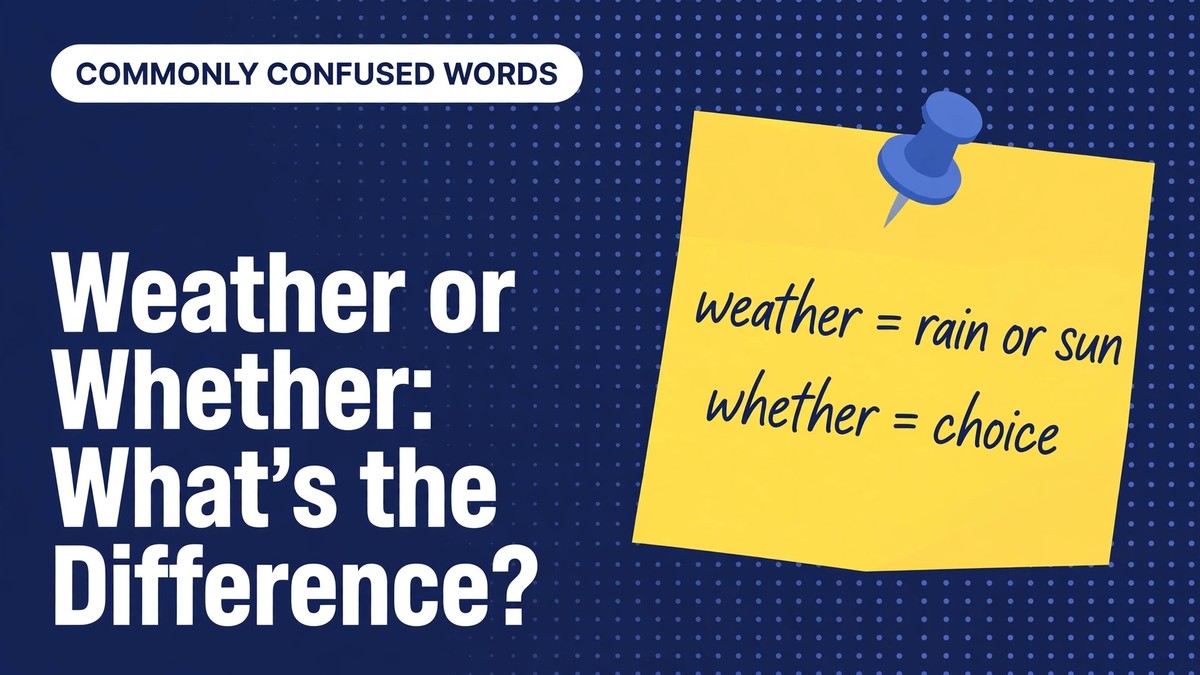
Weather or Whether? Learn the Correct Meaning and Examples
The weather or whether mix-up is one of the most common homophone errors in English because the two words sound exactly the same but mean completely different things. Weather is about the atmosphere, rain, sun, wind, and storms, and it can also be a verb meaning “to survive.” Whether is a conjunction that introduces a choice or a doubt, as in “I don’t know whether to go.” They are never interchangeable. This guide gives you the rules, the memory tricks, and plenty of examples. Check any sentence with the free Grammar Checker on the KnowsVista homepage.
⚡ Quick answer
Use weather when you mean the atmosphere or a forecast: The weather is sunny today. Use whether when you introduce a choice, an alternative, or a doubt: I don’t know whether to stay or go. If you can replace the word with “if,” use whether; if it is about rain or sunshine, use weather.
🧠 Memory trick: Weather starts like weather’s cousins wind and water, all about the outdoors. Whether starts with wh-, like the question words what, when, and why, because it always asks a question about possibilities.
When to use weather
Weather is usually a noun meaning the state of the atmosphere at a particular place and time: temperature, precipitation, wind, and humidity. Merriam-Webster’s weather entry also lists its verb senses: to endure a difficulty (“weather the storm”) and to wear away by exposure (“weathered wood”). If your sentence is about the sky, the forecast, or surviving something hard, weather is your word.
✓ The weather forecast predicts thunderstorms this afternoon.
✓ We canceled the picnic because the weather turned cold and windy.
✓ Farmers watch the weather closely before planting their crops.
✓ The company weathered the financial crisis and came out stronger.
✓ The old fence was weathered by years of sun and rain.
✗ The whether is beautiful today. → ✓ The weather is beautiful today.
The test is simple: is the sentence about the sky, the forecast, or surviving difficulty? Then it is weather. The same “is it about the physical world?” test helps with other homophone pairs, like peek or peak.
When to use whether
Whether is a subordinating conjunction that introduces two or more alternatives, an indirect question, or a doubt. It appears in patterns like whether…or, whether to + verb, and whether or not. It never refers to the sky. If your sentence presents a choice (“this or that”) or reports uncertainty (“I wonder if…”), whether is correct.
✓ I don’t know whether to accept the job offer.
✓ She asked whether I wanted tea or coffee.
✓ The team discussed whether the project should continue.
✓ He will pass the exam whether he studies or not.
✓ Please let me know whether you are coming to the party.
✗ I don’t know weather we should leave now. → ✓ I don’t know whether we should leave now.
Notice that every whether sentence hides a choice or a question. That “choice” signal is the same clue that settles pairs like between vs among, where the structure of the sentence tells you the word.
The tricky exceptions
“Whether or not”, and when “or not” is redundant
Whether or not is a set phrase meaning “regardless of which option is true,” as in “we’ll go whether or not it rains.” But after verbs like know, wonder, and decide, the or not is often unnecessary: “I don’t know whether she will come” already covers both cases. Keep or not only when it adds the “regardless” meaning.
✓ We’ll have the picnic whether or not it rains. (Regardless of the weather.)
✓ I don’t know whether she will come. (The “or not” adds nothing here.)
Whether vs if: not always interchangeable
Whether and if overlap in indirect questions (“I don’t know whether/if she agrees”), but they are not identical. Use whether, not if, before an infinitive (“whether to go”), after a preposition (“talk about whether…”), and when presenting two alternatives (“whether tea or coffee”). Formal writing prefers whether in all these cases.
✓ She couldn’t decide whether to stay or leave.
✗ She couldn’t decide if to stay or leave. → ✓ She couldn’t decide whether to stay or leave.
“Weather” as a verb: weathered, weathering
Do not let the verb sense of weather confuse you: weathered (as an adjective) describes something worn by exposure, and to weather means to survive a difficulty. Neither sense has anything to do with whether, even though the spelling is only two letters apart.
✓ The climbers weathered the blizzard in a mountain hut.
✓ The weathered barn boards gave the cottage its rustic look.
Weather vs whether at a glance
| Weather | Whether | |
|---|---|---|
| Part of speech | Noun (usually); also a verb | Conjunction |
| Meaning | Atmospheric conditions; or to survive/endure | A choice, alternative, or doubt |
| Memory clue | wea- like wind and water | wh- like question words what, when, why |
| Substitution test | Talking about rain, sun, or forecast? | Can you replace it with “if”? |
| Common patterns | weather forecast, bad weather, weathered wood | whether…or, whether to, whether or not |
| Example | The weather is perfect for hiking. | I wonder whether it will rain. |
Quick practice
Fill in the blank with weather or whether:
- The __________ in Canada can be extremely cold in winter.
- He couldn’t decide __________ to accept the job offer.
- __________ I should wear a sweater depends on the __________.
- The crew __________ the storm by staying in the harbor.
Answer key:
- 1. weather (atmospheric conditions)
- 2. whether (a choice, “whether to accept”)
- 3. Whether … weather (a choice, then the atmosphere)
- 4. weathered (verb, survived the storm)
Frequently Asked Questions
What is the difference between weather and whether?
Weather refers to atmospheric conditions like rain, sun, and wind. Whether is a conjunction that introduces a choice, an alternative, or a doubt. They are homophones, they sound the same but are never interchangeable.
Is it “whether or not” or “weather or not”?
Whether or not is correct, it is a set phrase meaning “regardless of which option is true.” Weather never appears in this phrase.
Can weather be a verb?
Yes, to weather something means to survive it (“weather the storm”) or to be worn by exposure (“weathered wood”). The past participle weathered is also used as an adjective.
When should I use whether instead of if?
Use whether before infinitives (“whether to go”), after prepositions, and when presenting alternatives (“whether tea or coffee”). In plain indirect questions (“I don’t know whether/if she agrees”), both work, but whether is preferred in formal writing.
How can I remember weather vs whether?
Weather starts like wind and water (outdoors words). Whether starts with wh-, like the question words what, when, and why, because it always introduces a question about possibilities.
Final thoughts
Weather is the sky; whether is the choice. If the sentence is about rain, sun, or a forecast, or about surviving a storm, it is weather. If it hides a question, a doubt, or a “this or that,” it is whether. Keep the two memory tricks (wea- = wind and water, wh- = question words) and you will never swap them again. Lock the rule in with the free Spelling Quiz.
Leave a Reply