Author: zoya khan

  • Wifes or Wives: Which Spelling Is Correct?

    Wifes or Wives: Which Spelling Is Correct?

    Wifes or Wives: Which Spelling Is Correct?

    The wifes or wives question trips up writers who know the basic plural rule, just add s, and stop there. English has other plans for words ending in f. One spelling is correct, the other is a misspelling that spellcheckers flag every time. The fix takes less than a minute: one simple consonant swap. This guide gives you the rule, a memory trick, 14 example sentences, and the words that break the pattern. For another common spelling trap, see our loose vs lose guide.

    โšก Quick answer

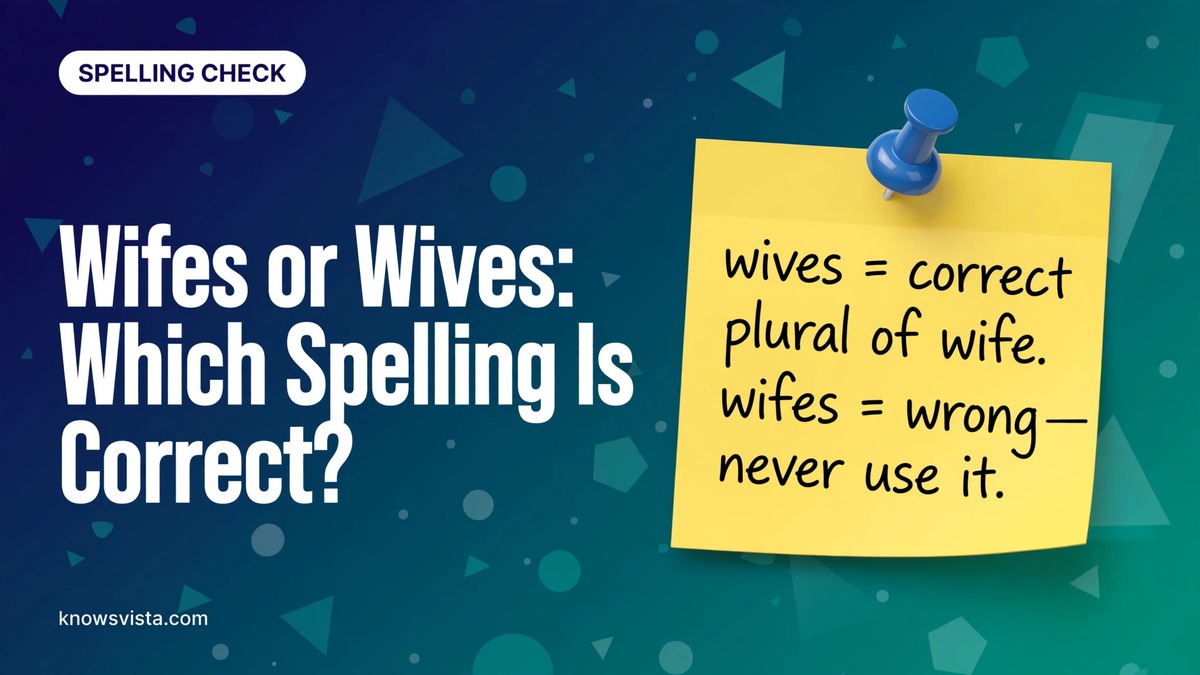
    Wives is the correct plural of wife. Wifes is a misspelling, it is not a word in any dictionary. Nouns ending in -fe change the f to v and add -es.

    ๐Ÿง  Memory trick: Think “life, knife, wife, all take a v”. If the singular ends in -fe, swap the f for a v before adding -es: wife โ†’ wives, just like knife โ†’ knives and life โ†’ lives.

    When to use “wives”

    Use wives whenever you mean more than one wife. The singular noun wife (one married woman) becomes wives in the plural, pronounced “wahyvz.” Pair it with plural verbs, wives are, not wives is.

    The two wives became close friends.

    Both husbands and wives attended the dinner.

    The soldiers waved goodbye to their wives.

    All three wives are doctors.

    The wives planned a surprise trip together.

    Many famous writers’ wives worked as their editors.

    The wives shared stories over coffee.

    Two of the wives started a small business.

    Why “wifes” is wrong

    The spelling wifes is a common misspelling caused by applying the regular add-s rule to an irregular noun. No dictionary lists it. If you see a red underline under it, the fix is always the same: change wifes to wives.

    โœ— Wrong: “The wifes met for lunch.” (misspelling of the plural)
    โœ“ Right: “The wives met for lunch.”
    โœ— Wrong: “Both wifes are teachers.” (misspelling of the plural)
    โœ“ Right: “Both wives are teachers.”

    โœ— Wrong: His wifes both work in finance.

    โœ“ Right: His wives both work in finance.

    Spot the pattern: the same swap works for a small family of words. Writers who learn this rule also stop mixing up other lookalikes, our farther vs further guide covers another classic pair.

    The tricky exceptions

    Words that follow the same f-to-v rule

    The -fe to -ves swap is shared by a handful of common nouns. Learn them as a set: wife โ†’ wives, life โ†’ lives, knife โ†’ knives, leaf โ†’ leaves, half โ†’ halves, wolf โ†’ wolves, thief โ†’ thieves, and loaf โ†’ loaves. Cambridge’s grammar guide lists wife, thief, and loaf as textbook examples of this rule.

    She packed three knives for the camping trip.

    The wolves howled at the edge of the forest.

    The -f words that break the rule

    Not every word ending in f changes to v, and this is where the real trap lies. Roof becomes roofs, chief becomes chiefs, belief becomes beliefs, and cliff becomes cliffs. These words simply add s. When in doubt, check a dictionary, for the full authority, see Cambridge Dictionary’s noun plural rules.

    The roofs of the old houses were covered in snow.

    โœ— Wrong: The rooves of the old houses were covered in snow.

    Wives vs wifes at a glance

    WivesWifes
    Correct?Yes, the only correct pluralNo, a common misspelling
    Part of speechPlural nounNot a word
    RuleNouns ending in -fe: change f to v, add -esWrongly applies the regular add-s rule
    Pronounced“wahyvz,” rhymes with lives,
    TrickLife, knife, wife, all take a vIf it ends in -fes, it is wrong

    Quick practice

    Fill in the blank with the correct spelling:

    1. The two __________ opened a bakery together.
    2. All of my friends’ __________ are doctors.
    3. She sharpened the __________ before dinner. (plural of knife)
    4. The __________ of the cabin needed repairs. (plural of roof)

    Answer key:

    • 1. wives (the plural of wife changes f to v)
    • 2. wives (plural possessive needs the plural form first)
    • 3. knives (same -fe to -ves rule)
    • 4. roofs (an exception, this one just adds s)

    Frequently Asked Questions

    What is the plural of “wife”?

    The plural of wife is wives. Change the f to v and add -es. The spelling wifes is always a misspelling.

    Why does “wife” become “wives” instead of “wifes”?

    English has a small group of nouns ending in -f or -fe that change the f to v in the plural: wife โ†’ wives, knife โ†’ knives, life โ†’ lives, leaf โ†’ leaves. The change keeps the voiced v sound consistent with how the word is spoken.

    Is “wifes” ever correct?

    No. Wifes is never correct in standard English, no dictionary lists it. It is one of the most common spelling errors in student essays and social media posts. Always write wives.

    Which -f words do NOT change to -ves?

    Several common words simply add s: roof โ†’ roofs, chief โ†’ chiefs, belief โ†’ beliefs, cliff โ†’ cliffs, and safe โ†’ safes. There is no shortcut here, memorizing the short -ves list (wife, life, knife, leaf, half, wolf, thief, loaf) is the reliable approach.

    How do you pronounce “wives”?

    Wives is pronounced “wahyvz” (/waษชvz/), it rhymes with lives and knives. The singular wife ends in a soft f sound (“wahyf”), while the plural switches to a buzzing v sound. There is no US vs UK difference in spelling or pronunciation.

    What is the difference between “wives”, “wife’s”, and “wives’”?

    Wives is the plural (more than one wife). Wife’s is the singular possessive (belonging to one wife: “my wife’s car”). Wives’ is the plural possessive (belonging to several wives: “the wives’ club”). The apostrophe always marks possession, never use it to form the plural.

    Final thoughts

    The wifes or wives question has exactly one right answer: wives. Lock in the pattern, life, knife, wife, all take a v, and you will also nail lives, knives, leaves, and wolves. Master this pair and the next spelling trap falls just as fast, compare it with our Chris’s or Chris’ guide, or test yourself on the spelling quiz and the free grammar checker.

  • Photoshoot or Photo Shoot: Which Spelling Is Correct?

    Photoshoot or Photo Shoot: Which Spelling Is Correct?

    Photoshoot or Photo Shoot: Which Spelling Is Correct?

    The photoshoot or photo shoot question confuses even professional photographers. You will see the one-word form on Instagram, the two-word form in newspapers, and a hyphenated version in between. The good news: this is not a right-vs-wrong trap. Both main spellings are correct, the choice depends on where you are writing. This guide gives you the dictionary answer, a memory trick, 14 example sentences, and the one form to avoid. For another tricky pair, see our full-time or full time guide.

    โšก Quick answer

    Photo shoot (two words) is the classic dictionary spelling and the safest choice in formal writing. Photoshoot (one word) is also correct and widely used, especially online and in casual contexts. Never write photo-shoot as a noun.

    ๐Ÿง  Memory trick: Think two words, two jobs, photo (what it is) plus shoot (what happens). When in doubt, split it: the two-word form is never wrong.

    When to use “photo shoot”

    Use photo shoot as two separate words in formal writing, news articles, magazines, business websites, and school essays. Merriam-Webster lists it as its headword entry, defined as a photography session where a professional photographer takes photographs for commercial use. When style matters, the two-word form always looks polished.

    The magazine planned a photo shoot at the beach.

    She booked a photo shoot for her wedding portraits.

    The article described the chaos behind the fashion photo shoot.

    They arrived early for the product photo shoot.

    Her first professional photo shoot lasted six hours.

    All models must sign a release before the photo shoot.

    When “photoshoot” is acceptable

    Use photoshoot as one word in casual, digital, and creative contexts, social media captions, hashtags, blog headlines, and photography branding. It means exactly the same thing, and major dictionaries now recognize the closed compound. Just stay consistent: pick one spelling per document and stick with it.

    Behind the scenes of today’s photoshoot!

    He runs a small photoshoot studio downtown.

    Their engagement photoshoot took place at sunset.

    Tag your best photoshoot moments with #studio.

    The baby’s first photoshoot was adorable.

    We scheduled the photoshoot for Saturday morning.

    Spot the mistakes below. Writers who hesitate over spellings like this often mix up other close pairs too, our breathe vs breath guide covers another one.

    โœ— Wrong: “She booked a photo-shoot yesterday.” (the noun is never hyphenated)
    โœ“ Right: “She booked a photo shoot yesterday.”
    โœ— Wrong: “The photo shot was really fun.” (a shot is one picture, not the session)
    โœ“ Right: “The photo shoot was really fun.”

    โœ— Wrong: He missed the photo-shoot on Monday.

    โœ“ Right: He missed the photo shoot on Monday.

    The tricky exceptions

    Plurals and pronunciation

    Both forms pluralize simply by adding s: photo shoots and photoshoots. Pronunciation never changes, say “FOH-toh shoot” either way. There is no US vs UK difference here; both regions accept both spellings. For the full authority check, see Merriam-Webster’s entry for photo shoot.

    The agency runs three photo shoots every week.

    Her portfolio includes dozens of photoshoots.

    The hyphen appears only as a compound adjective

    The hyphenated form photo-shoot is not the standard noun spelling, but hyphens can appear when the phrase works as an adjective before a noun. In “a photo-shoot location,” the hyphen links the two words into one modifier. This is the same pattern as full-time job, see our full-time or full time guide for how compound forms shift by role. As a standalone noun, never use the hyphen.

    The photo-shoot location was a rooftop garden.

    โœ— Wrong as a noun: The photo-shoot starts at noon.

    Photo shoot vs photoshoot at a glance

    Photo shootPhotoshoot
    SpellingTwo words (open compound)One word (closed compound)
    Correct?Yes, dictionary-preferred, always safeYes, accepted, especially informal
    Best forNews, essays, business writingSocial media, captions, branding
    PluralPhoto shootsPhotoshoots
    TrickTwo words, two jobs: photo + shootOne word feels faster, like a hashtag

    Quick practice

    Choose the best spelling for each sentence:

    1. The newspaper covered the fashion __________ last week. (formal article)
    2. Behind the scenes of my first __________! (Instagram caption)
    3. Which spelling should you never use for the noun: photo-shoot, photo shoot, or photoshoot?
    4. The studio booked three __________ this month. (give both plurals)

    Answer key:

    • 1. photo shoot (two words for formal writing)
    • 2. photoshoot (one word is natural for social media)
    • 3. photo-shoot (never hyphenate the standalone noun)
    • 4. photo shoots / photoshoots (both plurals are fine)

    Frequently Asked Questions

    Is it “photoshoot” or “photo shoot”?

    Both are correct. “Photo shoot” (two words) is the traditional dictionary spelling and the safest choice. “Photoshoot” (one word) is an accepted variant, especially in casual and digital writing. Pick one per document and stay consistent.

    Is “photoshoot” in the dictionary?

    Yes. Merriam-Webster lists photoshoot as its own headword with the same meaning as photo shoot: a photography session, especially a professional one. That said, the two-word entry remains the more established spelling.

    Is “photo-shoot” with a hyphen correct?

    Not as a standalone noun, write photo shoot or photoshoot. The hyphen only belongs in compound adjectives before a noun, as in “a photo-shoot location,” following the same hyphenation habit as full-time job.

    What is the plural of “photo shoot”?

    Add s to the last word: photo shoots or photoshoots, matching whichever spelling you chose. Both plurals are standard and pronounced the same way.

    Is there a US vs UK difference?

    No. American and British English both accept photo shoot and photoshoot. The one-word form is slightly more common in informal online writing on both sides of the Atlantic.

    What happens at a photo shoot?

    A photo shoot is a planned session where a photographer takes a series of photographs of a person, product, or scene, for magazines, advertising, weddings, or portfolios. The session is the shoot; each individual picture is a shot.

    Final thoughts

    The photoshoot or photo shoot question is really about register, not right and wrong. Write photo shoot as two words when the writing is formal, and use photoshoot when the tone is casual, just never hyphenate the noun itself. Master this pair and the next compound-word trap falls just as fast, compare it with our farther vs further guide, or test yourself on the spelling quiz and the free grammar checker.

  • Putting or Puting: Which Spelling Is Correct?

    Putting or Puting: Which Spelling Is Correct?

    Putting or Puting: Which Spelling Is Correct?

    The putting or puting question looks tiny, but it shows up constantly in emails, captions, and schoolwork. One of the two spellings is correct, and the other never appears in any dictionary. The fix takes less than a minute: it all comes down to one simple doubling rule. This guide gives you the rule, a memory trick, 13 example sentences, and the mistakes to avoid. For another classic mix-up, see our loose vs lose guide.

    โšก Quick answer

    Putting (with a double t) is the correct spelling, it is the present participle of the verb put. Puting (with one t) is a misspelling and does not appear in any dictionary.

    ๐Ÿง  Memory trick: The verb put is short and punchy, so its final letter refuses to stand alone before -ing. Give the lonely t a twin, put-t-ing, and you will always spell it right.

    The correct spelling: putting

    Use putting whenever you need the -ing form of the verb put, meaning to place or set something somewhere. It works as a verb (“She is putting the books away”) and as a gerund naming the action (“Putting things off never helps”). The past tense of put stays the same, put, so putting is the only -ing form you need.

    She is putting the groceries in the fridge.

    They are putting up a new fence this weekend.

    Putting your phone away helps you focus.

    He kept putting off the dentist appointment.

    We are putting the kids to bed at eight.

    The chef is putting the finishing touches on the dish.

    Putting the meeting first saved us hours later.

    She was putting on her coat when the phone rang.

    The company is putting safety before profit.

    Why “puting” is always wrong

    The spelling puting follows no English rule and appears in no dictionary. It happens when writers forget the doubling rule below. Spellcheckers flag it, and teachers mark it wrong every time.

    โœ— Wrong: “She is puting the keys away.” (missing the doubled t)
    โœ“ Right: “She is putting the keys away.”
    โœ— Wrong: “Stop puting it off.” (missing the doubled t)
    โœ“ Right: “Stop putting it off.”

    โœ— Wrong: They are puting the chairs in a circle.

    โœ“ Right: They are putting the chairs in a circle.

    The tricky exceptions

    The doubling rule and its limits

    The rule is simple: a one-syllable verb ending in one vowel plus one consonant doubles that consonant before -ing. So put becomes putting, just like cut becomes cutting and run becomes running. Longer verbs only double when the stress falls on the last syllable, begin gives beginning, but visit gives visiting with a single t. There is no US vs UK difference here; both regions spell it putting.

    He cut his finger while cutting vegetables.

    She is running late, so she is putting on her shoes.

    Don’t confuse “put” with “putt”

    The golf verb putt is a different word from put. Its past tense is putted (“He putted twice on the last hole”), while put never changes in the past tense (“I put it there yesterday”). For the full dictionary check, see Merriam-Webster’s entry for putting.

    He putted the ball gently toward the hole.

    She put the letter in the mailbox this morning.

    Putting vs puting at a glance

    PuttingPuting
    Correct?Yes, the only correct formNo, a common misspelling
    Part of speechPresent participle / gerund of putNot a word
    RuleOne-syllable CVC verb: double the final t before -ingBreaks the doubling rule
    ExampleShe is putting it away.She is puting it away. โœ—
    TrickGive the lonely t a twin: put-t-ingIf it has one t, it is wrong

    Quick practice

    Fill in the blank with the correct spelling:

    1. She is __________ the toys back in the box.
    2. __________ off your homework only makes it harder.
    3. They are __________ the final coat of paint today.
    4. He was __________ his jacket on when I called.

    Answer key:

    • 1. putting (the -ing form of put doubles the t)
    • 2. Putting (gerund at the start of the sentence)
    • 3. putting (present continuous needs the -ing form)
    • 4. putting (after was, the -ing form is required)

    Frequently Asked Questions

    Is it “puting” or “putting”?

    Always “putting” with a double t. The spelling puting is a misspelling that no dictionary recognizes. If your spellchecker underlines it, add the second t.

    Why does “put” become “putting” with two t’s?

    English doubles the final consonant of a one-syllable verb ending in one vowel plus one consonant before -ing. Put fits the pattern (p-u-t), so it becomes putting, exactly like cut becomes cutting and swim becomes swimming.

    Is “putting” a verb or a noun?

    Most often it is the present participle of the verb put (“They are putting it away”). It can also act as a gerund, a verb working as a noun (“Putting it off was a mistake”). Writers who mix up word forms like this often trip on breathe vs breath too.

    What is the past tense of “put”?

    The past tense of put is put, the verb never changes form. “I put it there yesterday” is correct. Do not confuse it with the golf verb putt, whose past tense is putted.

    Is there a US vs UK difference in spelling “putting”?

    No. Both American and British English spell it putting with a double t. Unlike pairs like traveling vs travelling, this word never splits by region.

    What does “putting green” mean in golf?

    A putting green is the smooth, closely cut area around the hole on a golf course. Here putting comes from the golf verb putt (to hit the ball gently), not from put, a handy reminder that the two verbs are separate words.

    Final thoughts

    The putting or puting question has exactly one right answer: putting, with its doubled t. Remember the pattern, short verb, single vowel, single consonant, double the letter before -ing, and you will also nail cutting, running, and swimming. Master this pair and the next spelling trap falls just as fast, compare it with our Chris’s or Chris’ guide, or test yourself on the spelling quiz and the free grammar checker.
  • Chris’s or Chris’: Which Possessive Form Is Correct?

    Chris’s or Chris’: Which Possessive Form Is Correct?

    Chris’s or Chris’: Which Possessive Form Is Correct?

    The Chris’s or Chris’ question sparks more office debates than almost any other spelling choice. Both forms look plausible, spellcheckers accept either, and teachers disagree, so which possessive form is correct? The honest answer: both are correct, but style guides split the vote. Chris’s is the most common and matches Chicago style and British English; Chris’ follows AP style. This guide shows you when to use each, the pronunciation trick, and the plural trap. For another pair that confuses writers, see breathe vs breath.

    โšก Quick answer

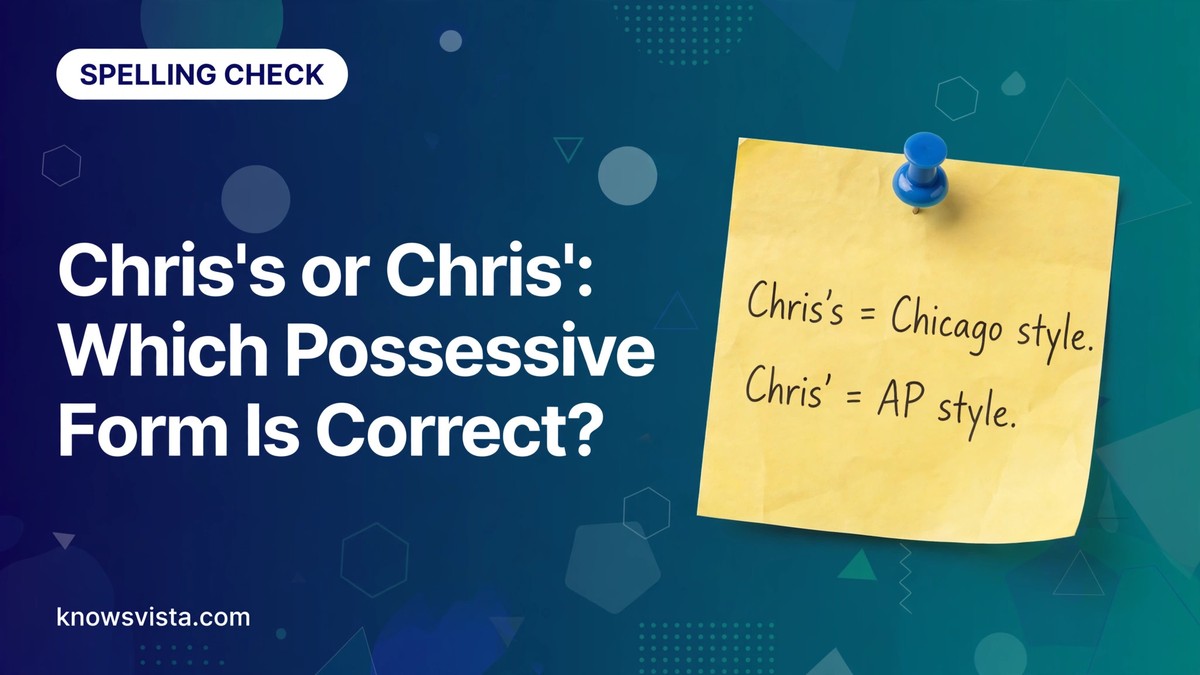
    Both are correct. Use Chris’s for Chicago, MLA, and British English (the most common choice). Use Chris’ for AP style, the standard in newsrooms. The key rule: pick one style and stay consistent.

    ๐Ÿง  Memory trick: Say the word out loud. Most people say it as two syllables, “Chris-es.” Writing Chris’s matches exactly what you hear, letter for letter.

    When to use Chris’s

    Write Chris’s when you follow the Chicago Manual of Style, MLA, or British English, the standard in schools, books, and business writing. This form treats Chris like any other singular noun and simply adds ‘s, the way boss’s and James’s work.

    Chris’s birthday party starts at seven.

    That bike is Chris’s, not mine.

    Chris’s presentation impressed the judges.

    We stayed at Chris’s parents’ house all weekend.

    The teacher praised Chris’s essay in front of the class.

    James’s car broke down, just like Chris’s did last month.

    When to use Chris’

    Write Chris’ when you follow AP style, the house rule for journalists, news sites, and press releases. AP drops the extra s after the apostrophe for any singular noun that ends in s, including names like James, Tess, and Chris.

    The reporter quoted Chris’ statement on the new policy.

    Chris’ project won first prize at the science fair.

    Please return Chris’ notebook before Friday.

    The headline read “Chris’ team takes the championship.”

    Editors moved Tess’ desk next to James’ office.

    Watch out for the plural trap: โœ— “The Chrises’s house is big.” (never double up) โœ“ “The Chrises’ house is big.” (plural family name + apostrophe only). Possessive puzzles like this one sit next to other tricky pairs on our site, such as loose vs lose.

    The tricky exceptions

    Classical and biblical names keep just the apostrophe

    Traditional style writes ancient and biblical names with only an apostrophe: Jesus’, Moses’, Achilles’. This exception survives even in Chicago style, which otherwise loves Chris’s. It is a convention of respect and history, not pronunciation, and it does not extend to modern names.

    Jesus’ disciples gathered around him.

    Moses’ leadership shaped the nation.

    Plural names ending in “s” take only the apostrophe

    When Chris becomes plural, the Chrises, meaning the whole family, the possessive adds only an apostrophe: the Chrises’. This rule never changes, in every style guide. Confusing it with the singular is the one true error in this whole topic, so double-check whose name you are pluralizing. For the dictionary view, see Merriam-Webster’s dictionary.

    The Chrises’ reunion drew relatives from five states.

    The bosses’ meeting ran late, but the boss’s memo was short.

    Chris’s vs Chris’ at a glance

    Chris’sChris’
    StyleChicago, MLA, British EnglishAP (news and journalism)
    TrickSay “Chrises”, the extra s matchesAP trims the second s for speed

    Quick practice

    Choose the correct possessive for each style guide:

    1. (Chicago style) I borrowed __________ laptop for the trip.
    2. (AP style) The article quoted __________ remarks on the budget.
    3. (British English) Have you met __________ younger brother?
    4. (Any style) The __________ (whole family) car broke down on the highway.

    Answer key:

    • 1. Chris’s (Chicago adds ‘s to singular names)
    • 2. Chris’ (AP uses the apostrophe alone)
    • 3. Chris’s (British English prefers ‘s)
    • 4. Chrises’ (plural name + apostrophe only, both styles agree)

    Frequently Asked Questions

    Is “Chris’s” or “Chris’” more correct?

    Neither is more correct in general, Chris’s is the more common choice and the standard in Chicago style, MLA, and British English. Chris’ is equally correct in AP style. The only wrong move is mixing both forms in one document.

    How do you pronounce “Chris’s”?

    Say it as “Chrises”, two syllables, with the extra -es sound at the end, just like bosses or boxes. Most people say Chris’ exactly the same way, which is why the two spellings coexist so peacefully.

    What about the possessive for two people named Chris?

    Pluralize first, then add the apostrophe: the Chrises’ house. This is the one rule with no exceptions, plural nouns ending in s always take the apostrophe alone, in every style guide. The same goes for the Joneses’ or the Williamses’.

    Final thoughts

    The Chris’s or Chris’ debate ends with a style-guide check, not a coin flip. Writing for school, business, or a British audience? Go with Chris’s. Writing for a newsroom? Go with Chris’. Either way, keep it consistent and remember the plural exception, the Chrises’, that every guide agrees on. Compare it with another style-split pair in our farther vs further guide or our former vs latter guide, or run your writing through the free grammar checker and the spelling quiz.

  • Former vs Latter: Meaning, Difference & Examples

    Former vs Latter: Meaning, Difference & Examples

    Former vs Latter: Meaning, Difference & Examples

    Former vs latter is one of those pairs that looks formal and confusing, but the rule behind it is almost embarrassingly simple. You mention two things, then use the former to point at the first and the latter to point at the second, no repeating yourself. The catch is that the pair refuses to work with three or more items, and each word has a second life as a plain adjective. This guide covers both meanings, the memory trick, and the mistake lists to avoid. For another classic mix-up, see breathe vs breath.

    โšก Quick answer

    The former refers to the first of two things already mentioned. The latter refers to the second of two things already mentioned. Only use this pair with exactly two items, never three or more.

    ๐Ÿง  Memory trick: Former = First. Latter sounds like later, and later things come second. Pair the letters and you will never swap them.

    When to use the former

    Use the former (always with the) to refer back to the first of two options, people, or ideas you just named. It is a shortcut that keeps formal writing from repeating the same word twice in one sentence.

    Between tea and coffee, I always choose the former.

    We visited Paris and Rome; the former charmed us more.

    Alex and Sam joined the team; the former plays goalkeeper.

    Of the two proposals, the former costs far less to run.

    She was offered a raise or extra leave; the former suited her better.

    The two branches in Leeds and York report separately, with the former turning a profit.

    When to use the latter

    Use the latter (again, always with the) to refer back to the second of two things you just named. It shines in comparisons, essays, and business writing where repeating full names would sound clumsy.

    She offered pizza or pasta, and I took the latter.

    The book was filmed twice; I prefer the latter version.

    Given the choice between a bonus and a promotion, he’d pick the latter.

    We trained in spring and summer; the latter season was hotter.

    Of courage and caution, the latter often wins the day.

    Both plans were risky, but the latter had the bigger payoff.

    Mark the wrong usage clearly: โœ— “My hobbies are guitar, reading, and knitting, but the former is my passion.” (three items, wrong!) โœ“ “My hobbies are guitar, reading, and knitting, but the first is my passion.” Pairs like this appear across our site, including farther vs further.

    The tricky exceptions

    “Former” as a plain adjective (no pair needed)

    Former also works as an ordinary adjective meaning “previous” or “ex”, no second item required. The former president, her former boss, a former student all describe someone who used to hold a role. This meaning has nothing to do with first-of-two, so do not mix the two uses in one sentence.

    The former mayor opened a bakery after leaving office.

    His former teacher wrote him a strong reference letter.

    “Latter” as a plain adjective, and the distance trap

    Latter also works as an adjective meaning “toward the end of something,” as in the latter half of the year. A second trap: when the two items sit several sentences apart, readers forget which was first. In that case skip former/latter entirely and repeat the names, clarity beats elegance. For the full dictionary treatment, see Merriam-Webster’s dictionary.

    Sales improved in the latter half of the year.

    The film dragged in its latter half and lost my attention.

    Former vs latter at a glance

    The formerThe latter
    Points toThe first of two itemsThe second of two items
    As adjectivePrevious, ex (former boss)Toward the end (latter half)
    Needs “the”?Yes, as a nounYes, as a noun
    TrickFormer = FirstLatter = later = second

    Quick practice

    Fill in the blank with the former or the latter:

    1. We debated email or a phone call; __________ felt faster.
    2. Two candidates applied: a veteran and a newcomer. __________ won the role.
    3. Cats and dogs both make great pets, but __________ is easier to train.
    4. Between savings and investing, she chose __________.

    Answer key:

    • 1. the former (email was named first)
    • 2. the former (a veteran was named first)
    • 3. the latter (dogs were named second)
    • 4. the latter (investing was named second)

    Frequently Asked Questions

    Can I use “former” and “latter” with three or more items?

    No. Former and latter only work with exactly two items. With three or more, use the first, the second, the last, or just repeat the names. This is the most tested former vs latter rule in exams.

    Do I always need “the” before “former” and “latter”?

    Yes, when they act as nouns pointing back at two items, always the former and the latter. Without the, the reference feels broken: โœ— “Between tea and coffee, former wins” is simply not standard English.

    Are “former” and “latter” formal or informal words?

    They are formal words. You will meet them in essays, reports, news articles, and academic writing, almost never in casual speech, where people just say the first one and the second one instead.

    Final thoughts

    The former vs latter habit is a two-second checklist: are there exactly two things, named just before? Point back with the former for the first and the latter for the second. Anything else, three items, a distant reference, casual speech, deserves plain words instead. Keep this rule and your comparisons stay crisp. Want more pairs like this? Try our full time vs full-time guide, the Chris’s or Chris’ guide, or sharpen up on the spelling quiz and the free grammar checker.
  • Breathe vs Breath: Meaning, Difference & Examples

    Breathe vs Breath: Meaning, Difference & Examples

    Breathe vs Breath: Meaning, Difference & Examples

    The breathe vs breath mix-up trips up even confident writers, because the two words look almost identical and sound nearly the same. In fast emails and school essays, the wrong one slips in and the sentence still reads fine, until a careful reader notices. The fix takes less than a minute to learn: one is an action, the other is a thing. This guide gives you the rule, a memory trick, 16 example sentences, and the phrases where breath always wins. If you want to see how another tricky pair works, read our guide on former vs latter next.

    โšก Quick answer

    Breathe (with an e) is a verb, the action of taking air into your lungs and letting it out: Just breathe. Breath (no e) is a noun, the air itself or one in-and-out cycle: Take a breath.

    ๐Ÿง  Memory trick: The extra e in breathe stands for energy, energy means action, and actions are verbs. No extra letter? Then it is the thing itself: breath, the noun.

    When to use breathe

    Use breathe whenever your sentence needs the action, after helpers like can, should, need to, or the word to. It also changes form with tense: breathes, breathed, breathing.

    She had to breathe slowly during the exam.

    The doctor asked him to breathe in and out.

    Try to breathe through your nose, not your mouth.

    He could hardly breathe after running up the stairs.

    “Just breathe,” the coach told the nervous runner.

    She breathed a sigh of relief when the results came in.

    Plants help us breathe by making the oxygen we need.

    He breathes best in cool, fresh air.

    When to use breath

    Use breath whenever your sentence needs the thing, after a, the, my, deep, or short. Its plural is breaths (said like “breths”), a form the verb never takes.

    Take a deep breath before you start your speech.

    She held her breath under the water.

    I could smell coffee on his breath.

    He was out of breath after climbing the hill.

    Don’t waste your breath arguing with him.

    A breath of fresh air lifted the mood in the room.

    Her breath came in short, quick gasps.

    The nurse told him to take three slow breaths.

    Spot the classic mistake below, then read the fix. Writers who confuse breathe and breath often mix up other lookalikes too, our loose vs lose guide covers another common pair.

    โœ— Wrong: “I need to take a deep breathe.” (needs the noun)
    โœ“ Right: “I need to take a deep breath.”
    โœ— Wrong: “It is hard to breath in this room.” (needs the verb)
    โœ“ Right: “It is hard to breathe in this room.”

    The tricky exceptions

    “Breathing” can be a noun too

    The -ing form of the verb doubles as a gerund, a verb acting as a noun. In “His breathing was calm,” the word names the action itself, so it works as the sentence subject. You still never write “breath” with an extra e as a noun, breath stays the noun for the air, and breathing covers the act.

    Deep breathing before bed helps him fall asleep.

    She listened to the baby’s soft breathing.

    Fixed phrases that always use “breath”

    Some idioms lock in the noun no matter what. Hold your breath, catch my breath, out of breath, and don’t breathe a word look similar but split: the first three use the noun, while the last uses the verb because it describes an action. When in doubt, ask the thing-or-action question, it never fails. For a full authority check, see Merriam-Webster’s dictionary.

    “Don’t breathe a word of this to anyone,” she whispered.

    He paused to catch his breath at the top of the stairs.

    Breathe vs breath at a glance

    BreatheBreath
    Part of speechVerb (the action)Noun (the thing)
    Pronounced“breeth,” rhymes with leave“breth,” rhymes with death
    ExampleJust breathe slowly.Take a deep breath.
    TrickExtra e = energy = actionNo extra letter = the noun

    Quick practice

    Fill in the blank with breathe or breath:

    1. Remember to __________ deeply during the exercise.
    2. He took a deep __________ before answering the question.
    3. She was out of __________ after the long run.
    4. I could not __________ through the thick dust.

    Answer key:

    • 1. breathe (the sentence needs an action)
    • 2. breath (after a deep, the noun)
    • 3. breath (the fixed phrase out of breath)
    • 4. breathe (after could not, the verb)

    Frequently Asked Questions

    Is it “take a deep breathe” or “take a deep breath”?

    Always “take a deep breath.” The phrase a deep signals that a noun must follow, and breath is the noun. This is the single most common breathe vs breath mistake in emails and essays.

    What is the past tense of “breathe”?

    The past tense is breathed: “She breathed deeply to relax.” Because breathe is a regular verb, it simply adds -d. The noun never takes a past tense, it pluralizes instead, as breaths.

    How do you pronounce “breath” and “breathe”?

    Breath is said like “breth” and rhymes with death, the th is soft. Breathe is said like “breeth” and rhymes with leave, the th buzzes like a z. There is no US vs UK difference here; both regions spell and say them the same way.

    Final thoughts

    The breathe vs breath question always comes down to one habit: ask whether the sentence needs an action or a thing. Action? Write breathe with its extra, energetic e. Thing? Write breath, short and simple. Master this pair and the next lookalike falls just as fast, compare it with our Chris’s or Chris’ guide or test yourself on the spelling quiz and the free grammar checker.
  • Farther vs Further: Difference, Rules & Examples

    Farther vs Further: Difference, Rules & Examples

    Farther vs Further: Difference, Rules & Examples

    Farther and further have been swapping places in English for centuries, so it is no surprise that most writers pause before choosing one. The traditional rule is tidy: farther handles physical distance, and further handles everything else. Reality is a little messier, because the two words overlap more than the rule suggests. This guide gives you the simple rule, the honest exceptions, and plenty of examples so you can choose with confidence. Find more plain-English word guides on the KnowsVista homepage.

    โšก Quick answer

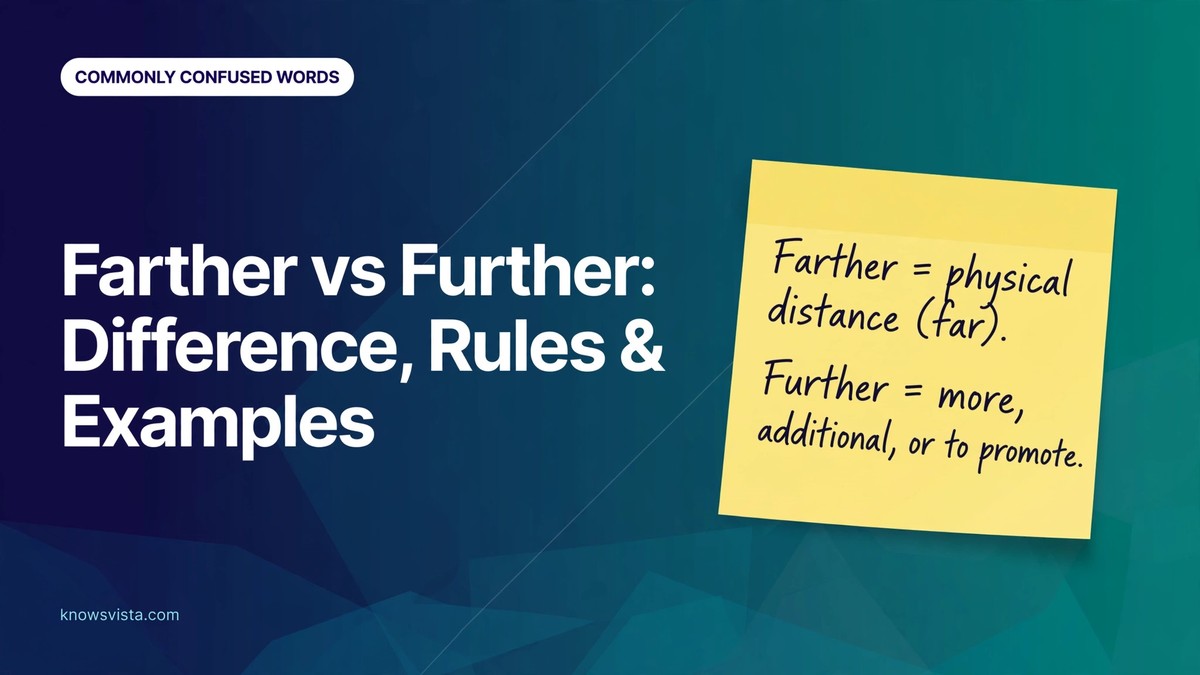
    Farther refers to physical distance you could measure: farther down the road. Further covers figurative distance, degree, and “additional”: further discussion, further delayed, further questions. Only further works as a verb meaning “to promote.”

    ๐Ÿง  Memory trick: Farther contains the word far, think of literal, measurable distance. If you cannot measure it in miles or meters, reach for further.

    When to use farther

    Use farther for literal, physical distance, how far something is in space. It works as both an adverb and an adjective, and the far hiding inside the word is your clue.

    • The beach is farther from our hotel than we expected.
    • She can throw a ball farther than anyone on the team.
    • We drove two miles farther before finding a gas station.
    • The farther cabin sits right on the lake.

    When to use further

    Use further for everything distance-related that is not physical: figurative extent, degree, additional amounts, and, uniquely, as a verb meaning “to advance or promote.”

    • Let’s discuss this further at tomorrow’s meeting.
    • Do you have any further questions before we finish?
    • The repairs were delayed further by the storm.
    • She took night classes to further her career.

    The tricky exceptions

    Both words work for physical distance

    Strictly speaking, the tidy rule above is a preference, not a law. Merriam-Webster’s usage guide notes that farther and further are used interchangeably for physical distance, we walked farther down the trail and we walked further down the trail are both acceptable. Most careful writers still choose farther for literal distance, and editors tend to prefer it, but you will not be wrong either way.

    • They hiked farther into the valley than planned.
    • They hiked further into the valley than planned. (also acceptable)

    Only further does the extra jobs

    The overlap runs in one direction only. Farther can step into further‘s territory for physical distance, but further never lends farther its special roles: the verb, the “additional” sense, and fixed phrases like until further notice and furthermore.

    • The charity event helped further the cause. (verb, farther impossible here)
    • There will be no further announcements today.

    Farther vs further at a glance

    FartherFurther
    UsuallyPhysical, measurable distanceFigurative distance, degree, “additional”
    MeaningAt or to a greater distance in spaceTo a greater extent; moreover; to promote
    ExampleThe store is farther away.We need further details.
    TrickContains far, think miles and metersThe versatile one: verb, adverb, adjective

    Quick practice

    Fill in the blank with farther or further:

    1. The library is __________ than the post office.
    2. Please send __________ details by Friday.
    3. He refused to discuss the matter __________.

    Answer key:

    • 1. farther (physical distance between buildings)
    • 2. further (“additional” details)
    • 3. further (figurative extent, not distance)

    Frequently Asked Questions

    Can farther and further be used interchangeably?

    For physical distance, yes, dictionaries accept both. Everywhere else, no: only further means “additional,” “to a greater degree,” or “to promote.” When in doubt, use further for anything non-physical.

    Is it “further information” or “farther information”?

    It is further information. Information is not a physical distance you can measure, so the “additional” sense of further applies.

    Is it “nothing could be farther from the truth”?

    The standard idiom uses further: “Nothing could be further from the truth.” The distance from the truth is figurative, not something you can measure in miles, so further is the right choice.

    Final thoughts

    Farther and further overlap just enough to keep writers guessing, but the rule of thumb holds: physical distance goes to farther, and everything abstract, degree, addition, promotion, belongs to further. Remember the far inside farther, and the choice becomes automatic. To double-check tricky pairs like this one in your own writing, run your draft through the free KnowsVista grammar checker.

  • Loose vs Lose: Meaning, Difference & Examples

    Loose vs Lose: Meaning, Difference & Examples

    Loose vs Lose: Meaning, Difference & Examples

    Loose and lose look almost identical on the page, which is exactly why they are mixed up so often. One extra letter o changes everything: one word describes something that is not tight, and the other is a verb about misplacing things or failing to win. Once you connect each spelling to its job in a sentence, the confusion disappears. You can explore more word-pair guides like this one on the KnowsVista homepage.

    โšก Quick answer

    Loose is mostly an adjective meaning “not tight” or “not firmly fixed”: a loose tooth, loose clothing. Lose is a verb meaning “to misplace” or “to fail to win”: lose your keys, lose the game.

    ๐Ÿง  Memory trick: Loose has an extra o, like the extra room inside baggy, loose clothing. If you can picture extra space, spell it with the extra letter.

    When to use loose

    Use loose when you are describing a noun, something wobbly, baggy, unfastened, or free from restraint. It answers the question “what kind?” about the thing it modifies.

    • One of the screws on the door handle is loose.
    • She prefers loose, comfortable sweaters in winter.
    • The dog slipped its collar and is running loose in the park.
    • They tied up the loose ends before launching the product.

    When to use lose

    Use lose when something is being misplaced, missed, given up, or defeated. It is an action word, the past forms are lost and losing, never loosed.

    • Don’t lose your ticket to the concert.
    • Our team can’t afford to lose this match.
    • He started exercising so he could lose some weight.
    • She tends to lose track of time when she reads.

    The tricky exceptions

    Loose can also be a verb

    Surprise: loose is not only an adjective. As a verb it means “to release or set free”, think of letting something go. This use is less common, but it shows up in literature and idioms, so it is worth knowing.

    • The archers loosed their arrows at dawn.
    • He loosed the knot, and the rope fell free.

    They do not even sound the same

    Reading the words aloud is the fastest fix. Loose rhymes with goose (a hissing s sound), while lose rhymes with choose (a buzzing z sound). Merriam-Webster’s usage notes confirm the split: lose is a verb, while loose spans adjective, verb, noun, and adverb. If your sentence needs the z sound, drop the extra o.

    • The loose /luหs/ floorboard creaked under his feet.
    • Did we lose /luหz/ the receipt for the repair?

    Loose vs lose at a glance

    LooseLose
    UsuallyAn adjective describing a nounA verb showing an action
    MeaningNot tight; not firmly fixed; freeTo misplace; to fail to win; to miss
    ExampleThe knot is loose.Don’t lose the knot instructions.
    TrickExtra o = extra room, like baggy clothesRhymes with choose; has the z sound

    Quick practice

    Fill in the blank with loose or lose:

    1. The button on my coat is __________.
    2. If you don’t hurry, you’ll __________ your seat.
    3. The horse broke __________ from the stable.

    Answer key:

    • 1. loose (describing the button, not firmly fixed)
    • 2. lose (the action of missing your seat)
    • 3. loose (describing the horse’s free state)

    Frequently Asked Questions

    What is the difference between loose and lose in one sentence?

    Try this: “A loose lid is easy to lose.” The first word describes the wobbly lid; the second is the verb for misplacing it.

    Is it “loose weight” or “lose weight”?

    It is lose weight. Shedding pounds is an action, so you need the verb lose. Writing loose weight is one of the most common mix-ups online.

    How do you pronounce loose vs lose?

    Loose is pronounced /luหs/, rhyming with goose. Lose is pronounced /luหz/, rhyming with choose. Saying them out loud makes the spelling choice obvious.

    Final thoughts

    The loose vs lose mix-up survives because the words look like twins but work completely different jobs. Keep the roles straight, loose describes, lose acts, and use the extra-o trick whenever you hesitate. Before you send an important email or publish a post, run it through the free KnowsVista grammar checker to catch this pair and other commonly confused words automatically.

  • Full Time or Full-Time: The Simple Grammar Rule

    Full Time or Full-Time: The Simple Grammar Rule

    Full Time or Full-Time: The Simple Grammar Rule

    Few hyphens cause as much second-guessing as the one in full-time. You will see it with the hyphen on job postings, without the hyphen on resumes, and sometimes smashed into one word as fulltime in a hurried email. The good news is that the rule behind it is genuinely simple, and once you learn it, you will never hesitate again. This guide breaks down exactly when to write full-time and when to write full time, with clear examples, the tricky exceptions, and a memory trick you can keep in your back pocket. If you enjoy sharpening your writing, you will also like the free resources at the KnowsVista homepage.

    โšก Quick answer

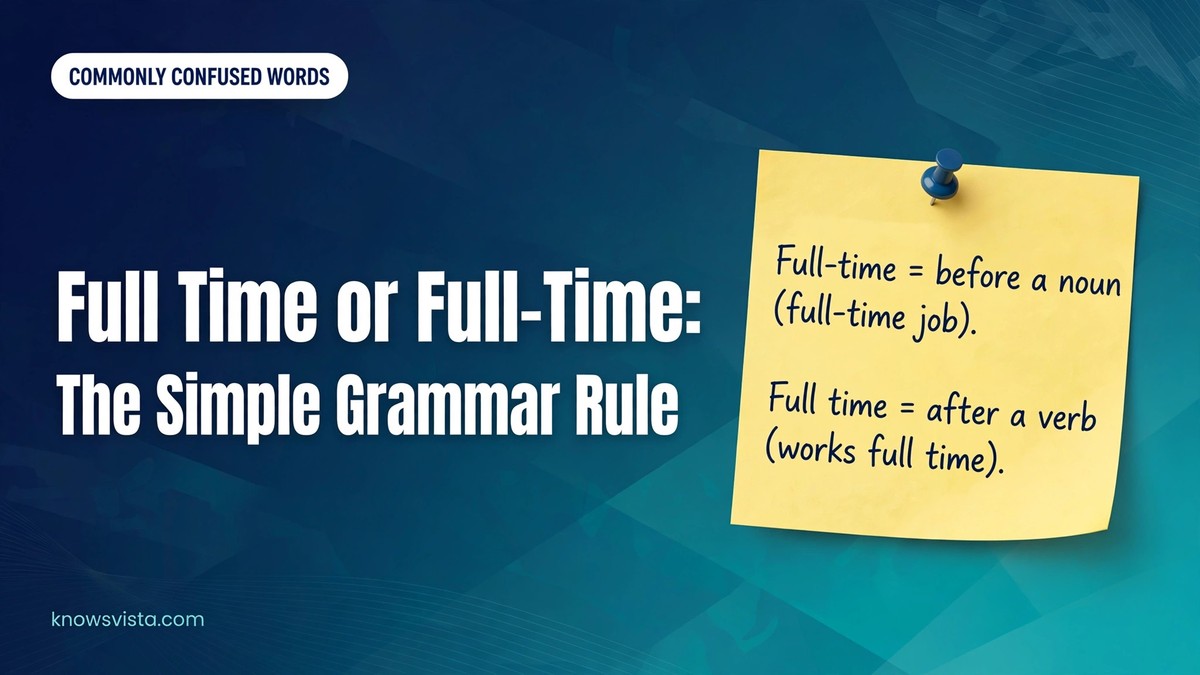
    Full-time (with a hyphen) is a compound adjective used directly before a noun: a full-time employee, full-time work. Full time (no hyphen) is a noun or adverb phrase used after a verb: She works full time, He switched to full time.

    ๐Ÿง  Memory trick: The hyphen acts like glue, sticking full and time together into one describing word that sits in front of a noun. No noun right after it? Drop the glue, write full time.

    When to use full-time

    Use the hyphenated form full-time when the two words team up as a single adjective placed immediately before the noun they describe. This is the classic compound-adjective rule: two words doing the job of one modifier get joined with a hyphen.

    • She landed a full-time role at the publishing house.
    • A full-time student takes a complete course load each semester.
    • The store hired two full-time cashiers for the holiday season.
    • His full-time salary includes health and retirement benefits.

    When to use full time

    Write full time as two open words when it functions as a noun phrase, usually after a verb like work, switch, or commit. Here the words are not describing a noun that follows them, so the hyphen has nothing to do.

    • She works full time at the publishing house.
    • After graduation, he switched from part time to full time.
    • The project needs someone who can commit full time.
    • Full time at this office means forty hours a week.

    The tricky exceptions

    “She works full-time”, the adverb exception

    Here is where it gets interesting. Major dictionaries, including Merriam-Webster’s entry for full-time, also list full-time as an adverb meaning “on a full-time basis.” Because of that, writing She works full-time is widely accepted, even though the phrase comes after the verb. You will see this hyphenated adverb form everywhere, especially in American job listings.

    • He writes full-time for a technology blog.
    • They volunteered full-time during the election season.

    Style guides do not fully agree

    Newsrooms following AP style tend to hyphenate full-time in every position, while the Chicago Manual of Style recommends the hyphen only before a noun. Neither is wrong, what matters is consistency within a single document. Pick the style your audience expects and stick with it from the first sentence to the last.

    • AP-style newsroom: “The mayor works full-time at city hall.”
    • Chicago-style manuscript: “The mayor works full time at city hall.”

    Full-time vs full time at a glance

    Full-timeFull time
    UsuallyBefore a noun, as a compound adjectiveAfter a verb, as a noun or adverb phrase
    MeaningOne glued-together describing wordTwo separate words naming a schedule
    Examplea full-time designerShe designs full time.
    TrickHyphen glues it into one adjectiveNo noun after it? No hyphen needed

    Quick practice

    Fill in the blank with full-time or full time:

    1. The company advertised a __________ marketing role.
    2. After the internship ended, she was hired __________.
    3. A __________ schedule leaves little room for weekend hobbies.

    Answer key:

    • 1. full-time (before the noun role)
    • 2. full time (after the verb hired)
    • 3. full-time (before the noun schedule)

    Frequently Asked Questions

    Is “fulltime” one word or two?

    Standard English does not use fulltime as a single closed word. Write it hyphenated (full-time) as an adjective before a noun, or open (full time) as a noun or adverb phrase. If your spellchecker flags fulltime, trust it.

    Do I write “full time employee” or “full-time employee”?

    Write full-time employee. Because the phrase comes directly before the noun employee and works as a single adjective, the hyphen is required.

    Is it “works full-time” or “works full time”?

    Both appear in real writing. Dictionaries list full-time as an adverb, so the hyphenated version is perfectly acceptable, while the Chicago Manual of Style prefers the open form after verbs. Choose one style and use it consistently.

    Final thoughts

    The full time vs full-time question boils down to one habit: check what follows the phrase. If a noun comes right after, glue the words together with a hyphen, full-time job. If the phrase stands alone after a verb, let the words breathe, works full time. Master that, and the same logic will handle part-time, well-known, and every other compound adjective you meet. For more hands-on help with tricky word pairs, try the free KnowsVista grammar checker before you hit publish.