Author: zoya khan

  • Brasil or Brazil: Which Spelling Is Correct?

    Brasil or Brazil: Which Spelling Is Correct?

    Brasil or Brazil: Which Spelling Is Correct?

    The country with the samba, the Amazon, and five World Cup stars seems to spell its own name two different ways. Football jerseys shout Brasil, while geography textbooks calmly print Brazil. Both are real, both are correct somewhere, but they are not interchangeable. This guide settles the Brasil vs Brazil question once and for all, with the rule, the exceptions, and examples you can copy. Find more plain-English spelling guides on the KnowsVista homepage.

    ⚡ Quick answer

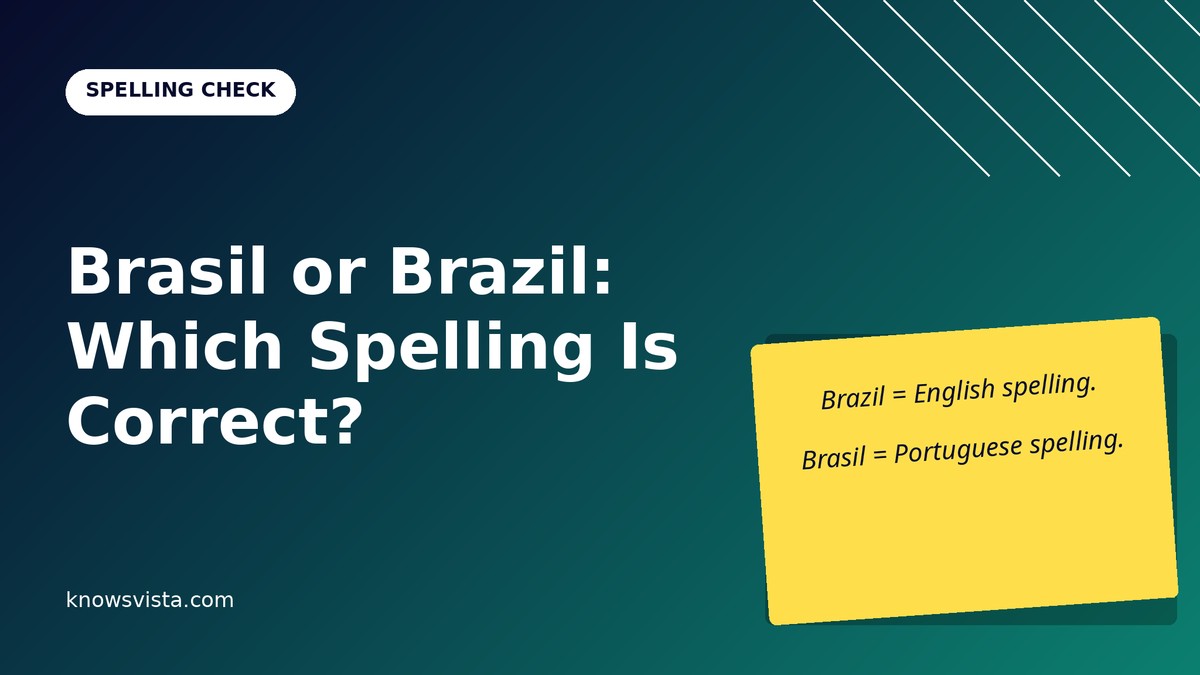
    In English, the country’s name is spelled Brazil (with a z): the beaches of Brazil. Brasil (with an s) is the Portuguese spelling, correct when writing in Portuguese or quoting a Portuguese name.

    🧠 Memory trick: Brazil with a z is for the English-speaking world; Brasil with an s belongs to South America, where they speak Portuguese.

    When to use Brazil

    Use Brazil in every piece of English writing, essays, news articles, emails, travel blogs, and conversation. It is the only spelling English-language dictionaries and style guides accept for the country.

    • Brazil is the largest country in South America.
    • She spent a month backpacking through Brazil.
    • Brazil has won the FIFA World Cup five times.
    • Our supplier ships coffee beans directly from Brazil.

    When to use Brasil

    Write Brasil when you are writing in Portuguese, quoting a Portuguese phrase, or reproducing an official Portuguese name exactly. You will also meet it on jerseys, chants, and logos aimed at Brazilian audiences.

    • Ele mora no Brasil. (Portuguese: He lives in Brazil.)
    • The stadium roared “Brasil! Brasil!” during the match.
    • Confederação Brasileira de Futebol, the Brasilian football federation.
    • The airline’s logo reads “Voar para o Brasil” on its Portuguese site.

    The tricky exceptions

    Proper names keep their original spelling

    When a Portuguese name appears inside English text, keep its Brasil spelling, translating a proper noun would be a mistake. Merriam-Webster’s entry for Brazil lists the country as a geographical name “Brazil” with the variant “Portuguese Brasil,” which confirms that Brasil is a language difference, not an English misspelling. So in English you write “the beaches of Brazil,” but you quote the Portuguese anthem’s line about Brasil as written.

    • English text: “Tourism to Brazil is booming.”
    • Portuguese quote: “Amado Brasil” in the anthem’s lyrics.

    Brasília and other look-alikes

    The capital city is spelled Brasília (with an s and an accent) in both English and Portuguese, do not “correct” it to Brazília. The same goes for the adjective form: English uses Brazilian (with a z), as in Brazilian music, while Portuguese uses brasileiro. And the country code you see at the Olympics is BRA, which comes from Brasil, but that does not change the English spelling.

    • The summit was held in Brasília, the capital.
    • He plays Brazilian jazz on Friday nights.

    Brasil vs Brazil at a glance

    BrasilBrazil
    UsuallyPortuguese writing and namesAll English writing
    MeaningThe country’s name in PortugueseThe country’s name in English
    ExampleSeleção do BrasilThe music of Brazil
    TrickS for South America, where they speak PortugueseZ is the English spelling, always

    Quick practice

    Fill in the blank with Brasil or Brazil:

    1. My cousin moved to __________ last year. (English sentence)
    2. Ela nasceu no __________. (Portuguese sentence)
    3. The report compared exports from __________ and Argentina. (English report)

    Answer key:

    • 1. Brazil (English sentence)
    • 2. Brasil (Portuguese sentence)
    • 3. Brazil (English report)

    Frequently Asked Questions

    Why do football fans write “Brasil” with an S?

    Because the national team’s own name is Portuguese: Seleção do Brasil. Fans chant the Portuguese spelling, and jerseys carry it. In English commentary, though, the country is still Brazil.

    Is it “Brazilian” or “Brasilian”?

    In English it is Brazilian with a z, Brazilian coffee, Brazilian Portuguese. Brasiliano exists only in Portuguese and Italian contexts.

    How do you spell the capital of Brazil?

    Brasília, with an s and an accent on the i. Both English and Portuguese use this spelling, so do not change it to a z.

    Final thoughts

    The Brasil or Brazil question is really a language question, not a spelling contest. English says Brazil with a z; Portuguese says Brasil with an s. Match your spelling to the language you are writing in, and you will never be wrong. If you struggle with look-alike pairs like this one, separate or seperate is another classic worth reviewing, and you can run any draft through the free KnowsVista grammar checker before you hit publish.
  • Cosy or Cozy: What’s the Correct Spelling?

    Cosy or Cozy: What’s the Correct Spelling?

    Cosy or Cozy: What’s the Correct Spelling?

    One letter, S or Z, and suddenly your perfectly good sentence looks “wrong” to half the planet. Cosy and cozy mean exactly the same thing: warm, comfortable, snug. The only difference is which side of the Atlantic your readers live on. This guide shows you which spelling belongs to which English, the related word forms, and the mistake to avoid when mixing them. Find more plain-English spelling guides on the KnowsVista homepage.

    ⚡ Quick answer

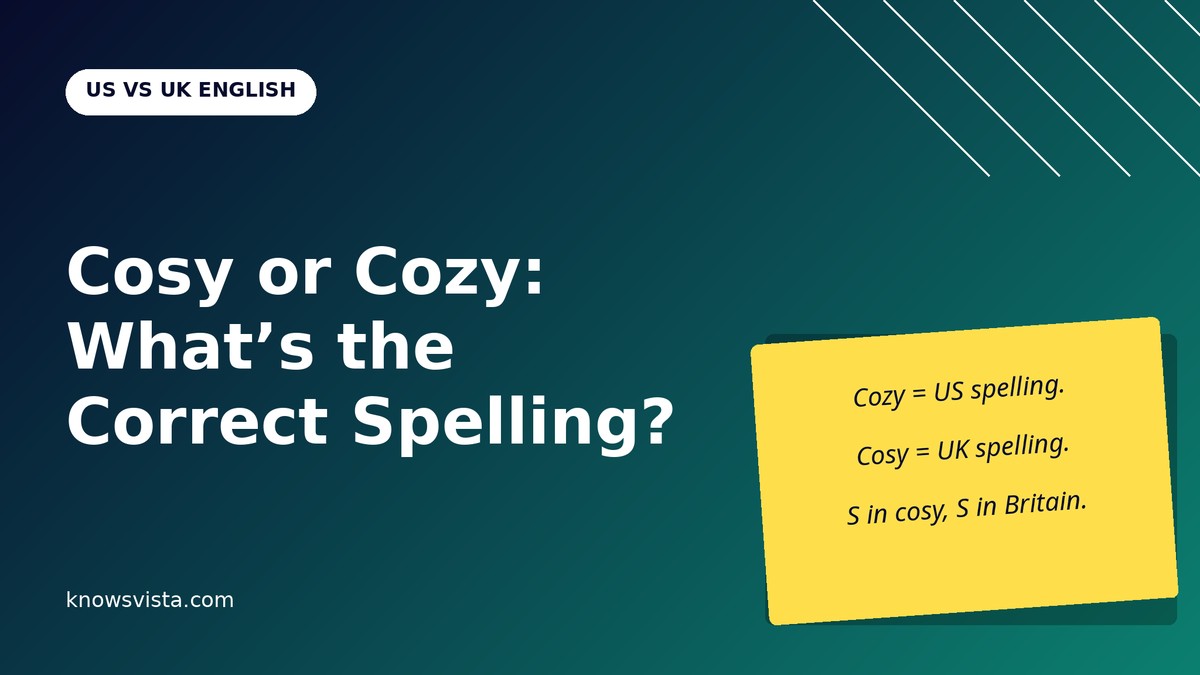
    Cozy (with a z) is the American English spelling: a cozy cabin. Cosy (with an s) is the British English spelling: a cosy cottage. Both are correct, just match your audience.

    🧠 Memory trick: Cosy with an S is the Standard in South-of-nowhere… no, simpler: cosy and British both contain S. If you are writing for Britain, use the S.

    When to use cozy

    Use cozy when you write for American readers, and for Canadian, Indian, and Philippine audiences too, which follow the American convention. This is the spelling American dictionaries and style guides list first.

    • We spent a cozy evening by the fireplace.
    • The cabin felt warm and cozy after the storm.
    • She wrapped the teapot in a cozy to keep it hot.
    • It was the coziest little bookstore I had ever visited.

    When to use cosy

    Use cosy when you write for British, Irish, or Australian readers, anywhere British spelling conventions rule. Swap in the S and keep it there for the whole document.

    • The pub had a cosy corner by the fire.
    • It was a cosy little flat above the bookshop.
    • She knitted a tea cosy for her grandmother.
    • This is much cosier than our last hotel.

    The tricky exceptions

    The family has to match

    The S-or-Z choice ripples through every related word, so do not mix them. Merriam-Webster’s entry for cozy traces the word back to a Scandinavian root and lists the American forms, cozier, coziest, coziness, cozily. The British side mirrors them with S: cosier, cosiest, cosiness, cosily. Pick your team in the first paragraph and keep every derivative on it.

    • US: cozy → cozier → coziest → coziness
    • UK: cosy → cosier → cosiest → cosiness

    Watch the look-alike misspellings

    Plenty of almost-right spellings are simply wrong in every dialect: cosey, cosie, cozie, and cozey. There are exactly two correct spellings, cozy and cosy, and everything else is an error your spellchecker will catch. Also note the noun sense: a tea cozy (US) or tea cosy (UK) is the padded cover that keeps a teapot warm.

    • ❌ cosey, cosie, cozie, misspellings everywhere
    • ✅ a cozy mystery novel (US) / a cosy mystery novel (UK)

    Cosy vs cozy at a glance

    CozyCosy
    UsuallyAmerican English (US, Canada, India)British English (UK, Ireland, Australia)
    MeaningWarm, comfortable, snugWarm, comfortable, snug
    Examplea cozy reading nooka cosy reading nook
    TrickZ for the American styleS in cosy, S in British

    Quick practice

    Fill in the blank with cozy or cosy:

    1. The New York blog described a __________ autumn afternoon. (US audience)
    2. The London magazine praised the __________ little café. (UK audience)
    3. It was the __________ blanket she had ever owned. (Australian audience)

    Answer key:

    • 1. cozy (American audience)
    • 2. cosy (British audience)
    • 3. cosiest (Australian English follows British spelling)

    Frequently Asked Questions

    Which spelling is more common, cosy or cozy?

    Globally, cozy leads because of the size of the American publishing and media market, but in British books, newspapers, and shops, cosy dominates completely. “More common” depends entirely on whose English you are reading.

    Can I mix cozy and cosy in one document?

    You should not. Mixing spellings looks careless to editors and confuses readers. Choose the spelling your audience expects and use it, plus its matching derivatives, from start to finish.

    Is it “cosiness” or “coziness”?

    Coziness is American, cosiness is British. Like the base word, the noun form follows the spelling tradition of the audience you are writing for.

    Final thoughts

    The cosy or cozy question is settled by geography, not grammar. Write cozy with a Z for American readers and cosy with an S for British readers, keep the whole word family on the same side, and both camps will think you spelled it perfectly. For another classic US-vs-UK spelling split, see ambience or ambiance, and run your draft through the free KnowsVista grammar checker before you hit publish.
  • Emcee or MC: Which Spelling Is Correct?

    Emcee or MC: Which Spelling Is Correct?

    Emcee or MC: Which Spelling Is Correct?

    Event programs say MC, wedding blogs say emcee, and hip-hop liner notes seem to use both. Are they different words, different spellings of the same word, or is one of them wrong? The answer is refreshingly friendly: both are correct, and choosing between them is about tone and grammar, not right and wrong. This guide explains exactly when to write MC and when to write emcee, with examples, the verb forms, and the tricky exceptions. Find more plain-English spelling guides on the KnowsVista homepage.

    ⚡ Quick answer

    MC is the abbreviation of “master of ceremonies”: our MC for the evening. Emcee is the phonetic spelling of those same letters, and the only form that works as a verb: she emceed the awards show.

    🧠 Memory trick: Say the letters M-C out loud. What you hear, “em-see”, is exactly how emcee is spelled. Letters become the noun; the sound becomes the verb.

    When to use MC

    Use MC as a noun for a person hosting an event or performing as a rapper. It reads a little more formal and compact, which is why it dominates programs, posters, and headlines. Write it in capitals with no periods.

    • Please welcome tonight’s MC, comedian Priya Shah.
    • The wedding MC kept the schedule running smoothly.
    • MC Lyte was one of hip-hop’s pioneering voices.
    • Our MC for the conference will introduce each speaker.

    When to use emcee

    Use emcee as a noun in running prose (it blends into sentences more naturally) and, crucially, as a verb meaning “to act as master of ceremonies.” The verb forms are emcees, emceed, and emceeing. There is no verb form of MC.

    • The local radio DJ acted as the emcee for the fundraiser.
    • She emceed three award ceremonies this year.
    • He has been emceeing open-mic nights since college.
    • An experienced emcee can rescue a dying event.

    The tricky exceptions

    Only emcee works as a verb

    This is the one hard rule. Merriam-Webster’s entry for emcee lists it as both noun and verb, with the verb meaning “to perform the role of a master of ceremonies”, and its etymology confirms it is simply the spoken form of MC, first recorded around 1930. So “she emceed the gala” is perfect, while “she MCed the gala” looks broken. If the sentence needs an action, emcee is your only option.

    • ✅ She emceed the charity auction.
    • ❌ She MC’d the charity auction. (awkward and nonstandard)

    Hip-hop, periods, and formality

    In hip-hop, MC (and emcee) also means a rapper or lyricist, as in “a skilled emcee.” Do not write M.C. with periods; that styling is dated. And while the two spellings are interchangeable as nouns, match your tone: MC suits programs and posters, emcee suits articles, invitations, and everyday prose.

    • Poster style: “MC: DJ Rafi”
    • Article style: “The evening’s emcee was DJ Rafi.”

    Emcee vs MC at a glance

    EmceeMC
    UsuallyProse, invitations, and all verb usesPrograms, posters, headlines, hip-hop
    MeaningPhonetic spelling of M-CAbbreviation of “master of ceremonies”
    ExampleShe emceed the awards.Our MC kept things moving.
    TrickSound it out, “em-see”Letters on a poster stay letters

    Quick practice

    Fill in the blank with emcee or MC:

    1. The __________ introduced each graduate by name. (event program)
    2. He __________ the company’s annual dinner last December. (verb)
    3. As the evening’s __________, she kept the energy high. (article sentence)

    Answer key:

    • 1. MC (compact, formal, poster style)
    • 2. emceed (verb, only emcee works)
    • 3. emcee (natural in prose)

    Frequently Asked Questions

    What does MC stand for?

    MC stands for “master of ceremonies”, the person who hosts an event and introduces the participants. In hip-hop it also means a rapper or lyricist.

    Can I use MC as a verb?

    No. Only emcee works as a verb: emcees, emceed, emceeing. Writing “he MCed the show” is nonstandard, use “he emceed the show.”

    Should I write “M.C.” with periods?

    No. Modern style writes MC with no periods. The dotted form M.C. is dated and will look old-fashioned to readers.

    Final thoughts

    The emcee or MC question is a choice, not a contest. MC is the crisp abbreviation for programs and posters; emcee is the natural spelling for prose and the only one that becomes a verb. Say the letters aloud, and the spelling writes itself. If you like untangling words that sound like their spelling, putting or puting is another good one, and you can run any draft through the free KnowsVista grammar checker before you hit publish.
  • Diddo or Ditto: Which Spelling Is Correct?

    Diddo or Ditto: Which Spelling Is Correct?

    Diddo or Ditto: Which Spelling Is Correct?

    One sneaky letter turns a real word into a fake one. Ditto has been in English dictionaries since the 1600s, yet it is still misspelled as diddo in texts, comments, and even work emails. The good news: this is a true-or-false question, and the answer is easy to lock in forever. This guide shows you the correct spelling, how to use the word properly, and the one memory trick that ends the confusion. Find more plain-English spelling guides on the KnowsVista homepage.

    ⚡ Quick answer

    Ditto is the only correct spelling: a noun, verb, and adverb meaning “the same” or “as said before.” Diddo is a misspelling, it does not exist in any standard dictionary.

    🧠 Memory trick: Ditto comes from the Italian detto, meaning “said”, both have a T-T in the middle. The D you hear belongs to the start of the word, never to the middle. T-T wins.

    When to use ditto

    Use ditto whenever you mean “the same as above”, agreeing with someone, avoiding repetition, or copying a statement. It works as a noun (the word or mark), a verb (to repeat), and an adverb (meaning “likewise”).

    • “I can’t wait for the weekend.”, “Ditto!”
    • The prices were high last month, and this month is ditto.
    • She simply dittoed his entire presentation.
    • Place ditto marks (“) under any repeated entry.

    When to never use diddo

    Never use diddo in standard English. It is simply a misspelling born from how the word sounds when spoken quickly. You may see diddo in casual texts or memes, but your spellchecker, your teacher, and your boss will all mark it wrong.

    • ❌ “I love pizza.”, “Diddo.” (misspelled)
    • ✅ “I love pizza.”, “Ditto.” (correct)
    • ❌ He diddoed the same excuse. (misspelled)
    • ✅ He dittoed the same excuse. (correct)

    The tricky exceptions

    Ditto is three parts of speech, not one

    Ditto is more flexible than most people realize. Merriam-Webster’s entry for ditto lists it as an adverb (“ditto the defensive line”), a verb (“she dittoed his comments”), and an adjective (“ditto merchandise”). The plural is dittos, and the verb forms are dittoed and dittoing. Every form keeps the T-T spelling, no form of the word ever uses a D in the middle.

    • Adverb: “The committee agreed, ditto the board.”
    • Verb: “The article was dittoed across dozens of blogs.”

    The “Ghost” line everyone quotes

    The most famous use of the word comes from the 1990 film Ghost, where Sam replies “Ditto” when Molly says “I love you”, his shy way of saying the same back. The line is spelled D-I-T-T-O in every official transcript. If movie quotes, pop culture, and 400 years of dictionary history all agree, diddo never stood a chance.

    • Sam: “I love you.” Molly waits. Sam: “Ditto.”
    • Office chat: “Great work, everyone.”, “Ditto from me.”

    Diddo vs ditto at a glance

    DittoDiddo
    UsuallyThe only standard spellingA common misspelling
    Meaning“The same,” “as said before”Nothing, not a word
    Example“I agree.”, “Ditto.”❌ “Diddo!” (wrong)
    TrickT-T in the middle, like Italian dettoThere is no D in the middle

    Quick practice

    Fill in the blank with ditto or diddo:

    1. “I’m exhausted after that hike.”, “________.”
    2. The correct spelling of the word meaning “the same” is ________.
    3. He ________ her order at the restaurant.

    Answer key:

    • 1. ditto (agreement, “me too”)
    • 2. ditto (the dictionary spelling)
    • 3. dittoed (past tense of the verb ditto)

    Frequently Asked Questions

    Is “diddo” ever correct?

    No. Diddo is a misspelling of ditto and appears in no standard dictionary. It shows up in casual texting and memes, but it is never acceptable in writing that matters.

    Is it rude to say “ditto” instead of “I love you”?

    It can feel a little curt, that is the joke in Ghost, after all. In friendly contexts like “Great job!”, “Ditto!”, it is perfectly fine. Save the full sentence for moments that deserve it.

    What is the plural of ditto?

    The plural is dittos: a page full of dittos. The verb forms are dittoed and dittoing, every form keeps the T-T.

    Final thoughts

    The diddo or ditto question is the simplest kind: one real word, one fake one. Ditto with the double T is the dictionary spelling for the noun, the verb, and the agreement, and it has been for about four hundred years. Let the double T remind you of the Italian detto (“said”), and you will never type diddo again. For another spelling question that trips people up by sound alone, see to late or too late, and run your draft through the free KnowsVista grammar checker before you hit publish.
  • Headcount or Head Count: Which Spelling Is Correct?

    Headcount or Head Count: Which Spelling Is Correct?

    Headcount or Head Count: Which Spelling Is Correct?

    Every office memo seems to spell it differently. You will see headcount as one word in an HR report, head count as two words in a news article, and sometimes even a panicked head-count with a hyphen thrown in for good measure. The truth is calmer than the confusion: both spellings are correct, but they are not perfectly interchangeable. This guide shows you exactly when to close the gap and when to leave a space, with clear examples, the tricky exceptions, and a memory trick you will keep. Find more plain-English spelling guides on the KnowsVista homepage.

    ⚡ Quick answer

    Headcount (one word) is the standard closed spelling, especially in business and HR writing: a company headcount of 200. Head count (two words) is also correct and feels natural when you mean the act of counting: do a head count. When in doubt, use the one-word form.

    🧠 Memory trick: A headcount is one single number, so squash the word into one single unit, headcount. Two words stay two words only when you are literally counting heads, one by one.

    When to use headcount

    Write headcount as one closed word when you mean the total number of people in an organization or at an event, a figure, a metric, a statistic. This is the spelling dictionaries list first and the one business writing prefers.

    • The startup doubled its headcount in eighteen months.
    • Management froze the department headcount until next quarter.
    • The final headcount at the conference was 340 attendees.
    • Reducing headcount was the last option on the table.

    When to use head count

    Write head count as two open words when you are describing the action of counting, the verb-like event of going through the group one person at a time. It usually follows verbs like do, take, or conduct.

    • The teacher did a head count before leaving the museum.
    • Security conducted a head count at every entrance.
    • They took a quick head count to see if anyone was missing.
    • After the fire drill, the head count came up short by two.

    The tricky exceptions

    Dictionaries list it open, usage prefers it closed

    Here is the quirk that causes the confusion. Merriam-Webster’s entry for headcount uses the open form as its headword but defines it with the closed form woven through its examples, proof that both spellings live happily side by side. American business writing has steadily closed the gap over the past few decades, so headcount now reads as the default in HR and corporate contexts. Matching your audience’s habit matters more than picking a winner.

    • Corporate memo: “Our headcount grew by 12 percent.” (standard)
    • News report: “The head count at the rally reached 5,000.” (also fine)

    Plurals and the hyphenated trap

    Both spellings take a regular plural: headcounts and head counts. Do not invent a hyphenated version, head-count is not standard English. Also note that headcount as a verb (“we will headcount the staff”) exists but sounds awkward; prefer “do a headcount” or “count heads.”

    • The headcounts from both shifts matched perfectly.
    • Daily head counts help the kitchen plan portions.

    Headcount vs head count at a glance

    HeadcountHead count
    UsuallyOne closed word, a figure or metricTwo open words, the act of counting
    MeaningThe total number of peopleCounting heads one by one
    ExampleThe headcount is 250.Do a head count first.
    TrickOne number, one wordAn action needs breathing room

    Quick practice

    Fill in the blank with headcount or head count:

    1. The HR team reported a __________ of 1,200 employees.
    2. Before the bus left, the guide did a __________.
    3. Budget cuts forced the company to reduce its __________.

    Answer key:

    • 1. headcount (a total number, business context)
    • 2. head count (the act of counting, after “did”)
    • 3. headcount (a metric, business context)

    Frequently Asked Questions

    Is “headcount” one word or two?

    Both forms exist, but headcount (one word) is the standard spelling, especially in business and HR writing. Head count (two words) is also correct, typically for the act of counting. The hyphenated head-count is not standard.

    Is “head count” wrong?

    No. Head count as two words is perfectly correct, and dictionaries list it. It simply reads a little more old-fashioned than headcount in corporate writing. No editor will flag it.

    What is the plural of headcount?

    The plural is headcounts for the closed form and head counts for the open form. Use whichever matches the spelling you chose in the sentence.

    Final thoughts

    The headcount or head count question has no villain, both spellings are correct, and the difference is style, not error. Default to the closed headcount in business writing, and reach for the open head count when you picture someone counting heads one by one. Pick one spelling per document and stay consistent. For more lessons on words that change shape like this one, see totaling or totalling, and run your draft through the free KnowsVista grammar checker before you hit publish.

  • Totaling or Totalling: Which Spelling Is Correct?

    Totaling or Totalling: Which Spelling Is Correct?

    Totaling or Totalling: Which Spelling Is Correct?

    The totaling or totalling split is pure geography: one L for American English, two for British English. Both spell the same word, the present participle of total, meaning to add up. The difference comes from the consonant-doubling rule and which side of the Atlantic applies it to the letter L. This guide gives you the rule, the stress test, and a memory trick, so your spelling always matches your audience. For another doubling-rule puzzle, see our putting vs puting guide.

    ⚡ Quick answer

    Totaling (one L) is the American spelling; totalling (two L’s) is the British spelling. Both mean “adding up.” Because total is stressed on the first syllable (TO-tal), American English keeps the single L while British English doubles it.

    🧠 Memory trick: American English sheds extra letters, think color vs colour. So in America it’s the shorter totaling; in Britain it’s the bigger totalling.

    Totaling: the American spelling

    In US English, total (stressed on the first syllable: TO-tal) does not double its L before -ing. Merriam-Webster lists totaling as the standard American participle, the same pattern as traveling, labeling, and canceling. The rule: double the final consonant only when the stress falls on the last syllable.

    The damages are totaling more than $10,000.

    She is totaling the receipts from the trip.

    Our losses kept totaling up through December.

    He spent the evening totaling scores for the league.

    The committee is totaling the votes now.

    Monthly sales are totaling above target.

    Totalling: the British spelling

    In UK English, verbs ending in a single vowel + L double the L before a vowel suffix: total → totalling, travel → travelling, label → labelling. British spelling doubles the L regardless of stress, it’s the convention for this letter specifically. The Oxford English Dictionary recognizes totalling as the standard British form.

    She is totalling the expenses for the trip.

    The charity event is totalling over £10,000 in donations.

    He was totalling the points while we played.

    The bill is totalling £85 so far.

    They are totalling donations at the door.

    We spent the afternoon totalling receipts.

    ✗ Avoid: “The report is totaling £5,000″ in a London newspaper. (wrong L-count for the audience)
    ✓ Right: “The report is totalling £5,000.”

    The tricky exceptions

    The past tense doubles (or doesn’t) too

    The same split hits the -ed form: American totaled, British totalled. Keep your whole document consistent, mixing “totalling” with “totaled” looks sloppy to careful readers. The spelling breakdown at ThoughtGenic’s totalling vs totaling guide shows the full -ing and -ed tables for both variants.

    She totaled the columns in seconds. (US)

    He totalled the columns in seconds. (UK)

    Stress on the last syllable doubles everywhere

    When a two-syllable verb is stressed on the last syllable, both variants double: begin → beginning, compel → compelled, prefer → preferred. The US/UK split only appears when the stress sits on the first syllable (TO-tal, TRA-vel). That’s the real rule behind the difference, say the word aloud and listen for the stress.

    The meeting is beginning at noon. (double in US and UK)

    She preferred the earlier flight. (double in US and UK)

    Totaling or totalling at a glance

    TotalingTotalling
    Correct?Yes, in American EnglishYes, in British English
    The ruleStress on first syllable → no doublingFinal L always doubles before -ing
    Past tensetotaledtotalled
    Same patterntraveling, labeling, cancelingtravelling, labelling, cancelling
    ExampleCosts are totaling $50,000.Costs are totalling £50,000.
    TrickAmerica sheds lettersBritain keeps the double L

    Quick practice

    Choose the right form:

    1. US report: The costs are __________ $50,000.
    2. UK email: She is __________ the receipts.
    3. Total is stressed on the first syllable, so American English keeps __________ L.
    4. British past tense: He __________ the bill.

    Answer key:

    • 1. totaling (American audience = single L)
    • 2. totalling (British audience = double L)
    • 3. one (first-syllable stress → no doubling in US English)
    • 4. totalled (the -ed form follows the same US/UK split)

    Frequently Asked Questions

    Which is correct: “totaling” or “totalling”?

    Both, it depends on your audience. Use totaling for American readers and totalling for British readers. Neither is a typo; they’re regional conventions for the same word.

    Is “totalling” a typo in American English?

    It will read as British. In a US document, stick with totaling for consistency, a proofreader may flag totalling as an error. Match your L’s to your audience.

    What about “traveled” vs “travelled”?

    The same rule applies: traveled is American, travelled is British. Any verb with first-syllable stress ending in vowel + L follows the pattern, cancel/canceled/cancelled, label/labeled/labelled.

    Does Canada use “totalling” or “totaling”?

    Canada generally follows British practice, totalling. Australian and New Zealand English do the same. When writing for those audiences, double the L.

    What are “totaled” and “totalled”?

    The past-tense pair, with the same US/UK split: American totaled, British totalled. This doubling pattern also decides our putting vs puting guide, put doubles everywhere because it’s a one-syllable verb.

    Why does British English double the L?

    Convention, mostly, British spelling traditionally doubles the final consonant before vowel suffixes to preserve the short vowel. Noah Webster’s American reforms deliberately dropped “unnecessary” letters, giving the US its simpler forms.

    Final thoughts

    The totaling or totalling question is geography, not grammar: totaling for American readers, totalling for British readers, decided by the consonant-doubling rule. Say the word, stress on the first syllable means the US keeps one L. Keep the whole document consistent and your spelling will always look professional. Keep practicing variant spellings, try our ambience or ambiance guide or our putting vs puting guide, and test yourself on the spelling quiz and the free grammar checker.

  • Lite or Light: Which Spelling Is Correct?

    Lite or Light: Which Spelling Is Correct?

    Lite or Light: Which Spelling Is Correct?

    The lite or light question is really a question about tone. Light is the standard English word, bright, not heavy, gentle, and it is correct everywhere. Lite is its informal, commercial cousin, used for reduced-calorie foods, simpler product versions, and brand names. Use the wrong one in the wrong place and a formal essay suddenly sounds like a soda commercial. This guide maps the boundary, with the brand-name rule and a memory trick. For another spelling that shifts with register, see our ambience or ambiance guide.

    ⚡ Quick answer

    Light is the standard spelling for every meaning, weight, brightness, gentleness: “a light bag,” “morning light.” Lite is the informal variant used in marketing for reduced or simplified versions: “lite yogurt,” “a lite app.” In formal writing, always use light.

    🧠 Memory trick: Lite is a lighter spelling for lighter products. If the thing isn’t a diet food, a slimmed-down app, or a brand name, spell it light.

    Light: the standard word

    Use light as a noun (brightness), a verb (to ignite), an adjective (not heavy; gentle), and an adverb. It is always safe, no dictionary flags it, no teacher circles it, and no editor changes it. When you are unsure, light is the answer.

    The suitcase is light enough to carry upstairs.

    Morning light filled the kitchen.

    She prefers light meals in the summer.

    Please light the candles before dinner.

    The room needs more light for reading.

    They had a light conversation over coffee.

    This jacket is light but surprisingly warm.

    Lite: the informal, commercial variant

    Use lite for low-calorie or low-fat foods, simplified versions of products and apps, and official brand names. It took off in the 1960s with the diet-food boom, when companies wanted a spelling that looked lighter. Keep it out of essays, reports, and formal emails, there it reads as a mistake.

    She bought lite yogurt with half the fat.

    The lite version of the app skips the premium tools.

    He ordered a Miller Lite at the game.

    This lite salad dressing tastes just as good.

    Try our new lite plan, fewer features, lower price.

    The airline now sells a lite fare with no checked bag.

    Lite mayonnaise has a third fewer calories.

    ✗ Avoid: “This room needs more lite.” (brightness is never spelled lite)
    ✓ Right: “This room needs more light.”

    The tricky exceptions

    The -lite suffix: “diet-lite,” “Palin-lite”

    Writers attach -lite to names and ideas to mean “a watered-down version”: “a Palin-lite candidate,” “horror-lite.” It’s slangy and metaphorical, fine in opinion columns and casual writing, wrong in a formal essay. The usage breakdown at Grammarist’s lite vs light page gives more examples of this suffix use.

    The show is basically drama-lite for tired weeknights.

    He called the policy “reform-lite.”

    Brand names lock the spelling in

    Some products are officially Lite: Miller Lite, Lite-Brite. Always copy the brand’s own spelling, “Bud Light” keeps the GH while “Miller Lite” drops it. The brand decides, not the dictionary, so never “correct” a trademark.

    Miller Lite launched in the 1970s as a low-calorie beer.

    She played with Lite-Brite as a kid.

    Lite or light at a glance

    LightLite
    Correct?Yes, the standard spellingYes, but only informal or commercial
    MeaningBright; not heavy; gentleReduced: fewer calories, fat, or features
    RegisterFormal and informal, always safeMarketing, branding, casual use
    Brand names“Bud Light”, copy the brand“Miller Lite”, copy the brand
    ExampleA light jacket for spring.The lite app saves storage.
    TrickWhen unsure, choose lightLite spelling for lite products

    Quick practice

    Choose the right form:

    1. The bag is too heavy, I need a __________ one.
    2. This __________ cheese has 30% less fat.
    3. __________ the candles before the guests arrive.
    4. Download the __________ app to save storage space.

    Answer key:

    • 1. light (weight = the standard word)
    • 2. lite (reduced-fat product = the marketing spelling)
    • 3. Light (igniting candles = the verb light)
    • 4. lite (a simplified version = the informal variant)

    Frequently Asked Questions

    Is “lite” a real word?

    Yes, but an informal one. Lite is an established commercial variant of light, mainly for reduced-calorie foods and simplified product versions. Dictionaries list it, with a note that it’s informal.

    Can I use “lite” in an essay?

    No. In academic and formal writing, always use light. “Lite” in an essay reads as a spelling error, unless you are quoting a brand name like Miller Lite.

    Why do companies spell it “lite”?

    Because it looks modern and literally lighter, dropping the GH signals “less.” The catchy spelling attracts health-conscious shoppers and tech users who want the simpler version.

    Is it “light beer” or “lite beer”?

    Both exist, the brand decides. It’s “Bud Light” but “Miller Lite.” Copy the label exactly. For more spelling pairs that depend on context, see our full time or full-time guide.

    Does “lite” ever mean “not heavy”?

    Only informally, as in “lite luggage.” In standard English the word for “not heavy” is light, keep lite for products and brand names.

    What does the “-lite” suffix mean?

    Attached to a name or idea, -lite means “a lesser or watered-down version”: “horror-lite,” “reform-lite.” It’s journalistic slang, colorful, but not formal.

    Final thoughts

    The lite or light question is really about register: light is the standard word for brightness, weight, and gentleness, and it is never wrong. Lite is the marketing spelling, diet foods, simplified apps, brand names, and the slangy -lite suffix. Remember that the lite spelling fits lite products, and the boundary will hold. Keep practicing variant spellings, try our ambience or ambiance guide or our full time or full-time guide, and test yourself on the spelling quiz and the free grammar checker.

  • Add vs Ad: Which Spelling Is Correct?

    Add vs Ad: Which Spelling Is Correct?

    Add vs Ad: Which Spelling Is Correct?

    The add vs ad mix-up is a single-letter trap with completely different meanings. Add is a verb, to combine, join, or increase. Ad is a noun, a shortened form of advertisement. They sound identical, which is why spellcheckers and fast typists keep swapping them. This guide gives you the part-of-speech test, the one-sentence trick that uses both words, and a memory aid so the extra D never lands in the wrong place. For another doubling trap that fools writers, see our putting vs puting guide.

    ⚡ Quick answer

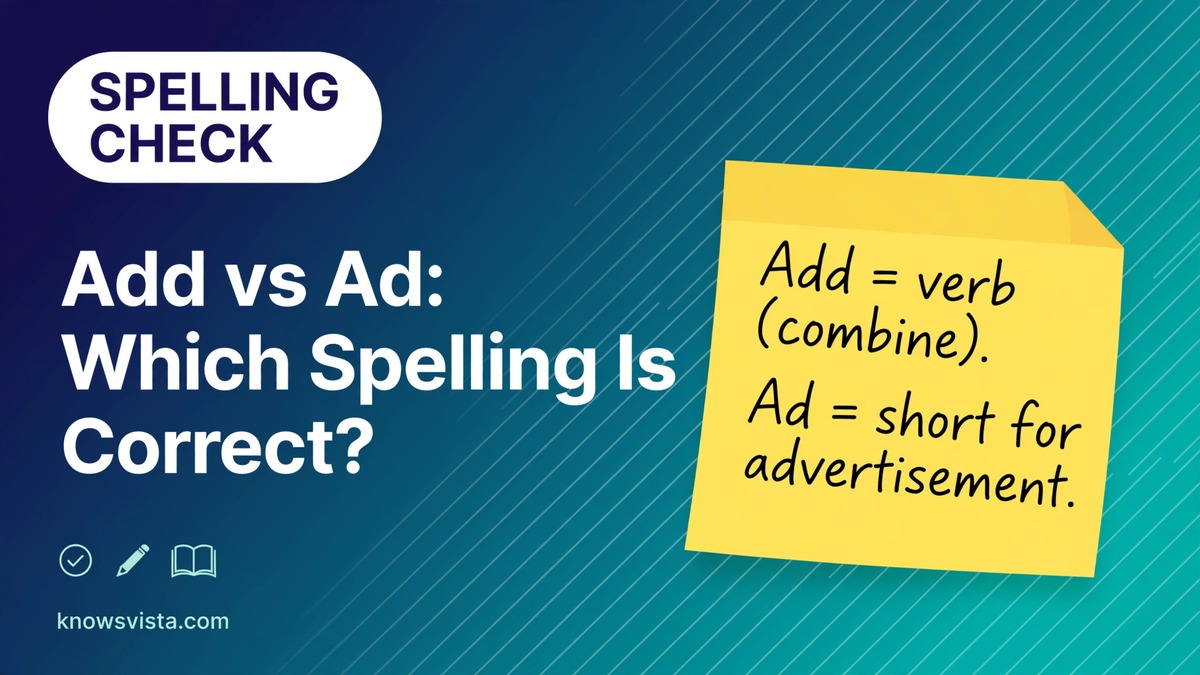
    Add (verb, two D’s) = to combine or increase: “Add two numbers.” Ad (noun, one D) = an advertisement: “a TV ad.” One sentence uses both correctly: “Add a photo to the ad.”

    🧠 Memory trick: Add gets an extra D because you’re adding more. Ad is the short form of advertisement, so it takes the short spelling.

    Add: the verb that combines

    Use add for any action of joining, increasing, or including: numbers, names, comments, ingredients, people. It conjugates as add / adds / added / adding, always with two D’s. If your sentence describes something being done, you need add.

    Please add more sugar to my coffee.

    Can you add my name to the guest list?

    Let’s add up the grocery bill.

    Add a comment before you send the draft.

    She added three new photos to the album.

    The chef added a pinch of salt at the end.

    Would you like to add anything to the discussion?

    Ad: the noun that advertises

    Use ad only for a promotional message, TV ads, online ads, newspaper ads, podcast ads. It is the standard shortened form of advertisement, acceptable in all but the most formal writing. Because it starts with a vowel sound, it takes “an”: “an ad,” never “a ad.”

    The ad played three times during the game.

    She clicked the ad for the new phone.

    They launched a clever ad campaign in March.

    The newspaper ad listed the job opening.

    I keep seeing ads for that airline.

    He works at an ad agency downtown.

    This episode is brought to you by our sponsors, ad break over.

    ✗ Avoid: “I saw an add for the concert.” (a thing can’t be a verb)
    ✓ Right: “I saw an ad for the concert.”

    The tricky exceptions

    “Ad” as a describing word: ad campaign, ad blocker

    An ad can sit in front of another noun as an attributive noun: “ad campaign,” “ad revenue,” “ad blocker,” “ad spend.” It still means advertisement, its position doesn’t turn it into a verb. Never write “add campaign.” The usage guide at writingtips.org’s ad vs add page lists more of these fixed phrases.

    The ad blocker hid every banner on the page.

    Their ad spend doubled this quarter.

    Uppercase AD is a different word entirely

    Capital AD usually means Anno Domini (“in the year of the Lord”) in dates: “AD 1066.” It can also abbreviate other terms, like assistant director or active duty. If the letters are capitalized, read it as an abbreviation, it has nothing to do with advertisements.

    The manuscript dates to AD 900.

    The assistant director (AD) called for quiet on set.

    Add vs ad at a glance

    AddAd
    Correct?Yes, the verbYes, the noun
    Part of speechVerb (adds, added, adding)Noun (plural: ads)
    MeaningTo combine, join, or increaseShort for advertisement
    SpellingTwo D’s (a-d-d)One D (a-d)
    ExampleAdd your name to the list.Skip the ad to start the video.
    TrickExtra D for extra actionShort word for a short form

    Quick practice

    Choose the right form:

    1. Please __________ your signature to the form.
    2. I skipped the __________ before the video started.
    3. __________ the total before you pay the cashier.
    4. Can you __________ a caption to the __________?

    Answer key:

    • 1. add (an action is being performed)
    • 2. ad (a promotional message before a video)
    • 3. Add (combining numbers = the verb)
    • 4. add, ad (“Add a caption” = action; “the ad” = the advertisement)

    Frequently Asked Questions

    Is “ad” short for advertisement?

    Yes. Ad is the accepted short form of advertisement (and sometimes advertising), meaning a public message that promotes something. It is standard in everyday and business writing.

    Is it “add to cart” or “ad to cart”?

    Add to cart, it’s an action, so it needs the verb. The same test works everywhere: if you can replace it with “include” or “combine,” spell it add.

    Why do people mix up “add” and “ad”?

    Both are pronounced /æd/, so ears can’t tell them apart, only context and spelling can. Fast typing and autocorrect finish the job. The part-of-speech test (verb vs noun) resolves every case.

    Can “ad” be plural?

    Yes, ads: “TV ads,” “online ads.” The plural is a quick proof of the noun: verbs don’t take an -s plural, but ad does, because it’s a thing, not an action.

    Is “ad” acceptable in formal writing?

    Mostly yes, ad is widely accepted, though academic writing prefers the full advertisement. When in doubt, write the full word. For another pair where formality changes the spelling, see our nevermind or never mind guide.

    What does “ad hoc” mean?

    Ad hoc is a Latin phrase meaning “for this purpose”, as in “an ad hoc committee” formed for one specific task. Note the single D: it uses the Latin ad (meaning “to”), not the verb add.

    Final thoughts

    The add vs ad question is really a grammar test in disguise: add is the verb that combines, and ad is the noun that advertises. Two D’s for action, one D for promotion, and both can live in one sentence. Keep practicing spelling traps, try our putting vs puting guide or our nevermind or never mind guide, and test yourself on the spelling quiz and the free grammar checker.

  • Motif vs Theme: What’s the Difference?

    Motif vs Theme: What’s the Difference?

    Motif vs Theme: What’s the Difference?

    The motif vs theme mix-up troubles literature students and book-club regulars alike, because both words gesture at “what the story is about.” They are not interchangeable. A motif is a concrete, repeating element, an image, object, or phrase that keeps showing up. A theme is the abstract message those repetitions build toward. This guide untangles the pair with famous examples, the symbol-overlap trap, and a memory trick. For another pair that asks you to compare two ideas, see our former vs latter guide.

    ⚡ Quick answer

    Motif = the recurring thing: the green light in The Great Gatsby, the blood in Macbeth. Theme = the message: the hollowness of the American Dream, the inescapability of guilt. Point at the repeating detail to find the motif; ask what the story claims about life to find the theme.

    🧠 Memory trick: A motif is the thread; the theme is the tapestry. You can point at one thread (motif), but you step back to take in the whole picture (theme).

    Motif: the repeating detail

    A motif is a concrete element, an image, sound, object, situation, or phrase, that recurs through a work and gathers meaning with each appearance. Grammarly’s literary-device guide puts it neatly: a motif is an element that points toward the theme. The motif does the pointing; the theme is what it points at. Famous motifs are everywhere once you start looking.

    The green light at the end of Daisy’s dock, glimpsed again and again across the bay.

    “So it goes”, Kurt Vonnegut’s flat refrain after every death in Slaughterhouse-Five.

    Blood that will not wash off in Macbeth: “Out, damned spot!”

    Oranges appearing beside doomed characters in The Godfather.

    Yellow butterflies trailing the Buendía family in One Hundred Years of Solitude.

    Mirrors and glass in Jane Eyre, echoing identity and self-scrutiny.

    Theme: the big idea

    A theme is the abstract, central insight a work offers, what it claims about love, power, death, or freedom. Themes are stated as full ideas, not single words: “Ambition destroys the ambitious” is a theme; “ambition” alone is just a topic. You infer a theme from the whole story; you cannot underline it the way you underline a motif.

    Macbeth: unchecked ambition corrupts everything it touches.

    The Great Gatsby: the American Dream is a beautiful, unreachable illusion.

    Romeo and Juliet: passion cannot outrun fate.

    1984: total power rewrites truth itself.

    To Kill a Mockingbird: moral courage means standing alone.

    Frankenstein: creation without responsibility turns monstrous.

    ✗ Avoid: “The theme of Gatsby is the green light.” (a light is a thing, not an idea)
    ✓ Right: “The green light is a motif that builds the theme of the unreachable American Dream.”

    The tricky exceptions

    One element can be both a symbol and a motif

    The green light is a symbol (it stands for Gatsby’s hopes) and a motif (it keeps reappearing). A symbol becomes a motif the moment it recurs, the labels overlap instead of competing. The breakdown at Grammarly’s motif guide walks through this overlap with book and film examples.

    The green light’s first appearance, a symbol of longing.

    The green light’s return at the novel’s close, now a full motif.

    In music, the words blur together

    Composers call a recurring melody a “theme”, think of the two-note Jaws figure, which musicians happily call a theme. In opera this is the leitmotif: a short musical idea attached to a character or idea. In a literature essay, though, keep the book meanings: the repeating technique is the motif, and the big message is the theme.

    Yoda’s entrance music in The Empire Strikes Back, a new motif begins to play.

    The five-note alien phrase in Close Encounters, repeated until it carries the whole idea.

    Motif vs theme at a glance

    MotifTheme
    DefinitionA concrete element that recursThe abstract message of the work
    Concrete or abstract?Concrete, you can point at itAbstract, you infer it
    Defined by repetition?Yes, repetition is the pointNo, it emerges from the whole
    You find it by…Spotting images, objects, phrases that repeatAsking what the story claims about life
    ExampleThe green light in GatsbyThe American Dream is an illusion
    TrickMotif = the threadTheme = the tapestry

    Quick practice

    Choose the right term:

    1. The blood in Macbeth is a __________.
    2. “Guilt cannot be escaped” in Macbeth is the __________.
    3. A melody that plays whenever the villain appears is a __________.
    4. “So it goes,” repeated after every death, is a __________.

    Answer key:

    • 1. motif (a concrete image that keeps reappearing)
    • 2. theme (the abstract claim the story makes)
    • 3. motif (a leitmotif, the repeating technique, not the message)
    • 4. motif (a recurring phrase that points at the theme of mortality)

    Frequently Asked Questions

    What is the difference between a motif and a theme?

    A motif is the concrete, repeating element, an image, object, or phrase you can point to in the text. A theme is the abstract idea or message those repetitions build toward. Blood is the motif in Macbeth; “guilt cannot be escaped” is the theme it supports.

    Can a story have more than one motif or theme?

    Yes, most novels layer several of each. Macbeth has motifs of blood, sleep, and darkness, and themes of ambition, guilt, and fate. Essays usually trace one motif to one theme for clarity.

    Is a motif the same as a symbol?

    Not quite. A symbol is a single element that stands for something beyond itself. A motif is defined by repetition. But they overlap constantly: a symbol that recurs throughout a work, like Gatsby’s green light, functions as both.

    How do I find the motif in a story?

    Look for repetition: images, objects, phrases, colors, or situations that appear more than twice. Ask what changes each time it returns, the strongest motif analysis traces how the element’s meaning deepens. For more compare-and-contrast practice, try our loose vs lose guide.

    What is a leitmotif?

    A leitmotif (“leading motif”) is a short musical phrase tied to a character, place, or idea, repeated whenever it appears, invented in opera and now standard in film scores. Darth Vader’s Imperial March is the most famous example.

    Can a theme be a single word, like “love”?

    That is a topic, not a theme. A theme states the work’s claim about the topic: “Love requires sacrifice,” or “Love cannot defeat fate.” If your theme fits in one word, push it one step further into a full sentence.

    Final thoughts

    The motif vs theme question comes down to this: the motif is the repeating detail you can underline, and the theme is the big idea those details add up to. Spot the thread, then step back for the tapestry. Keep sharpening your comparisons, try our former vs latter guide or our loose vs lose guide, and test yourself on the spelling quiz and the free grammar checker.

  • Payed or Paid: Which Spelling Is Correct?

    Payed or Paid: Which Spelling Is Correct?

    Payed or Paid: Which Spelling Is Correct?

    The payed or paid question pops up in emails and invoices more than almost any other spelling worry. The answer is simple: use paid, it is the past tense of pay in every everyday sense, from settling a bill to paying attention. Payed survives only in narrow nautical contexts, like letting out a rope or sealing a ship’s seams. This guide shows you when each form is correct, why payed is tempting, and a memory trick to end the mix-up. For another verb that tempts writers into adding an extra letter, see our putting vs puting guide.

    ⚡ Quick answer

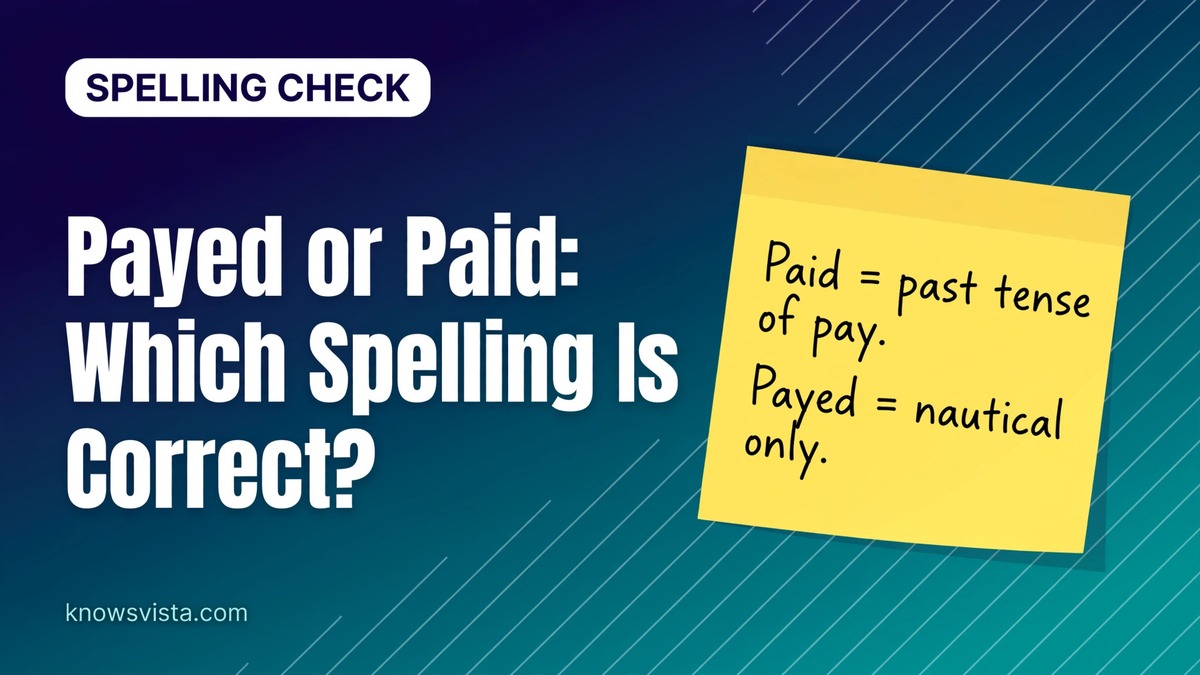
    Paid is the past tense and past participle of pay in nearly every context: “I paid the bill,” “She has paid in full.” Payed is correct only in nautical English, when a sailor pays out rope or pays a ship’s seams with tar. If your sentence is not about a boat, write paid.

    🧠 Memory trick: Think say → said and lay → laid: the Y turns into an I. Pay → paid follows the same old pattern. And if you can sail it, you might spell it payed, otherwise, drop the Y.

    Paid: the correct past tense

    Use paid whenever pay means giving money, attention, or consequences, or describes something already settled. It covers bills, salaries, visits (“pay a visit”), compliments (“pay a compliment”), and prices paid for mistakes. It also works as an adjective: “a paid position,” “paid vacation.”

    I paid the electricity bill this morning.

    She has already paid for the tickets.

    He paid no attention to the warning signs.

    The company paid its employees on Friday.

    They paid dearly for their mistake.

    This is a paid position, not a volunteer role.

    The invoice is marked paid in full.

    We paid off the car loan last year.

    ✗ Avoid: “We payed the supplier yesterday.” (money always takes paid)
    ✓ Right: “We paid the supplier yesterday.”

    Payed: the rare nautical exception

    Use payed only when describing ships: letting out rope or chain (“pay out”), or coating a wooden hull’s seams with pitch or tar. It is the past tense of a separate, older verb pay meaning “to smear with pitch.” You will almost never need it unless you write about sailing.

    The crew payed out the rope as the tide fell.

    They payed the hull’s seams with tar before the voyage.

    He payed the line hand over hand until the anchor held.

    The old sailors payed the deck to make it watertight.

    The tricky exceptions

    The past participle is paid too

    Both the simple past and the past participle of pay are paid: “I paid,” “I have paid.” Writing “have payed” doubles the error, wrong tense form and wrong spelling, and it appears in real business emails constantly.

    She had already paid the deposit before arriving.

    The debt was finally paid after two years.

    “Payed out” vs “paid off”

    The nautical phrase pay out (let rope run) keeps payed: “They payed out the anchor line.” But the financial phrase pay off takes paid: “She paid off her loan.” Check the meaning of your verb, if money changes hands, the answer is always paid. The grammar breakdown at Scribbr’s payed vs paid guide confirms the nautical-only use of payed.

    They payed out the anchor line slowly.

    She paid off her student loan in March.

    Payed or paid at a glance

    PaidPayed
    Correct?Yes, in nearly every contextYes, but only for ships and ropes
    MeaningPast tense of pay: money, attention, consequencesPast tense of nautical pay: rope, pitch, tar
    Pronunciation/peɪd/, identical/peɪd/, identical
    As past participle“have paid“, alwaysNever in normal writing
    ExampleI paid the rent.The crew payed out the rope.
    TrickIf it’s about money, it’s paidIf there’s a boat, maybe payed

    Quick practice

    Choose the right form:

    1. She __________ the bill before leaving the restaurant.
    2. The sailor __________ out the anchor chain.
    3. He has __________ for the course in full.
    4. I never __________ attention in meetings. (the classic email mistake)

    Answer key:

    • 1. paid (money = the standard past tense)
    • 2. payed (nautical rope context = the rare exception)
    • 3. paid (past participle of pay is also paid)
    • 4. paid (“paid attention” is the fixed phrase, “payed attention” is a mistake)

    Frequently Asked Questions

    Is “payed” ever correct?

    Yes, but almost never in daily life. Payed is correct in nautical English for letting out rope or coating a ship’s seams with pitch or tar. For money, bills, attention, or consequences, it is always paid.

    Why do so many people write “payed”?

    Because it looks logical: most verbs form the past with -ed. But pay is irregular, like say → said and lay → laid, its Y changes to I. Autocorrect and fast typing let the wrong form slip through.

    Is it “payed attention” or “paid attention”?

    Paid attention is correct. This is one of the most common real-world errors, it shows up in school reports and work emails. For more doubling traps that fool spellcheckers, see our putting vs puting guide.

    What is the past participle of “pay”?

    Paid, the same as the simple past. “I have paid,” “the bill was paid.” There is no everyday use where “have payed” is right.

    Do “paid” and “payed” sound different?

    No, both are pronounced /peɪd/. That identical sound is exactly why the misspelling spreads: your ears can’t catch it, so your eyes have to. When you proofread, look for the Y.

    What does “paid in full” mean?

    It means the entire amount owed has been settled, nothing remains due. Receipts and invoices use “paid in full” as the final confirmation, and it is always spelled with paid.

    Final thoughts

    The payed or paid question comes down to this: paid is the past tense of pay in every normal sentence, money, attention, consequences, and settled bills. Payed belongs on boats, describing ropes and tar. Remember the say → said pattern and you will never mix them up. Keep practicing tricky spellings, try our putting vs puting guide or our insure vs ensure guide, and test yourself on the spelling quiz and the free grammar checker.