Insure or Ensure: Which Word Is Correct?
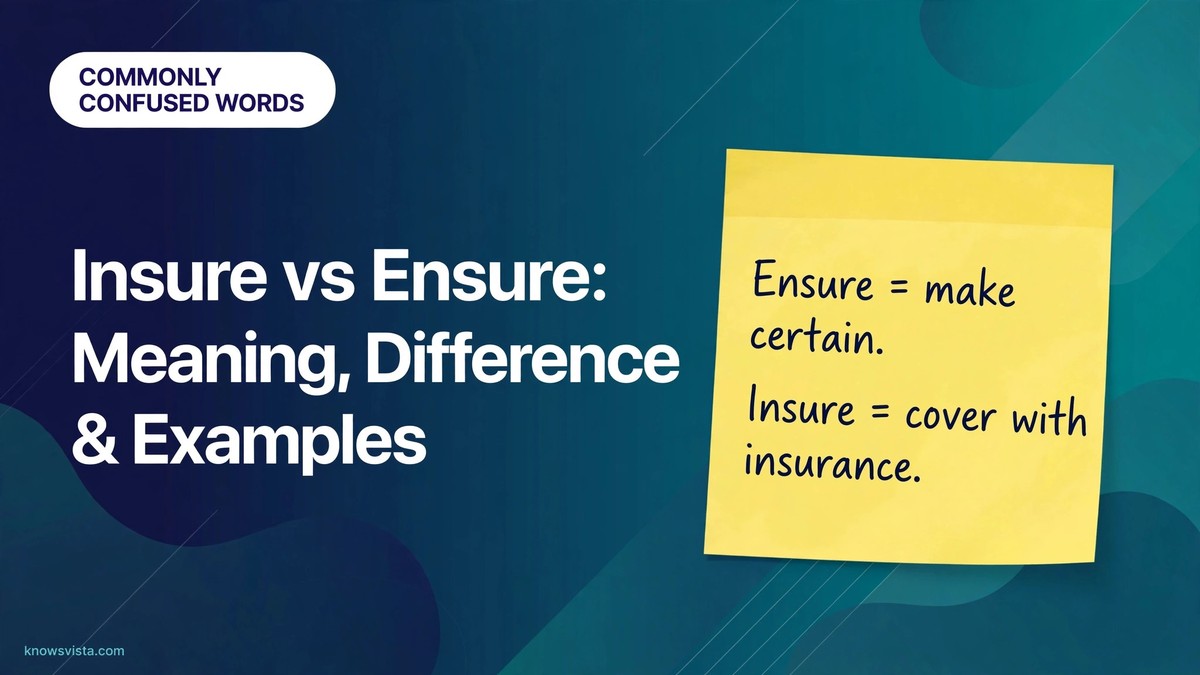
The insure or ensure question confuses even careful writers, because the two words genuinely overlap, and Merriam-Webster admits it. The clean rule: ensure means to make certain (“ensure the door is locked”), while insure means to cover with insurance (“insure the car”). There is also a third word in the trio, assure, which calms a person’s doubts. This guide sorts out all three with real examples and a quick quiz. For another pair that partly overlaps, see our farther vs further guide.
⚡ Quick answer
Ensure means to make sure, certain, or safe (“ensure the report is finished”). Insure means to provide insurance (“insure the house”), or to guard against a risk (“insure against flooding”). Assure means to remove someone’s doubt, it takes a person as its object (“I assure you”).
🧠 Memory trick: Insure has an i for insurance, if money or a policy is involved, spell it with i. Ensure has an e for everything certain, for plain “make sure,” use e.
When to use “ensure”
Use ensure in the general sense “to make certain.” No insurance company, no policy, no premium, just an outcome you are locking in. It is the safe default whenever you mean “make sure,” and usage guides recommend it over insure in this general sense.
Please ensure the door is locked.
The host ensured everyone had a seat.
Double-check the figures to ensure accuracy.
She ensured the team met the deadline.
The new law ensures safer working conditions.
Pack carefully to ensure nothing breaks.
He ensured his notes were complete.
The policy ensures equal treatment for all.
When to use “insure”
Use insure when insurance is involved, a policy, a premium, or protection against a loss. It also pairs with against when the meaning is guarding against a risk. If you can name the thing being protected and the danger it faces, insure is your word.
✗ Avoid: “We will insure the report is finished on time.” (no insurance involved)
✓ Right: “We will ensure the report is finished on time.”
✓ Right: “We will insure the shipment against damage.”
We insured our house against fire and flood.
She insured her book collection for a million dollars.
The tricky exceptions
In American English the lines blur
Merriam-Webster notes that one sense of insure, “to make certain, especially by taking necessary measures”, genuinely overlaps with ensure. Some usage guides recommend insure in financial contexts and ensure in the general “make certain” sense. Practical rule: when insurance, money, or risk protection is anywhere near the sentence, prefer insure; for plain “make sure,” prefer ensure.
Careful planning should insure the success of the party.
Careful planning should ensure the success of the party.
Don’t forget “assure”, the third word
The trio is not complete without assure: it removes doubt from a person’s mind, so it takes a person as its object, “I assure you,” never “I assure the door.” Trick: assure starts with a, for “a person assured.” The full three-way split is worth a look at Merriam-Webster’s insure page, where the usage note sorts out assure, ensure, and insure with examples.
I assure you that no harm will be done.
The manager assured the client the order was on its way.
Insure vs ensure at a glance
| Ensure | Insure | |
|---|---|---|
| Correct? | Yes, a real word | Yes, a real word |
| Core meaning | To make certain or safe | To cover with insurance |
| Typical object | An outcome or state of affairs | A thing, plus a risk (“against theft”) |
| Insurance involved? | Never | Usually, a policy or premium |
| Example | Ensure the door is locked. | Insure the car against theft. |
| Trick | e for everything certain | i for insurance |
Quick practice
Choose the right word (ensure, insure, or assure):
- Please __________ that the files are saved.
- They __________ the painting for $2 million.
- “I __________ you it will be fine,” she said.
- We took steps to __________ against flooding.
Answer key:
- 1. ensure (plain “make certain”, no insurance involved)
- 2. insured (a policy and a dollar amount = insurance)
- 3. assure (removing a person’s doubt takes assure)
- 4. insure (guarding against a risk pairs with insure)
Frequently Asked Questions
Is it “insure” or “ensure”?
It depends on the meaning. Use insure for insurance and protection against risk; use ensure for the general “make certain.” Both words are correct, they just do different jobs.
Can “insure” ever mean “make sure”?
Yes, dictionaries list one overlapping sense (“to make certain by taking necessary measures”). But ensure is the safer default for plain “make sure”; save insure for insurance and financial contexts.
What is the difference between “assure” and “ensure”?
Assure removes a person’s doubt (“I assure you it is safe”); ensure makes an outcome certain (“ensure it is safe”). If there is a person being calmed, use assure. Overlapping pairs like this are common, see our farther vs further guide for another.
Is there a US vs UK difference?
No meaningful one. Both American and British usage guides draw the same line: insure for insurance, ensure for making certain, assure for reassuring a person.
Which one goes with “against”?
Insure: “insure against loss,” “insured against flooding.” The against construction belongs to the risk-protection meaning, which is insure’s home turf.
How do you remember which is which?
Two tricks: insure has an i for insurance (money or a policy = i), and assure starts with a for “a person assured”, it is the only one of the three that takes a person as its object.
Final thoughts
The insure or ensure question comes down to insurance: insure protects with a policy, ensure makes something certain, and assure calms a person. Default to ensure for plain “make sure,” and reach for insure when money and risk are involved. Keep the trio straight and the next overlapping pair gets easier, try our farther vs further guide, or test yourself on the spelling quiz and the free grammar checker.