Author: zoya khan

  • Flip or Flop: Meaning, Origin and Which Form Should You Use?

    Flip or Flop: Meaning, Origin and Which Form Should You Use?

    Flip or Flop: Meaning, Origin and Which Form Should You Use?

    The flip or flop question is really three questions at once: what does flip mean, what does flop mean, and when do they join up as flip-flop? Flip is a quick, light turn or toss; flop is a heavy, clumsy fall, or a failure. Together, flip-flop means a sudden reversal, a beach sandal, or an electronic switch. They share a family tree but they are not interchangeable. Check any sentence with the free Grammar Checker on the KnowsVista homepage.

    โšก Quick answer

    Use flip for a quick turn or toss: Flip the pancake. Use flop for a heavy fall or a failure: He flopped onto the sofa; the film flopped at the box office. Use flip-flop (hyphenated) for a reversal of opinion, a sandal, or a switching circuit.

    ๐Ÿง  Memory trick: Flip is light and fast, say it and your tongue flicks up. Flop is heavy and flat, say it and your mouth drops open. Light flick = flip; heavy drop = flop.

    When to use flip

    Flip is a verb (and noun) for a quick, light movement: turning something over, tossing it in the air, or switching it to the opposite position. Merriam-Webster’s flip-flop entry also covers the combined form, defined as a reversal and as a sandal. On its own, flip covers coins, pancakes, pages, switches, houses, anything turned over fast and lightly.

    โœ“ Flip the pancake before it burns.

    โœ“ Let’s flip a coin to decide who goes first.

    โœ“ She flipped through the magazine in five minutes.

    โœ“ Flip the switch and the room lights up.

    โœ“ They buy old houses, flip them, and sell at a profit.

    โœ— He flipped onto the bed exhausted after the marathon. โ†’ โœ“ He flopped onto the bed exhausted after the marathon. (A heavy, exhausted collapse is a flop, not a flip.)

    Common phrases: flip out (lose control, informal), flip side (the other side of a situation), flip a coin (decide by chance). All keep the quick, light sense. The same verb-vs-phrase logic appears in our sink or swim guide.

    When to use flop

    Flop is a verb and noun for a heavy, uncontrolled fall, and, by extension, anything that fails badly. A person flops onto a sofa; a fish flops on the dock; a film flops at the box office; a plan flops when nobody shows up. Where flip is quick and controlled, flop is heavy, loose, and often embarrassing.

    โœ“ Exhausted, he flopped onto the sofa without taking off his shoes.

    โœ“ The fish flopped around on the deck of the boat.

    โœ“ The expensive musical flopped at the box office in its first week.

    โœ“ Her first attempt at baking flopped, the cake never rose.

    โœ“ The surprise party was a total flop; the guest of honour never arrived.

    โœ— Flop the coin to decide. โ†’ โœ“ Flip the coin to decide. (A coin toss is quick and light, a flip, never a flop.)

    Note the spelling family: flop โ†’ flopped โ†’ flopping doubles the p because flop is one stressed syllable ending in one vowel plus one consonant, unlike flip โ†’ flipped โ†’ flipping, where the same doubling rule applies too. This doubling pattern also appears in our bad rap or bad rep guide’s discussion of short-word forms.

    The tricky exceptions

    “Flip-flop” as a reversal: always hyphenated

    When someone abruptly reverses a position or decision, the word is flip-flop (hyphenated as a noun and verb; flip-flopper for the person). The sense of a “complete reversal of direction” dates to about 1900, and the political use, a politician accused of reversing opinions for votes, appears in an 1890 New York Times report. It is usually critical: a flip-flop implies inconsistency, not a thoughtful change of mind. As a verb: She flip-flopped on the tax plan. Do not write it as two separate words for this meaning.

    โœ“ The candidate’s flip-flop on taxes dominated the debate. โœ— The candidate’s flip flop on taxes dominated the debate.

    “Flip-flops” as sandals: plural, same spelling

    The beach sandal is a flip-flop, almost always plural in use: a pair of flip-flops. The name is imitative, it copies the slapping sound the sole makes against the foot as you walk, and the sandal sense dates to about 1970. Both flip and flop here echo the loose, flapping movement of the sandal itself.

    โœ“ She wore bright pink flip-flops to the beach. โœ“ He flip-flopped down the porch steps in battered trainers.

    Both words come from “flap”, and so does “flip-flap”

    Flip and flop are both variants of flap, first recorded in the 1300s for a sudden blow, then for the flapping flight of birds. Flip appears in the early 1600s, and the reduplicative flip-flap, the ancestor of flip-flop, appears in the 1500s for loose, flapping movement. In electronics, a flip-flop circuit switches between two stable states, again echoing the back-and-forth idea. One family, three lives: quick turn, heavy fall, and back-and-forth switch.

    โœ“ A flip-flop circuit stores one bit of memory by switching states. โœ“ The old flip-flap dance was a rollicking double shuffle. (Historical variant, not modern usage.)

    Flip vs flop at a glance

    FlipFlopFlip-flop
    Core senseQuick, light turn or tossHeavy fall; failureSudden reversal; sandal; circuit
    MovementControlled, fastUncontrolled, heavyBack and forth
    Past tenseflippedfloppedflip-flopped
    ExampleFlip the coin.The show flopped.Her flip-flop shocked voters.
    Don’t confuse withA heavy collapseA quick tossTwo separate words

    Quick practice

    Fill in the blank with flip, flop, or flip-flop:

    1. __________ the pancake before it burns.
    2. Exhausted, she __________ onto the bed.
    3. The candidate’s __________ on the policy angered supporters.
    4. She packed her __________ for the beach holiday. (plural)

    Answer key:

    • 1. flip (a quick, light turn)
    • 2. flopped (a heavy, exhausted collapse, past tense of flop)
    • 3. flip-flop (a sudden reversal of position)
    • 4. flip-flops (beach sandals, plural)

    Frequently Asked Questions

    What does flip-flop mean?

    Most often, an abrupt reversal of opinion or policy, especially by a politician. It can also mean a beach sandal or an electronic switching circuit. Context picks the meaning.

    Is it “flip flop” or “flip-flop”?

    Hyphenated: flip-flop for the reversal, the sandal, and the circuit. Two separate words is not the standard spelling for any of these meanings.

    What is the origin of flip-flop?

    Both words descend from flap (1300s). Flip-flap appears in the 1500s for loose flapping movement; flip-flop as a reversal dates to about 1900, and the sandal sense to about 1970, named for the sound of walking in them.

    Can flop mean a failure?

    Yes, that is one of its most common modern uses: The film flopped, the plan was a flop. It extends the “heavy fall” sense to anything that falls flat.

    What does “flip out” mean?

    Informally, to lose control from excitement, anger, or shock: She flipped out when she heard the news. It keeps flip‘s sudden, quick sense, a sudden reaction, not a heavy fall.

    Final thoughts

    Flip is light and fast, flop is heavy and flat, and flip-flop is the back-and-forth that joins them, a reversal, a sandal, a switch, all born from one old word for flapping. Say the word out loud, feel whether it flicks or drops, and you will pick the right one every time. Lock the rule in with the free Spelling Quiz.
  • Contractor or Contracter: Which Spelling Is Correct?

    Contractor or Contracter: Which Spelling Is Correct?

    Contractor or Contracter: Which Spelling Is Correct?

    The contractor or contracter question has only one correct answer, and it is good news for anyone who has ever hesitated over it: contractor is correct in every variety of English, and contracter is not a word at all. A contractor is a person or company that enters into a contract to do a job or provide a service, from building a house to consulting on a project. The -or ending comes from Latin, and it is the reason the -er spelling never works here. Check any sentence with the free Grammar Checker on the KnowsVista homepage.

    โšก Quick answer

    Always use contractor: We hired a contractor to renovate the kitchen. Never use contracter, it appears in no dictionary and will be flagged as a misspelling in American, British, and every other variety of English.

    ๐Ÿง  Memory trick: Contractor belongs to the Latin -or family: act-or, direct-or, creat-or, contract-or. If the word came from Latin, it keeps its -or. Think: contractOR does the contract, and or rhymes with the Latin ending it kept.

    When to use contractor

    Contractor is a noun for a person or business that agrees, under a formal contract, to perform work or provide services for another party. Merriam-Webster’s contractor entry defines it as one that contracts to perform work or provide supplies, and as a person who contracts to do work. It is spelled the same way in American and British English, and its plural is contractors.

    โœ“ We hired a contractor to renovate the kitchen.

    โœ“ The general contractor managed the whole building project.

    โœ“ She works as an independent contractor, not a full-time employee.

    โœ“ The government awarded the contractor a three-year service deal.

    โœ“ Subcontractors report to the main contractor on site.

    โœ— The firm hired a skilled contracter for the repairs. โ†’ โœ“ The firm hired a skilled contractor for the repairs.

    Use contractor in every register, emails, contracts, job ads, and essays alike. There is no informal version of this word. The same Latin-root logic appears in our precede vs proceed guide.

    When to use contracter

    Never. Contracter is not an accepted variant, a British spelling, or an informal form, it is simply a misspelling. It shows up only because English has so many genuine -er agent words (teacher, builder, writer, runner) that writers guess the pattern by sound. Sound is a bad guide here: contractor and contracter are pronounced almost identically, but only one is in the dictionary. If you see contracter on a business website or a job posting, treat it as a red flag for careless proofreading.

    โœ— Looking for a reliable contracter near you? โ†’ โœ“ Looking for a reliable contractor near you?

    โœ— The contracter finished the roof on Friday. โ†’ โœ“ The contractor finished the roof on Friday.

    โœ— Our team of contracters is ready to help. โ†’ โœ“ Our team of contractors is ready to help.

    โœ“ The contractor signed the agreement before work began. (Always -or, in every country.)

    โœ“ A good contractor gives a written quote first. (No exception for casual writing.)

    โœ— Spellcheck accepted contracter because it looks like teacher. โ†’ โœ“ Spellcheck should flag contracter; the correct form is contractor.

    The key point: this is not a US-vs-UK choice or a matter of preference. Unlike realise/realize, there is no second correct form to pick from. This “one correct form” pattern also appears in our putting or puting guide.

    The tricky exceptions

    “-or” vs “-er” is about word history, not a fixed rule

    As a rough guide, Latin-derived agent words take -or (actor, director, contractor, creator, inventor), while Germanic-rooted or newer words take -er (teacher, builder, writer, plumber). But it is only a rough guide: adviser and advisor are both accepted, and sailor keeps -or despite its Germanic roots. So do not guess from the rule alone, for contractor, memorize the word itself. It is always -or.

    โœ“ The actor thanked the director and the contractor. โœ“ The teacher praised the builder. Both families are correct, just not interchangeable.

    “Contractor” is not “constructor”

    A contractor is defined by the contract, the agreement to do the work. A constructor is defined by the building itself, one who constructs. In construction, a firm is called a contractor because its first job is entering into the agreement, even if it then builds. Use contractor for the business role and constructor only when you mean the act of building in a technical or legal sense.

    โœ“ The contractor signed the deal to build the bridge. โœ“ The bridge’s steel constructor supplied the beams. (Different words, different jobs.)

    Related words keep the “-or” too

    The whole word family keeps the Latin ending: contractor, contractors, subcontractor, contractual. The verb is contract (contracted, contracting), and the noun for the agreement itself is contract. None of these ever takes an -er agent ending, there is no subcontracter either.

    โœ“ The subcontractor signed a contractual agreement. โœ— The subcontracter signed the deal. โ†’ โœ“ The subcontractor signed the deal.

    Contractor vs contracter at a glance

    ContractorContracter
    StatusCorrect, standard wordMisspelling, not in dictionaries
    Used inUS, UK, Canada, Australia, everywhereNowhere standard
    OriginLatin contractor, “one who makes a contract”False pattern from -er words like teacher
    Pluralcontractors,
    Related wordssubcontractor, contractual, contract,
    ExampleWe hired a contractor.We hired a contracter. โœ—

    Quick practice

    Fill in the blank with contractor or contracter:

    1. We hired a __________ to remodel the bathroom.
    2. The __________ finished the roof on Friday. (US)
    3. The __________ finished the roof on Friday. (UK, same answer!)
    4. Our team of __________ is ready to help. (plural)

    Answer key:

    • 1. contractor (the only correct spelling)
    • 2. contractor (US standard)
    • 3. contractor (UK standard too, no regional difference here)
    • 4. contractors (plural adds s to contractor)

    Frequently Asked Questions

    Is contracter a real word?

    No. Contracter is not listed in Merriam-Webster, Oxford, or Cambridge dictionaries. It is a common misspelling of contractor, caused by the many genuine -er words in English.

    Which is correct: contractor or contracter?

    Contractor is correct, always, in every variety of English. Contracter is never correct.

    Is contracter the British spelling?

    No. British English also uses contractor. This word has no US-vs-UK split at all.

    What is the plural of contractor?

    Contractors, just add s. There is no contracters form.

    What is the difference between a contractor and a subcontractor?

    A contractor holds the main contract with the client; a subcontractor is hired by that contractor to handle part of the work. Both words end in -or.

    Final thoughts

    Contractor is the word, full stop: Latin root, -or ending, same spelling in every country and every register. Contracter is a sound-alike trap built from teacher and builder, convincing to the ear, wrong on the page. Remember the -or family, actor, director, contractor, and you will never misspell it again. Lock the rule in with the free Spelling Quiz.

  • Some Time or Sometime? Learn the Correct Usage in Minutes

    Some Time or Sometime? Learn the Correct Usage in Minutes

    Some Time or Sometime? Learn the Correct Usage in Minutes

    The some time or sometime mix-up is one of the most common spacing errors in English, because the two forms sound identical. The rule is about meaning, not sound: sometime (one word) means at an unspecified point in time, while some time (two words) means a period or amount of time. One small space changes the sentence completely. Check any sentence with the free Grammar Checker on the KnowsVista homepage.

    โšก Quick answer

    Use sometime for an unspecified moment: Let’s meet sometime next week. Use some time for a duration: I need some time to finish. If you can swap in “at some point,” use sometime; if you can swap in “for a while,” use some time.

    ๐Ÿง  Memory trick: Sometime = some point (a moment, one word, one point). Some time = some amount (a stretch, two words, room to stretch). Point โ†’ one word; period โ†’ two words.

    When to use sometime

    Sometime is an adverb meaning “at an unspecified time”, a single, unknown point on the timeline, in the past or the future. Merriam-Webster’s sometime entry defines it as at a time not specified, and also as a formal adjective meaning “former,” used before a noun. It answers the question when?, never how long?

    โœ“ Let’s meet for coffee sometime next week.

    โœ“ He will wash the car sometime this weekend.

    โœ“ I visited New York sometime last year.

    โœ“ They will get tested sometime during the school year.

    โœ“ Call me sometime, any day works.

    โœ— I need sometime to finish this report. โ†’ โœ“ I need some time to finish this report. (A duration needs two words.)

    In every correct sometime sentence, you can replace it with “at some point” and the meaning survives. That substitution test never fails. The same one-word-vs-two-words logic drives our any more or anymore guide.

    When to use some time

    Some time is a noun phrase: some (an adjective meaning an unspecified amount) plus time (the noun). It names a duration, a short while, a long while, or simply a while. It answers the question how long?, never when? You will often see it after verbs like need, take, spend, and give, or after the preposition for.

    โœ“ It took me some time to finish the project.

    โœ“ We need some time to decide on the final details.

    โœ“ She has not heard from her friend in some time.

    โœ“ Give him some time to recover before asking again.

    โœ“ They spent some time apart and came back stronger.

    โœ— Let’s meet some time next week. โ†’ โœ“ Let’s meet sometime next week. (An unspecified moment needs one word.)

    The giveaway: if you can put for in front of it, for some time, or swap in “a while,” you need two words. This duration sense also appears in our setup or set up guide’s noun-vs-verb tests.

    The tricky exceptions

    “Sometimes” is a third word, frequency, not timing

    Do not confuse either form with sometimes (one word, with an s), which means “occasionally” or “now and then.” It describes how often something happens, not when it happens or how long it takes. Sometime is one unknown moment; sometimes is repeated, occasional moments.

    โœ“ She sometimes walks to school. โœ— She sometime walks to school. โœ— I need sometimes to finish. โ†’ โœ“ I need some time to finish.

    “Sometime” as an adjective means “former”

    Before a noun, sometime can be a formal adjective meaning “former” or “at some past time holding a role”: a sometime actor, a sometime member of the committee. This use is rare and formal, do not use it when you mean “occasional.” A “sometime teacher” once was a teacher; a teacher who “sometimes teaches” still does.

    โœ“ The sometime mayor attended the ceremony. (He used to be mayor.) โœ— The sometime teacher helps on Fridays. โ†’ โœ“ The teacher sometimes helps on Fridays.

    “Some time ago” is always two words

    In the phrase some time ago, the words name a duration that has passed, so they stay separate: Some time ago, we had lunch together. If a preposition comes before it (in some time, for some time) or a quantity word follows it, two words is the answer. And never hyphenate: some-time is not a standard form in any variety of English.

    โœ“ Some time ago, the shop moved across the street. โœ— She needs some-time to respond. โ†’ โœ“ She needs some time to respond.

    Some time vs sometime at a glance

    SometimeSome timeSometimes
    FormOne word, adverb (rare adjective)Two words, noun phraseOne word, adverb
    MeaningAt an unspecified pointA period or amount of timeOccasionally
    AnswersWhen?How long?How often?
    Swap test“at some point”“for a while”“occasionally”
    ExampleMeet sometime soon.Take some time off.We sometimes meet.

    Quick practice

    Fill in the blank with sometime, some time, or sometimes:

    1. Let’s go for lunch __________ next month.
    2. I need __________ to think about the offer.
    3. He __________ reads before bed.
    4. __________ ago, this street was a quiet lane.

    Answer key:

    • 1. sometime (unspecified moment, “at some point” fits)
    • 2. some time (duration, “for a while” fits)
    • 3. sometimes (frequency, “occasionally” fits)
    • 4. Some time (a duration that has passed, two words)

    Frequently Asked Questions

    Is it “sometime” or “some time”?

    Both are correct, for different meanings. Use sometime for an unspecified point in time and some time for a period of time. The meaning you intend picks the spelling.

    Can sometime mean “former”?

    Yes, in formal writing before a noun: a sometime actor means someone who was formerly an actor. This use is rare; in everyday writing, sometime means “at an unspecified time.”

    What is the difference between sometime and sometimes?

    Sometime is one unknown moment (“Let’s meet sometime”). Sometimes means occasionally, again and again (“We sometimes meet”). One moment vs repeated moments.

    Is “some-time” with a hyphen correct?

    No. Some-time is not standard in any variety of English. Write sometime (one word) or some time (two words) depending on meaning.

    How do I remember which one to use?

    Use the swap test: “at some point” โ†’ sometime; “for a while” โ†’ some time; “occasionally” โ†’ sometimes. If none fits, reread the sentence, you may need a different word entirely.

    Final thoughts

    Sometime is a point, some time is a period, and sometimes is a pattern, point, period, pattern, one space at a time. Run the swap test before you hit send, and this classic mix-up disappears from your writing for good. Lock the rule in with the free Spelling Quiz.

  • Benefitting or Benefiting: Which Spelling Is Correct in 2026?

    Benefitting or Benefiting: Which Spelling Is Correct in 2026?

    Benefitting or Benefiting: Which Spelling Is Correct in 2026?

    The benefitting or benefiting question trips up even confident writers, because both spellings look right, and in a sense, both are. Benefiting (one t) is the standard American form and the safest choice worldwide. Benefitting (two ts) is the traditional British form. The difference comes from one spelling rule: whether English doubles a final consonant when the last syllable is stressed. Check any sentence with the free Grammar Checker on the KnowsVista homepage.

    โšก Quick answer

    Use benefiting in American English: The students are benefiting from the new library. In British English, benefitting is traditional but benefiting is now widely accepted too, so when in doubt, use benefiting everywhere.

    ๐Ÿง  Memory trick: Say the word out loud: BEN-e-fit. The stress is on the first syllable, not the last, and an unstressed last syllable never doubles its consonant in American spelling. Think: no stress, no extra letter.

    When to use benefiting

    Benefiting follows the standard doubling rule. You double a final consonant before -ing only when the verb ends in one vowel plus one consonant and the final syllable is stressed, as in begin โ†’ beginning and regret โ†’ regretting. In benefit, the stress falls on the first syllable (BEN-e-fit), so the t is not doubled. Merriam-Webster’s benefit entry lists benefited and benefiting as the verb forms.

    โœ“ The company is benefiting from the new policy.

    โœ“ Students are benefiting from the additional study resources.

    โœ“ Is she benefiting from the exercise program?

    โœ“ Local shops benefited from the summer tourism boom.

    โœ“ The charity has benefited thousands of families this year.

    โœ— The Boston report claimed clients were benefitting from the change. โ†’ โœ“ The Boston report claimed clients were benefiting from the change.

    In American writing, benefiting is never wrong, it is the only standard form. The same stress rule explains our putting or puting guide: put is one stressed syllable, so it doubles, while benefit does not.

    When to use benefitting

    Benefitting is the traditional British spelling. British English often doubles a final consonant even when the last syllable is unstressed, the same habit behind travelling (US: traveling) and cancelling (US: canceling). You will still see benefitting in British newspapers, but modern UK style guides increasingly prefer the single-t form, so benefiting is now safe in the UK as well.

    โœ“ The charity is benefitting from the donations. (traditional UK style)

    โœ“ Many people are benefitting from the government’s new healthcare plan. (traditional UK style)

    โœ“ Are children benefitting from the new curriculum? (traditional UK style)

    โœ“ The town benefitted from the new railway station. (traditional UK past tense)

    โœ“ The workers benefitted after the reforms. (traditional UK past tense)

    โœ— A US college essay wrote “students are benefitting.” โ†’ โœ“ A US college essay should write “students are benefiting.”

    The key point: benefitting is a regional variant, not a typo, but it marks your text as British, and it is fading even there. This “traditional vs modern” pattern also appears in our totaling or totalling guide.

    The tricky exceptions

    Stressed final syllables DO double: begin, regret, submit

    Do not overcorrect and stop doubling everywhere. When the stress is on the final syllable, doubling is required in both US and UK English: begin โ†’ beginning, regret โ†’ regretting, submit โ†’ submitting, prefer โ†’ preferred. The rule is about stress, not about the letter t. Test it by saying the word: if you punch the last syllable, double the consonant.

    โœ“ She is beginning a new job on Monday. โœ“ He regretted sending the email. โœ— He benefited is right; he benefitted is only traditional UK style.

    Do not pattern “benefit” on “fit”

    The most common cause of benefitting in American writing is copying fit โ†’ fitting. But fit is a one-syllable word, and one-syllable words ending in one vowel plus one consonant always double: fit โ†’ fitting, run โ†’ running, stop โ†’ stopped. Benefit has three syllables with stress on the first, so a different rule governs it. Similar traps: visit โ†’ visiting and offer โ†’ offered, never visitting or offerring.

    โœ“ The team is fitting new windows. โœ“ The team is benefiting from the grant. โœ— The team is benefitting from the grant. (US)

    “Beneficiary” and “beneficial” never double anything

    Only the -ed and -ing forms of the verb are in question. Related words keep a single t and a single f in every variety: beneficiary, beneficial, benefit itself. There is no benefitting hiding inside beneficial, the t there belongs to a different syllable pattern entirely.

    โœ“ She is the main beneficiary of the trust. โœ“ Regular exercise is beneficial for heart health.

    Benefitting vs benefiting at a glance

    BenefitingBenefitting
    SpellingOne tTwo ts
    Used inUS (standard); modern UK (accepted)Traditional UK (still seen)
    Past tensebenefitedbenefitted
    WhyStress on first syllable (BEN-e-fit), so no doublingUK habit of doubling even unstressed consonants
    Safe defaultYes, use everywhere when unsureNo, marks text as British
    ExampleThey are benefiting from tutoring.They are benefitting from tutoring.

    Quick practice

    Fill in the blank with benefiting or benefitting:

    1. The Chicago students are __________ from free meals. (US)
    2. She is __________ from extra tutoring this term. (safe worldwide default)
    3. He is __________ a new job on Monday. (stressed final syllable, different verb!)
    4. The village __________ from the new road last year. (traditional UK past tense)

    Answer key:

    • 1. benefiting (US standard, one t)
    • 2. benefiting (the safe default in every variety)
    • 3. beginning (begin has a stressed final syllable, so it doubles, unlike benefit)
    • 4. benefitted (traditional UK past tense, two ts)

    Frequently Asked Questions

    Is benefitting a real word?

    Yes, benefitting is a real, accepted spelling in traditional British English. It is not a typo, but it is not the American form, and modern UK guides increasingly prefer benefiting.

    Which is correct: benefitting or benefiting?

    Both are accepted, but benefiting is the standard American form and the safest worldwide default. Use benefitting only when you deliberately follow traditional British style.

    Is it “benefited” or “benefitted”?

    Same rule as the -ing form: benefited is American and modern standard; benefitted is traditional British. Keep the same choice for both forms in one document.

    Why do people write benefitting with two t’s?

    Two reasons: British doubling habits, and copying one-syllable fit โ†’ fitting. Neither applies to the American standard, because benefit is stressed on its first syllable.

    Does spellcheck flag benefitting?

    American spellcheckers usually flag benefitting as an error, while British spellcheckers accept both. If your audience is American, always use benefiting.

    Final thoughts

    Benefiting wins on every tiebreak: it follows the stress rule, it is the American standard, and it is now accepted in modern British English too. Reserve benefitting for traditional UK style, and never mix the two in one document. Remember no stress, no extra letter, and you will spell it right every time. Lock the rule in with the free Spelling Quiz.
  • Realise or Realize: Which Spelling Is Correct in 2026?

    Realise or Realize: Which Spelling Is Correct in 2026?

    Realise or Realize: Which Spelling Is Correct in 2026?

    The realise or realize question has a refreshingly simple answer: both spellings are correct, and they mean exactly the same thing. Realize is the standard spelling in American English, while realise is the preferred spelling in British English. The verb means to become aware of something, or to make something real, to achieve a dream, a profit, or a plan. The only real skill is matching your spelling to your reader. Check any sentence with the free Grammar Checker on the KnowsVista homepage.

    โšก Quick answer

    Use realize in American English: She realized her mistake. Use realise in British English: She realised her mistake. In the US, realise is always wrong; in the UK, realize is acceptable in Oxford style but realise is the everyday choice.

    ๐Ÿง  Memory trick: Realise ends in -ise, like its British cousins organise, recognise, and apologise. American English swaps the s for a z: organize, recognize, apologize, realize. Think: z = American zip, s = British standard.

    When to use realize

    Realize (with a z) is the only correct spelling in American English, and it is also the standard spelling in Canadian English. Merriam-Webster’s realize entry defines it as to conceive vividly as real, to bring into concrete existence, and to obtain as a result of effort. In the US, realise with an s will look like a spelling mistake to most readers and will be flagged by American spellcheckers.

    โœ“ I did not realize how late it was until the clock struck midnight.

    โœ“ After years of hard work, she finally realized her dream of becoming a doctor.

    โœ“ The company realized a profit for the first time in three years.

    โœ“ He realized that he had made a mistake and apologized at once.

    โœ“ Do you realize what this opportunity could mean for your career?

    โœ— The New York editor wrote that she realised the error too late. โ†’ โœ“ The New York editor wrote that she realized the error too late.

    In American writing, realize is never wrong, it is the default. The same -ize pattern shows up in our theatre or theater guide’s discussion of American spelling reform.

    When to use realise

    Realise (with an s) is the preferred spelling in British English, Australian English, and most other Commonwealth varieties. It means exactly the same as realize and is pronounced the same way. In British newspapers such as The Guardian, realise is roughly ten times as common as realize, so for a UK audience it is the natural, expected choice.

    โœ“ She realised that she had left her keys at home.

    โœ“ He realised he needed to make some changes in his life.

    โœ“ They realised they had a lot in common after just one meeting.

    โœ“ The team realised its full potential in the second half of the season.

    โœ“ I hope you realise how much your help meant to us.

    โœ— The London tutor told her pupil to realize his potential in a school essay. โ†’ โœ“ The London tutor told her pupil to realise his potential in a school essay. (In everyday UK writing, realise is the expected form.)

    The key point: in the UK, realise is the everyday preference, but realize is not an error there, see the Oxford exception below. This “preferred, not exclusive” pattern also appears in our cosy or cozy guide.

    The tricky exceptions

    Oxford style actually prefers “realize” in the UK

    Here is the twist most guides skip: Oxford University Press style recommends realize with a z, because the ending comes from the Greek suffix -izein. The -ize spelling is older than -ise in English and was the preferred British form before about 1875. So a British academic paper using realize is following Oxford style, not making an American mistake. For school essays and newspapers, though, realise remains the safer UK choice.

    โœ“ Oxford journal: “The authors realize the limitations of the study.” UK newspaper: “The authors realise the limitations of the study.” Both are correct in the UK.

    Every derived form follows the same pattern

    Whichever spelling you choose, use it consistently across the whole word family. American: realizing, realized, realization. British: realising, realised, realisation. Mixing them, realise in one paragraph and realization in the next, is the most common real-world error with this word.

    โœ— She came to the realization that she should have realised sooner. โ†’ โœ“ She came to the realisation that she should have realised sooner. (UK) / She came to the realization that she should have realized sooner. (US)

    Canada follows the US for “-ize” words

    Canadian English usually follows UK spelling, but for verbs ending in -ize or -yze it follows American spelling. So Canada uses realize, organize, and analyze, not realise, organise, and analyse. If you write for a Canadian audience, realize is the standard choice.

    โœ“ The Toronto firm realized gains after the merger. (Canadian standard)

    Realise vs realize at a glance

    RealizeRealise
    MeaningBecome aware; make real; achieveBecome aware; make real; achieve
    Used inUS (only correct form); Canada (standard)UK, Australia, Commonwealth (preferred)
    Present participlerealizingrealising
    Past formrealizedrealised
    Noun formrealizationrealisation
    ExampleShe realized her dream.She realised her dream.

    Quick practice

    Fill in the blank with realize or realise:

    1. The Chicago reporter did not __________ the story was false.
    2. The Manchester teacher hoped her pupils would __________ their potential.
    3. After the merger, the Toronto company __________ a large profit.
    4. She came to the __________ that she needed more sleep. (UK newspaper style)

    Answer key:

    • 1. realize (Chicago = US spelling)
    • 2. realise (Manchester = UK spelling)
    • 3. realize (Canada follows the US for -ize words)
    • 4. realisation (UK newspaper style uses -ise throughout the word family)

    Frequently Asked Questions

    Is realise a real word?

    Yes, realise is a real, standard word in British English. It is simply the British spelling of realize. It only looks unusual to American readers because the US never uses it.

    Which is correct: realise or realize?

    Both are correct. Use realize in American and Canadian English and realise in everyday British English. Oxford style in the UK also accepts realize.

    Is it “realised” or “realized”?

    Match your base spelling: realised goes with realise (UK), and realized goes with realize (US). Never mix the two within one document.

    What is the noun form: realisation or realization?

    Realisation is the British noun form and realization is the American noun form. Both mean the act of becoming aware of something, or of making something real.

    Can I use realise in American English?

    No, not if you want to look correct to an American audience. In the US, realise is treated as a misspelling. Always use realize for US readers.

    Final thoughts

    Realise and realize are the same verb wearing two regional spellings: realize for the US and Canada, realise for everyday British English, with Oxford style as the honourable UK exception. Pick one spelling, carry it through every derived form, and your reader will never trip over it. Lock the rule in with the free Spelling Quiz.
  • Weather or Whether? Learn the Correct Meaning and Examples

    Weather or Whether? Learn the Correct Meaning and Examples

    Weather or Whether? Learn the Correct Meaning and Examples

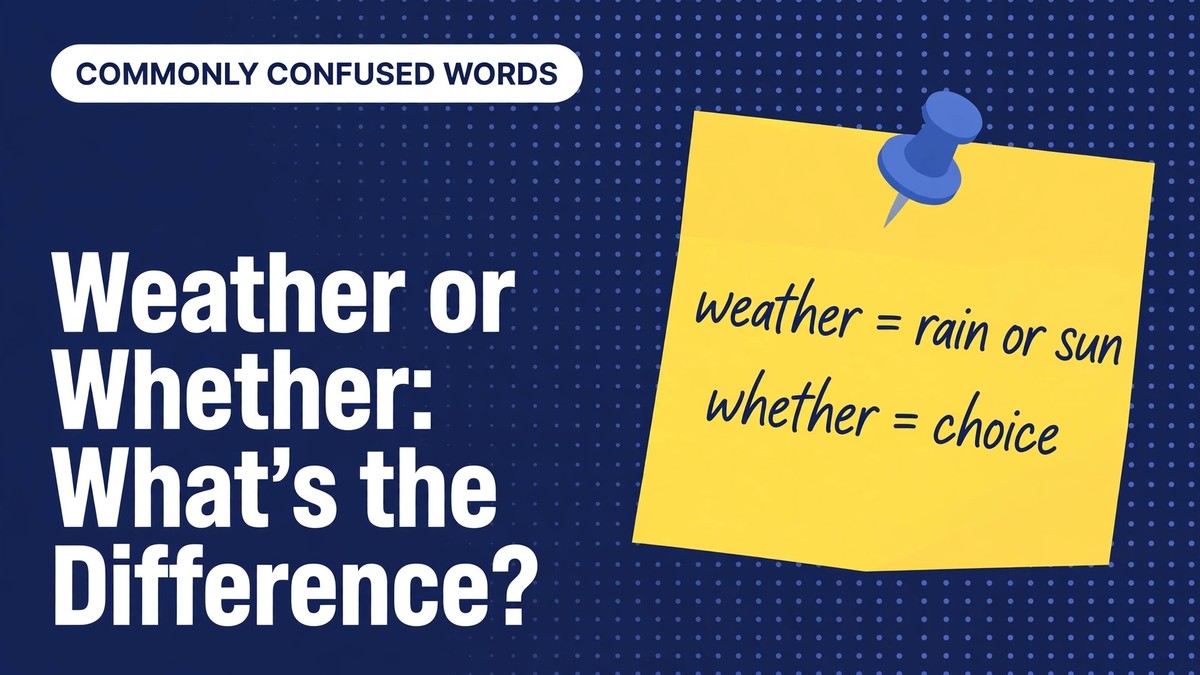
    The weather or whether mix-up is one of the most common homophone errors in English because the two words sound exactly the same but mean completely different things. Weather is about the atmosphere, rain, sun, wind, and storms, and it can also be a verb meaning “to survive.” Whether is a conjunction that introduces a choice or a doubt, as in “I don’t know whether to go.” They are never interchangeable. This guide gives you the rules, the memory tricks, and plenty of examples. Check any sentence with the free Grammar Checker on the KnowsVista homepage.

    โšก Quick answer

    Use weather when you mean the atmosphere or a forecast: The weather is sunny today. Use whether when you introduce a choice, an alternative, or a doubt: I don’t know whether to stay or go. If you can replace the word with “if,” use whether; if it is about rain or sunshine, use weather.

    ๐Ÿง  Memory trick: Weather starts like weather’s cousins wind and water, all about the outdoors. Whether starts with wh-, like the question words what, when, and why, because it always asks a question about possibilities.

    When to use weather

    Weather is usually a noun meaning the state of the atmosphere at a particular place and time: temperature, precipitation, wind, and humidity. Merriam-Webster’s weather entry also lists its verb senses: to endure a difficulty (“weather the storm”) and to wear away by exposure (“weathered wood”). If your sentence is about the sky, the forecast, or surviving something hard, weather is your word.

    โœ“ The weather forecast predicts thunderstorms this afternoon.

    โœ“ We canceled the picnic because the weather turned cold and windy.

    โœ“ Farmers watch the weather closely before planting their crops.

    โœ“ The company weathered the financial crisis and came out stronger.

    โœ“ The old fence was weathered by years of sun and rain.

    โœ— The whether is beautiful today. โ†’ โœ“ The weather is beautiful today.

    The test is simple: is the sentence about the sky, the forecast, or surviving difficulty? Then it is weather. The same “is it about the physical world?” test helps with other homophone pairs, like peek or peak.

    When to use whether

    Whether is a subordinating conjunction that introduces two or more alternatives, an indirect question, or a doubt. It appears in patterns like whetherโ€ฆor, whether to + verb, and whether or not. It never refers to the sky. If your sentence presents a choice (“this or that”) or reports uncertainty (“I wonder ifโ€ฆ”), whether is correct.

    โœ“ I don’t know whether to accept the job offer.

    โœ“ She asked whether I wanted tea or coffee.

    โœ“ The team discussed whether the project should continue.

    โœ“ He will pass the exam whether he studies or not.

    โœ“ Please let me know whether you are coming to the party.

    โœ— I don’t know weather we should leave now. โ†’ โœ“ I don’t know whether we should leave now.

    Notice that every whether sentence hides a choice or a question. That “choice” signal is the same clue that settles pairs like between vs among, where the structure of the sentence tells you the word.

    The tricky exceptions

    “Whether or not”, and when “or not” is redundant

    Whether or not is a set phrase meaning “regardless of which option is true,” as in “we’ll go whether or not it rains.” But after verbs like know, wonder, and decide, the or not is often unnecessary: “I don’t know whether she will come” already covers both cases. Keep or not only when it adds the “regardless” meaning.

    โœ“ We’ll have the picnic whether or not it rains. (Regardless of the weather.)

    โœ“ I don’t know whether she will come. (The “or not” adds nothing here.)

    Whether vs if: not always interchangeable

    Whether and if overlap in indirect questions (“I don’t know whether/if she agrees”), but they are not identical. Use whether, not if, before an infinitive (“whether to go”), after a preposition (“talk about whetherโ€ฆ”), and when presenting two alternatives (“whether tea or coffee”). Formal writing prefers whether in all these cases.

    โœ“ She couldn’t decide whether to stay or leave.

    โœ— She couldn’t decide if to stay or leave. โ†’ โœ“ She couldn’t decide whether to stay or leave.

    “Weather” as a verb: weathered, weathering

    Do not let the verb sense of weather confuse you: weathered (as an adjective) describes something worn by exposure, and to weather means to survive a difficulty. Neither sense has anything to do with whether, even though the spelling is only two letters apart.

    โœ“ The climbers weathered the blizzard in a mountain hut.

    โœ“ The weathered barn boards gave the cottage its rustic look.

    Weather vs whether at a glance

    WeatherWhether
    Part of speechNoun (usually); also a verbConjunction
    MeaningAtmospheric conditions; or to survive/endureA choice, alternative, or doubt
    Memory cluewea- like wind and waterwh- like question words what, when, why
    Substitution testTalking about rain, sun, or forecast?Can you replace it with “if”?
    Common patternsweather forecast, bad weather, weathered woodwhetherโ€ฆor, whether to, whether or not
    ExampleThe weather is perfect for hiking.I wonder whether it will rain.

    Quick practice

    Fill in the blank with weather or whether:

    1. The __________ in Canada can be extremely cold in winter.
    2. He couldn’t decide __________ to accept the job offer.
    3. __________ I should wear a sweater depends on the __________.
    4. The crew __________ the storm by staying in the harbor.

    Answer key:

    • 1. weather (atmospheric conditions)
    • 2. whether (a choice, “whether to accept”)
    • 3. Whether โ€ฆ weather (a choice, then the atmosphere)
    • 4. weathered (verb, survived the storm)

    Frequently Asked Questions

    What is the difference between weather and whether?

    Weather refers to atmospheric conditions like rain, sun, and wind. Whether is a conjunction that introduces a choice, an alternative, or a doubt. They are homophones, they sound the same but are never interchangeable.

    Is it “whether or not” or “weather or not”?

    Whether or not is correct, it is a set phrase meaning “regardless of which option is true.” Weather never appears in this phrase.

    Can weather be a verb?

    Yes, to weather something means to survive it (“weather the storm”) or to be worn by exposure (“weathered wood”). The past participle weathered is also used as an adjective.

    When should I use whether instead of if?

    Use whether before infinitives (“whether to go”), after prepositions, and when presenting alternatives (“whether tea or coffee”). In plain indirect questions (“I don’t know whether/if she agrees”), both work, but whether is preferred in formal writing.

    How can I remember weather vs whether?

    Weather starts like wind and water (outdoors words). Whether starts with wh-, like the question words what, when, and why, because it always introduces a question about possibilities.

    Final thoughts

    Weather is the sky; whether is the choice. If the sentence is about rain, sun, or a forecast, or about surviving a storm, it is weather. If it hides a question, a doubt, or a “this or that,” it is whether. Keep the two memory tricks (wea- = wind and water, wh- = question words) and you will never swap them again. Lock the rule in with the free Spelling Quiz.

  • Any More or Anymore: What’s the Difference and Which Is Correct?

    Any More or Anymore: What’s the Difference and Which Is Correct?

    Any More or Anymore: Whatโ€™s the Difference and Which Is Correct?

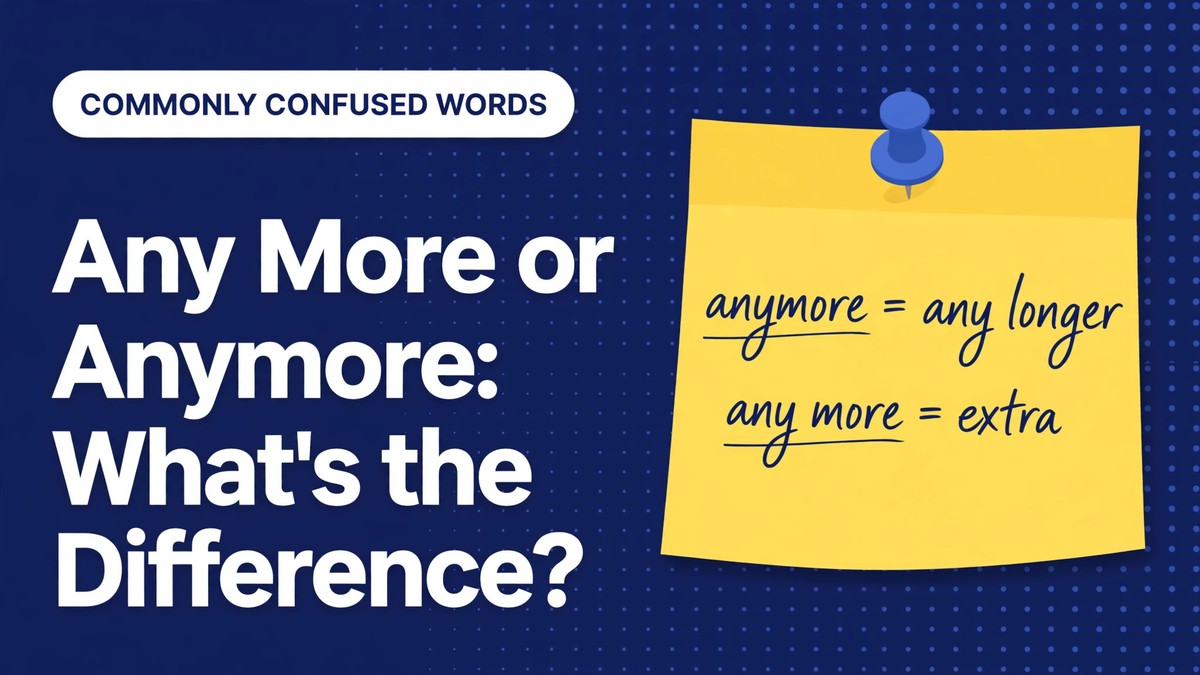
    The any more or anymore confusion trips up writers because the two forms sound identical but mean different things. Anymore (one word) is an adverb meaning “any longer”, it talks about time. Any more (two words) means “any additional” or “any extra”, it talks about quantity. Swap them and your sentence says something you did not mean. This guide gives you the substitution test, the British exception, and plenty of examples. Check any sentence with the free Grammar Checker on the KnowsVista homepage.

    โšก Quick answer

    Use anymore (one word) when you mean “any longer”: I don’t drink coffee anymore. Use any more (two words) when you mean “additional” or “extra”: Do you want any more coffee? Substitute “any longer” or “additional”, whichever fits tells you the spelling.

    ๐Ÿง  Memory trick: Anymore = any longer (time, both are about when). Any more = any extra (quantity, both are about how much). Time = one word; amount = two words.

    When to use anymore

    Anymore is a single-word adverb meaning “any longer,” “now no longer,” or “from now on.” It almost always appears in negative sentences, questions, or if clauses, and it usually sits at the end of the clause. Merriam-Webster’s anymore entry defines it as “any longer” and notes its use in negative constructions. If you can replace the word with “any longer” without changing the meaning, anymore is correct.

    โœ“ I don’t live in that city anymore.

    โœ“ She doesn’t work here anymore.

    โœ“ We hardly talk anymore since he moved away.

    โœ“ Do you smoke anymore?

    โœ“ If you aren’t coming to dinner anymore, please let me know.

    โœ— I don’t eat meat any more. โ†’ โœ“ I don’t eat meat anymore. (Meaning: any longer, time, not quantity.)

    The test never fails: “I don’t eat meat any longer” works, so one word is right. This substitution-test approach also fixes other two-word traps, like the ones in our nevermind or never mind guide.

    When to use any more

    Any more is two words: the determiner any plus the quantifier more. It means “an additional amount” or “a further quantity” of something, and it appears in questions, offers, and negative statements about quantity. If you can replace it with “additional” or “extra,” the two-word form is correct.

    โœ“ Do you want any more cake?

    โœ“ I don’t have any more questions for the speaker.

    โœ“ We don’t need any more chairs for the meeting.

    โœ“ Did he give you any more information about the trip?

    โœ“ I couldn’t love you any more than I already do. (Not “any longer”, an amount of love.)

    โœ— Do you want anymore tea? โ†’ โœ“ Do you want any more tea? (Meaning: additional tea, quantity, not time.)

    Notice the last example: “I couldn’t love you any more” is about degree and amount, so it stays two words, a classic trap. Quantity questions like this are cousins of the count-vs-mass confusion in our fewer vs less guide.

    The tricky exceptions

    British English often uses two words for both meanings

    In British English, any more (two words) is still common as the adverb meaning “any longer”, “I don’t go there any more” is standard in the UK. The one-word/two-word distinction is an American convention that is spreading in Britain, but it is not yet universal there. For an international audience, the American distinction is the safer choice.

    โœ“ UK: I don’t watch that show any more. US: I don’t watch that show anymore. (Both standard in their own variety.)

    Positive “anymore” meaning “nowadays” is nonstandard

    In some US regions, people say things like “Gas is expensive anymore” to mean “gas is expensive nowadays.” This positive use of anymore is dialectal and widely rejected in writing. Avoid it: in standard English, anymore belongs in negative sentences, questions, and if clauses.

    โœ— Coffee is expensive anymore. โ†’ โœ“ Coffee is expensive nowadays.

    Never hyphenate: “any-more” is not a word

    There is no hyphenated form. It is either anymore (one word) or any more (two words), never any-more. The same no-hyphen rule applies to other fused adverbs, as our setup or set up guide explains for a different pair.

    โœ— I don’t play tennis any-more. โ†’ โœ“ I don’t play tennis anymore.

    Any more vs anymore at a glance

    AnymoreAny more
    SpellingOne wordTwo words
    Part of speechAdverbDeterminer + quantifier
    MeaningAny longer (time)Additional, extra (quantity)
    Substitution testReplace with “any longer”Replace with “additional / extra”
    Typical sentenceNegative, question, or if clauseQuestion, offer, or quantity statement
    British noteSpreading in the UK, not yet universalTraditional UK form for both meanings
    ExampleHe doesn’t call anymore.Do you want any more coffee?

    Quick practice

    Fill in the blank with anymore or any more:

    1. She doesn’t eat sugar __________.
    2. Are there __________ cookies in the jar?
    3. We don’t go to that restaurant __________.
    4. I don’t need __________ help with this task.

    Answer key:

    • 1. anymore (means “any longer”, time)
    • 2. any more (means “additional” cookies, quantity)
    • 3. anymore (means “any longer”, time)
    • 4. any more (means “additional” help, quantity)

    Frequently Asked Questions

    What is the difference between any more and anymore?

    Anymore (one word) is an adverb meaning “any longer”, it is about time. Any more (two words) means “additional” or “extra”, it is about quantity. They are not interchangeable.

    Is it “I don’t love you anymore” or “any more”?

    “I don’t love you anymore” is correct in American English, it means “I don’t love you any longer” (time). “Any more” would mean an additional amount of love, which is not the intended meaning.

    Can anymore be used in a positive sentence?

    In standard English, no. Anymore appears in negative sentences, questions, and if clauses. The positive “nowadays” use (“Gas is expensive anymore”) is regional and nonstandard, write “nowadays” instead.

    Do British writers use anymore?

    Increasingly, yes, but the two-word form any more is still common in the UK for both meanings. The one-word/two-word distinction is an American convention that British publishers are gradually adopting.

    Is “any-more” with a hyphen correct?

    No, never hyphenate it. It is anymore (one word, time) or any more (two words, quantity), with no hyphen in either form.

    Final thoughts

    Anymore is about time, any more is about amount, and the substitution test settles every case: if “any longer” fits, write one word; if “additional” fits, write two. Remember that British English still allows two words for both meanings, and never use anymore in a positive “nowadays” sentence. Time = one word, amount = two words. Lock the rule in with the free Spelling Quiz.

  • Learned or Learnt: Which Spelling Is Correct? (+ Easy Examples)

    Learned or Learnt: Which Spelling Is Correct? (+ Easy Examples)

    Learned or Learnt: Which Spelling Is Correct? (+ Easy Examples)

    The learned or learnt question is really two questions in one: which past tense of learn should you use, and when does learned mean something else entirely? As the past tense and past participle of learn, both spellings are correct, learned is standard in American English, while learnt is standard in British English. But learned is also an adjective meaning “scholarly,” and that adjective is always spelled learned, even in the UK. This guide untangles all of it. Check any sentence with the free Grammar Checker on the KnowsVista homepage.

    โšก Quick answer

    Use learned for the past tense in American English: She learned to swim. Use learnt for the past tense in British English: She learnt to swim. As an adjective meaning “scholarly,” always use learned, never learnt, in every variety of English.

    ๐Ÿง  Memory trick: Learnt ends in -t, like its British cousins burnt, dreamt, and spelt. American English prefers the regular -ed ending: burned, dreamed, spelled, learned. Think: -t = traditional British, -ed = American regular.

    When to use learned

    Learned (pronounced lurnd, one syllable, as a verb) is the past tense and past participle of learn in American English, and it is also the accepted form in British English, just less common there. Merriam-Webster’s learned entry lists both the verb form and the adjective form. In the US, learned is the only natural choice for the verb, and learnt will look like a mistake to many American readers.

    โœ“ I learned to ride a bike when I was seven.

    โœ“ She has learned three languages since high school.

    โœ“ We learned the truth about the project yesterday.

    โœ“ He had never learned to cook before college.

    โœ“ The students learned about the Great Depression in class.

    โœ— The Boston teacher said her class learnt fast. โ†’ โœ“ The Boston teacher said her class learned fast.

    In American writing, learned is never wrong for the verb, it is the default. The same American preference for the regular -ed form shows up in our totaling or totalling guide.

    When to use learnt

    Learnt is the standard past tense and past participle of learn in British English, Australian English, and other Commonwealth varieties. It means exactly the same as learned the verb, and it is pronounced the same way (lurnt). In the UK it is the traditional, expected form, though learned is also widely accepted there, especially in formal writing.

    โœ“ I learnt to drive last summer.

    โœ“ She has learnt to be more patient over time.

    โœ“ The children learnt their lesson after the exam.

    โœ“ He learnt French at school in Manchester.

    โœ“ We had learnt the safety rules before the trip.

    โœ— The London tutor said her pupil learned quickly. โ†’ โœ“ The London tutor said her pupil learnt quickly. (Both are accepted in the UK, but learnt is the traditional British form.)

    The key point: in the UK, learnt and learned are both acceptable for the verb, but learnt is the distinctively British choice. This “both accepted, one preferred” pattern also appears in our precede vs proceed guide’s discussion of regional preferences.

    The tricky exceptions

    “Learned” the adjective is always spelled learned

    When learned means “scholarly” or “knowledgeable,” it is an adjective pronounced with two syllables, LUR-nid, and it is always spelled learned, even in British English. There is no adjective learnt in this sense. “A learnt professor” is simply wrong.

    โœ“ The learned professor spoke about ancient Rome for an hour.

    โœ— The learnt professor spoke about ancient Rome. โ†’ โœ“ The learned professor spoke about ancient Rome.

    “Learned helplessness” can be spelled either way

    In the psychology term learned helplessness, the word means “acquired by learning,” not “scholarly,” so it is pronounced with one syllable, and it can be spelled either learned or learnt. The standard form in textbooks is learned helplessness, even in the UK.

    โœ“ Learned helplessness develops after repeated failure with no control.

    “Learnt” looks like an error to American readers

    In the United States, learnt is rare enough that many readers, and most spellcheckers, flag it as a mistake. If your audience is American, always use learned for the verb. Save learnt for British, Australian, and other Commonwealth audiences, where it is fully standard.

    โœ“ US essay: “I learned a lot this semester.” UK essay: “I learnt a lot this term.”

    Learned vs learnt at a glance

    LearnedLearnt
    Verb meaningPast tense / participle of learnPast tense / participle of learn
    Used inUS (standard); also accepted in the UKUK, Australia, Commonwealth (standard)
    Verb pronunciationlurnd (1 syllable)lurnt (1 syllable)
    Adjective “scholarly”Yes, LUR-nid (2 syllables), always this spellingNo, never used for the adjective
    Related formsburned, dreamed, spelled (US pattern)burnt, dreamt, spelt (UK pattern)
    ExampleShe learned to code.She learnt to code.

    Quick practice

    Fill in the blank with learned or learnt:

    1. The Chicago student __________ to swim this summer.
    2. The __________ scholar published a new book on Shakespeare.
    3. Her class in Leeds __________ the poem by heart.
    4. They had __________ their lesson after failing the first test.

    Answer key:

    • 1. learned (Chicago = US verb form)
    • 2. learned (the adjective “scholarly” is always learned)
    • 3. learnt (Leeds = UK verb form)
    • 4. learned or learnt (past participle, either is correct; pick your region’s form)

    Frequently Asked Questions

    Is learnt a real word?

    Yes, learnt is a real, standard word in British English. It is the past tense and past participle of learn, exactly like learned. It only looks unusual to American readers because the US almost never uses it.

    Which is correct: learned or learnt?

    Both are correct for the verb. Use learned in American English and learnt in British English. For the adjective meaning “scholarly,” only learned is correct.

    How do you pronounce learned?

    It depends on the meaning. As a verb, learned is one syllable: lurnd. As an adjective meaning “scholarly,” it is two syllables: LUR-nid.

    Is it “learnt lesson” or “learned lesson”?

    Both appear, but the common idiom is “learned my lesson” in the US and “learnt my lesson” in the UK. Pick the form that matches your variety of English.

    Can I use learnt in American English?

    You can, but most American readers will think it is a typo. For a US audience, learned is the safe, standard choice for the verb.

    Final thoughts

    Learned and learnt are the same verb form with different passports: learned for the US, learnt for the UK, but the adjective is always learned (two syllables, scholarly) in every variety. Remember the -t family, burnt, dreamt, learnt, and you will always pick the British form with confidence. Lock the rule in with the free Spelling Quiz.
  • Catalog or Catalogue: Which Spelling Is Correct in 2026?

    Catalog or Catalogue: Which Spelling Is Correct in 2026?

    Catalog or Catalogue: Which Spelling Is Correct in 2026?

    The catalog or catalogue question has a simple answer: both spellings are correct, and they mean exactly the same thing, a systematic list of items, products, books, or courses. Catalog is the standard spelling in American English, while catalogue is the standard spelling in British English and most Commonwealth countries. The word works as both a noun and a verb, and the spelling rule is the same for both. This guide covers when to use each form, the verb spellings, and the exceptions. Check any sentence with the free Grammar Checker on the KnowsVista homepage.

    โšก Quick answer

    Use catalog for American readers: Browse our online catalog. Use catalogue for British, Australian, and Canadian readers: Browse our online catalogue. Both are correct, match your audience and stay consistent.

    ๐Ÿง  Memory trick: Catalogue keeps the French-style -ue ending, like dialogue and analogue in British English. American English drops the -ue: dialog, analog, catalog. Think: -ue = UK, no -ue = US.

    When to use catalog

    Catalog is the standard American spelling for the noun (a list or publication) and the verb (to make such a list). Merriam-Webster’s catalog entry lists it as the main form, with catalogue as a variant. In the US it covers every context: shopping, libraries, university course lists, and software. The verb forms in American English are cataloged and cataloging (single l).

    โœ“ Browse our new fall catalog for holiday gift ideas.

    โœ“ The university catalog lists every course for the year.

    โœ“ She cataloged all 200 books in the school library.

    โœ“ The app is still cataloging your photo collection.

    โœ“ Our online catalog updates every night with new stock.

    โœ— The Chicago store mailed out its autumn catalogue. โ†’ โœ“ The Chicago store mailed out its autumn catalog.

    For American readers, catalog is the safe default in every register, from casual shopping to academic writing. The same “drop the ending” pattern explains other US spellings in our theatre or theater guide.

    When to use catalogue

    Catalogue is the standard spelling in the United Kingdom, Australia, New Zealand, and Canada, for both the noun and the verb. British verb forms double the l in the past and -ing forms: catalogued and cataloguing. The word keeps its French flavour in British English, which is why it still appears in formal contexts such as museum and library catalogues.

    โœ“ The museum’s exhibition catalogue costs ยฃ20 in the gift shop.

    โœ“ Have you seen the new IKEA catalogue?

    โœ“ The librarian catalogued the rare manuscripts over the summer.

    โœ“ We are still cataloguing the archive’s photographs.

    โœ“ The garden centre’s spring catalogue arrived this morning.

    โœ— The Toronto library updated its catalog. โ†’ โœ“ The Toronto library updated its catalogue.

    Note that Canada sides with Britain here, unlike aluminum, where Canada follows the US. Spelling loyalties vary word by word, which is why our cosy or cozy guide is worth a read too.

    The tricky exceptions

    Tech and data always use “catalog”

    In computing, catalog is the global standard even in British English: data catalog, service catalog, product catalog. Software terms were coined in the US, and the short spelling stuck worldwide. Do not “correct” a product’s catalog feature to catalogue, the product name wins.

    โœ“ The team built a data catalog so analysts can find every dataset.

    Verb forms: cataloged vs catalogued

    The verb follows the same regional rule, with one extra twist: British English doubles the l (catalogued, cataloguing), while American English uses a single l (cataloged, cataloging). Mixing them, catalogued in a US document, or cataloged in a UK one, is the most common error with this word.

    โœ“ US: She cataloged the files. UK: She catalogued the files.

    “Catalogue” still appears in formal US writing

    Some American museums, auction houses, and academic publishers keep catalogue for a formal printed volume, exhibition catalogue, as a deliberate style choice. This is an exception, not the rule: unless a house style demands it, American writing uses catalog everywhere.

    โœ“ The auction house published a printed catalogue for the sale. (House style choice, still correct.)

    Catalog vs catalogue at a glance

    CatalogCatalogue
    Used inUnited StatesUK, Australia, New Zealand, Canada
    Spelling clueDrops -ue (American shortening)Keeps -ue (French-style, like dialogue)
    Past tensecataloged (one l)catalogued (two ls)
    -ing formcatalogingcataloguing
    Tech exceptiondata catalog, global standardAlso data catalog in tech, even in the UK
    ExampleOrder from our holiday catalog.Order from our holiday catalogue.

    Quick practice

    Fill in the blank with catalog or catalogue:

    1. The New York retailer mailed its spring __________ yesterday.
    2. The British Museum shop sells the exhibition __________.
    3. She spent the week __________ (verb, UK spelling) the archives.
    4. The software team launched a new data __________ for analysts.

    Answer key:

    • 1. catalog (New York = US spelling)
    • 2. catalogue (British Museum = UK spelling)
    • 3. cataloguing (UK verb form, double l)
    • 4. catalog (tech term, the short spelling is global)

    Frequently Asked Questions

    Which is correct: catalog or catalogue?

    Both are correct. Catalog is standard in American English; catalogue is standard in British, Australian, New Zealand, and Canadian English. The meaning is identical.

    Is catalogue more formal than catalog?

    Not really, the difference is regional, not formal. Catalogue can feel more traditional because it keeps the French-style ending, but a US catalogue is not more formal than a US catalog.

    What is the verb form: cataloged or catalogued?

    American English uses cataloged and cataloging (one l). British English uses catalogued and cataloguing (two ls). Match the verb to the spelling of your region.

    Do Canadians say catalogue or catalog?

    Canadians generally use catalogue, following British spelling, though catalog appears in Canadian tech and business contexts, just as it does in the UK.

    Can catalog be a verb?

    Yes, to catalog or catalogue something means to list it systematically, as in “she cataloged every book in the library.” The noun and verb share the same regional spelling rule.

    Final thoughts

    Catalog is American, catalogue is British, same word, same meaning, different ending. Remember the -ue rule (dialogue, analogue, catalogue in the UK; all shortened in the US), watch the verb forms (cataloged vs catalogued), and keep data catalog short everywhere. Match your audience and stay consistent. Lock the rule in with the free Spelling Quiz.

  • Aluminum or Aluminium: Which Spelling Is Correct in 2026?

    Aluminum or Aluminium: Which Spelling Is Correct in 2026?

    Aluminum or Aluminium: Which Spelling Is Correct in 2026?

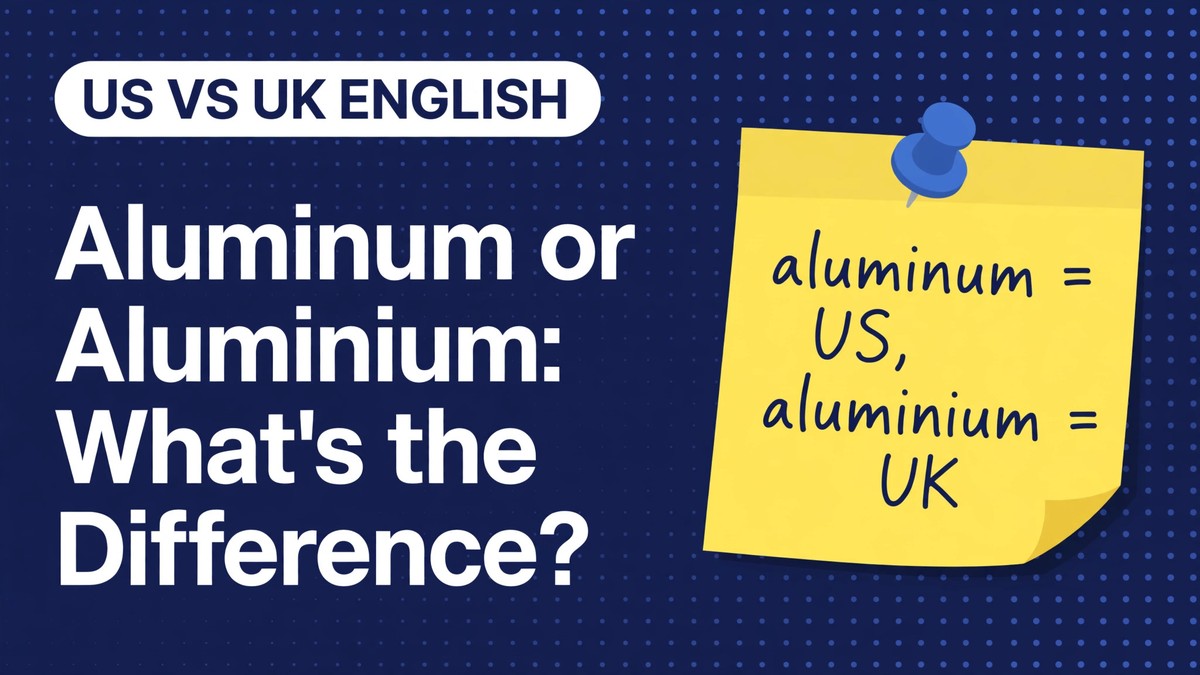
    The aluminum or aluminium question confuses writers because both spellings are correct, they are simply the American and British spellings of the same lightweight metal, element 13 on the periodic table. Aluminum is the standard spelling in the United States and Canada, while aluminium is the standard spelling in the United Kingdom, Australia, and most of the rest of the English-speaking world. The meaning never changes, only the spelling does. This guide explains the history, the pronunciation difference, and which form to use for your audience. Check any sentence with the free Grammar Checker on the KnowsVista homepage.

    โšก Quick answer

    Use aluminum for American and Canadian readers: The pan is made of aluminum. Use aluminium for British, Australian, and other Commonwealth readers: The pan is made of aluminium. Both spellings are correct, pick the one your audience expects and use it consistently.

    ๐Ÿง  Memory trick: Aluminium ends in -ium, like sodium, potassium, and magnesium, the classic pattern for element names. Aluminum drops the i, the way American spelling often shortens words. Think: -ium = international, -um = US.

    When to use aluminum

    Aluminum is the standard American spelling, used in US industry, trade, science writing, and everyday language. The American Chemical Society officially adopted aluminum in 1925, and Merriam-Webster’s aluminum entry lists it as the chiefly US spelling of the element. If you are writing for an American audience, a US school, business, or website, aluminum is the only natural choice.

    โœ“ The window frames are made of lightweight aluminum.

    โœ“ Please recycle your empty aluminum cans.

    โœ“ Aluminum foil keeps leftovers fresh in the fridge.

    โœ“ The aircraft’s body uses an aluminum alloy for strength.

    โœ“ Aluminum is the most abundant metal in the Earth’s crust.

    โœ— The London shop sells aluminum foil. โ†’ โœ“ The London shop sells aluminium foil.

    The rule is audience-first: an American reader expects aluminum, and the -ium spelling will look like a typo to them. The same audience-first logic settles other US vs UK pairs like mold or mould.

    When to use aluminium

    Aluminium is the standard spelling in the United Kingdom, Ireland, Australia, New Zealand, and most Commonwealth countries, and it is the name preferred by IUPAC, the International Union of Pure and Applied Chemistry. It is also the spelling used in British science, engineering, and everyday writing. If your readers are British or international, aluminium is correct, and aluminum will look like an Americanism.

    โœ“ The factory produces aluminium extrusions for the building trade.

    โœ“ Wrap the sandwiches in aluminium foil before the picnic.

    โœ“ Aluminium is prized for being both light and rust-resistant.

    โœ“ The Australian plant refines bauxite into aluminium.

    โœ“ She bought an aluminium ladder because it is easy to carry.

    โœ— The New York store sells aluminium cans. โ†’ โœ“ The New York store sells aluminum cans.

    Notice that the sentences are identical apart from the spelling, the metal, the meaning, and the grammar never change. That “same word, different spelling” pattern is exactly what our curb or kerb guide shows for another US vs UK pair.

    The tricky exceptions

    Why two spellings exist at all

    The element’s discoverer, Sir Humphry Davy, first called it alumium in 1808, then aluminum in 1812, and British scientists soon settled on aluminium to match the -ium pattern of other elements. In the US, Noah Webster’s 1828 dictionary listed only aluminum, and American industry followed. Neither side made a mistake, history simply split the spelling down the Atlantic.

    โœ“ Davy first named the metal alumium, then aluminum, before aluminium won out in Britain.

    Canada uses aluminum, Australia uses aluminium

    Do not assume every Commonwealth country agrees: Canada follows the US and uses aluminum, while Australia, New Zealand, and South Africa use aluminium. When in doubt, match the spelling of the country you are writing for, not the spelling of its neighbours.

    โœ“ The Canadian supplier lists aluminum siding, while the Australian supplier lists aluminium siding.

    The pronunciation is different too

    Americans say uh-LOO-mih-num (four syllables), while Brits say al-yoo-MIN-ee-um (five syllables). The extra syllable comes from the extra i. This is why the two forms sound like different words even though they name the same metal.

    โœ“ Americans pronounce it “uh-LOO-mih-num”; Brits pronounce it “al-yoo-MIN-ee-um.”

    Aluminum vs aluminium at a glance

    AluminumAluminium
    Used inUnited States, CanadaUK, Ireland, Australia, most Commonwealth countries
    Spelling clueEnds in -um (shorter, American style)Ends in -ium (like sodium, potassium, magnesium)
    Pronunciationuh-LOO-mih-num (4 syllables)al-yoo-MIN-ee-um (5 syllables)
    Official backingAmerican Chemical Society (1925)IUPAC preferred name (1990)
    MeaningIdentical, element 13, a light silvery metalIdentical, element 13, a light silvery metal
    ExampleAluminum cans are easy to recycle.Aluminium cans are easy to recycle.

    Quick practice

    Fill in the blank with aluminum or aluminium:

    1. The Texas factory casts __________ engine parts.
    2. Her London flat has __________ window frames.
    3. Canadian stores stock __________ foil in every aisle.
    4. The Sydney workshop ordered sheets of __________ for the roof.

    Answer key:

    • 1. aluminum (Texas = US spelling)
    • 2. aluminium (London = UK spelling)
    • 3. aluminum (Canada follows the US spelling)
    • 4. aluminium (Sydney = Australian spelling)

    Frequently Asked Questions

    Which is correct: aluminum or aluminium?

    Both are correct. Aluminum is the standard spelling in the United States and Canada; aluminium is the standard spelling in the UK, Australia, and most other English-speaking countries. Use the spelling your audience expects.

    Why do Americans spell it aluminum?

    Noah Webster’s 1828 dictionary listed only aluminum, and the American Chemical Society officially adopted it in 1925. American industry and publishing followed, so aluminum became the fixed US spelling.

    Is aluminium the scientific name?

    IUPAC, the international chemistry body, adopted aluminium as its preferred name in 1990, but it recognises aluminum as an acceptable variant. In practice, American scientific journals still use aluminum.

    How do you pronounce aluminium?

    British pronunciation is al-yoo-MIN-ee-um, with five syllables. American aluminum is pronounced uh-LOO-mih-num, with four syllables.

    Can I mix aluminum and aluminium in one document?

    No, pick one spelling and use it consistently throughout a document. Mixing them looks like careless editing, even though both forms are correct on their own.

    Final thoughts

    Aluminum and aluminium are the same metal with two passports: aluminum for the US and Canada, aluminium for the UK and most of the world. Remember the -ium pattern, sodium, potassium, magnesium, aluminium, and match your spelling to your readers. Get the audience right and you can never get this word wrong. Lock the rule in with the free Spelling Quiz.