Category: Spelling Check

Which spelling is correct? Quick answers with examples.

  • Leafs or Leaves? Which Spelling Is Correct in 2026?

    Leafs or Leaves? Which Spelling Is Correct in 2026?

    Leafs or Leaves? Which Spelling Is Correct in 2026?

    Leafs or leaves is a plural spelling question that trips up even confident writers, because English has two competing patterns for words ending in “f.” The standard answer is simple: leaves is the correct plural of “leaf” in almost every case. “Leafs” looks logical, just add an “s”, but it is only correct in one narrow, special case, explained below. The same f-to-ves pattern decides our wifes or wives guide.

    The confusion is understandable. Most English plurals simply add “s”: book becomes books, car becomes cars, tree becomes trees. But a small family of nouns ending in “f” or “fe” changes the “f” to “v” and adds “es”: leaf becomes leaves, wife becomes wives, life becomes lives. Once you know which family “leaf” belongs to, the spelling becomes automatic.

    โšก Quick answer

    Always write leaves for the plural of “leaf”: The leaves turned gold in October. “Leafs” is not the general plural. The only standard use of “leafs” is as a verb meaning to turn pages quickly (“she leafs through the magazine”) or in the proper name Toronto Maple Leafs.

    ๐Ÿง  Memory trick: Think of the v in “leaves” as a vein running through a leaf. No vein, no leaf, and no correct plural without that v.

    When to use leaves

    Use leaves whenever you mean more than one leaf, the flat, green part of a plant or tree. Merriam-Webster’s leaf entry gives “leaves” as the plural, and every major dictionary agrees. This covers autumn foliage, tea leaves, leaves on a table, and leaves in a book (the pages of a book are also called leaves).

    โœ“ The leaves fell thick and fast after the first frost.

    โœ“ She raked the leaves into a pile for the children to jump in.

    โœ“ Green tea leaves are picked by hand in the spring.

    โœ“ The old diary had several loose leaves tucked inside its cover.

    โœ— The leafs are changing colour. โ†’ โœ“ The leaves are changing colour.

    “Leaves” is also the third-person singular of the verb “to leave”, “she leaves at six”, which is a different word entirely, though spelled the same way. Context always makes the meaning clear, and neither use is ever spelled “leafs.”

    โœ“ He leaves for work before sunrise every morning.

    When to use leafs (the rare exceptions)

    Leafs is correct in exactly two situations. First, as a verb: when someone turns the pages of a book or magazine quickly, they “leaf through” it, and in the third person that becomes “she leafs through.” Second, as part of a proper name: the Toronto Maple Leafs hockey team keeps the “Leafs” spelling as a trademarked team name. Outside those two cases, “leafs” is a spelling error. Our heros or heroes guide shows the same pattern, where the “es” plural wins over the simple “s.”

    โœ“ He leafs through the newspaper every morning before breakfast.

    โœ“ The Toronto Maple Leafs played at home last night.

    โœ— The tree lost all its leafs in November. โ†’ โœ“ The tree lost all its leaves in November.

    The tricky exceptions

    Not every f-word changes to v

    English is inconsistent here, which is why the rule feels unfair. Some f-words simply add “s”: roofs, chiefs, proofs, beliefs, safes. Others change to “ves”: leaves, wives, lives, knives, wolves. There is no perfect rule, so the honest advice is to memorise the short “ves” family, leaf, wife, life, knife, wolf, calf, half, loaf, thief, and add “s” to everything else unless a dictionary says otherwise.

    โœ“ The roofs of the houses were covered in snow. (Roof keeps its f.)

    โœ“ The baker sliced two loaves for the morning rush. (Loaf changes to v.)

    Leaf as a verb: “to leaf”

    The verb “to leaf” means to put out leaves (a tree leafs in spring) or to turn pages (she leafs through a catalogue). Its forms are leaf, leafs, leafing, leafed. Confusingly, “leafed” is the past tense of this verb, while “leaved” describes something that has leaves, as in “a well-leaved tree.” Keep the verb and the noun in separate boxes and they stop colliding.

    โœ“ The oak leafs late, sometimes not until May.

    โœ“ She leafed through the brochure without reading a word.

    Compound words: maple leaf, bay leaf, gold leaf

    In compounds, the plural still follows the same rule: maple leaves, bay leaves, fig leaves. “Gold leaf” is a mass noun, thin sheets of gold, so it has no plural at all; you say “sheets of gold leaf,” not “gold leaves.” The same logic explains why our buses or busses guide treats a doubled consonant as a red herring: the plural rule belongs to the base word, not to the compound.

    โœ“ Add two bay leaves and simmer for twenty minutes.

    โœ“ Canadian flags show a single red maple leaf; the forest floor is covered in maple leaves.

    Leafs vs leaves at a glance

    LeafsLeaves
    Correct?Only as a verb or team nameAlways, as the plural noun
    MeaningTurns pages; Toronto Maple LeafsMore than one leaf; also “she leaves”
    Part of speechVerb, third-person singularNoun, plural; verb, third-person singular of “leave”
    Memory aid,The v is the vein in the leaf
    Exampleโœ“ She leafs through the magazine.โœ“ Autumn leaves covered the path.

    Quick practice

    Choose leafs or leaves for each sentence:

    1. The oak tree dropped all its ______ in a single week.
    2. He ______ through the report while waiting for the meeting.
    3. Fresh mint ______ make the tea taste much better.
    4. The Toronto Maple ______ won their home game last night.

    Answer key:

    • 1. leaves (plural noun)
    • 2. leafs (verb, “leafs through”)
    • 3. leaves (plural noun)
    • 4. Leafs (proper team name)

    Frequently Asked Questions

    Is it leafs or leaves?

    It is leaves. “Leafs” is only correct as a verb (“she leafs through a book”) or in the Toronto Maple Leafs team name. As the plural of the noun “leaf,” always write leaves.

    Why does leaf change to leaves?

    Leaf belongs to a small group of nouns ending in “f” or “fe” that change the “f” to “v” and add “es” in the plural: leaf/leaves, wife/wives, life/lives, knife/knives. The change goes back to Old English pronunciation, where the “f” was voiced to “v” between vowels.

    Is “leafs” ever correct in everyday writing?

    Yes, but rarely: only when “leaf” is a verb. “She leafs through the catalogue” is correct. If you mean more than one leaf from a tree, “leafs” is always wrong.

    What is the plural of “maple leaf”?

    Maple leaves. The plural rule applies to the final word of the compound, so bay leaf becomes bay leaves and fig leaf becomes fig leaves.

    Is “leafs” acceptable in American English?

    No. American and British English agree here: the plural noun is leaves on both sides of the Atlantic. The verb “leafs” and the Toronto team name are the only exceptions in either variety.

    Final Thoughts

    Leaves is the plural you need in almost every sentence you will ever write, the f turns to v, the es follows, and the autumn foliage stays correctly spelled. Save leafs for turning pages and for hockey, and the vein-in-the-leaf trick will keep the two apart for good. For the next member of the f-to-ves family, our wifes or wives guide works exactly the same way.

  • Elseโ€™s or Elses? Correct Spelling, Examples, and Grammar Guide

    Elseโ€™s or Elses? Correct Spelling, Examples, and Grammar Guide

    Elseโ€™s or Elses? Correct Spelling, Examples, and Grammar Guide

    Elseโ€™s or elses is one of those questions that looks tiny and causes big embarrassment, because the wrong form slips past spellcheckers and into professional emails. The answer is clear: elseโ€™s is correct, and elses is not a standard English word. The apostrophe shows possession, something belongs to “someone else”, and the ‘s always attaches to “else,” never to the pronoun before it. The same possessive-placement logic runs through our Chris’s or Chris’ guide.

    “Else” itself means “other” or “in addition.” It follows words like someone, anyone, everybody, nobody, and what: someone else, anything else, who else. When that whole phrase owns something, English puts the possessive ending on the last word of the phrase, which is “else.” That is why we write “someone else’s car” and never “someone’s else car” or “someone elses car.”

    โšก Quick answer

    Use elseโ€™s for possession: Please don’t read someone else’s messages. Never write “elses”, “else” has no plural, so a plain “s” with no apostrophe is always wrong. The ‘s goes on else, not on the pronoun: someone else’s, not someone’s else.

    ๐Ÿง  Memory trick: The last word owns it. In “someone else’s book,” the book belongs to the whole phrase, and the possessive marker lands on its last word, else. Last word, last letter: else + ‘s.

    When to use elseโ€™s

    Use elseโ€™s whenever a phrase ending in “else” owns or is connected to a noun that follows it. Merriam-Webster’s else entry defines “else” as “being different in identity”, somebody else, what else, and the possessive of those phrases always lands on “else.” Dictionaries and usage guides agree: “somebody else’s” and “everybody else’s” are the standard forms, while “somebody’s else” is nonstandard.

    โœ“ Please don’t read someone else’s messages.

    โœ“ Everyone else’s plans worked out better than mine.

    โœ“ Does anyone else’s dog bark at the vacuum cleaner?

    โœ“ This umbrella isn’t mine, it must be somebody else’s.

    โœ“ Nobody else’s opinion matters as much as your own judgment.

    โœ— Please don’t read someone elses messages. โ†’ โœ“ Please don’t read someone else’s messages. (Possession needs the apostrophe.)

    โœ— That is someone’s else idea. โ†’ โœ“ That is someone else’s idea. (The ‘s goes on “else,” the last word.)

    When to use else (without the possessive)

    Plain else, no apostrophe, no s, is the form you need whenever there is no possession involved. It appears after indefinite pronouns (someone else, nobody else), after question words (what else, who else, where else), and in the phrase “or else,” meaning “otherwise.” If nothing is owned, nothing gets an apostrophe. The same no-possession-no-apostrophe rule runs through our wifes or wives guide, where a plural and a possessive are easy to mix up.

    โœ“ Is there anything else you would like to add?

    โœ“ Who else is coming to the meeting?

    โœ“ Finish your homework, or else you can’t go out tonight.

    โœ“ Nobody else volunteered, so I took the job.

    โœ— Who else’s is coming tonight? โ†’ โœ“ Who else is coming tonight? (No possession, drop the ‘s.)

    The tricky exceptions

    “Whose else”, the one exception

    There is exactly one accepted exception. With “who else,” the possessive is sometimes formed as “whose else”, but only when no noun follows it. “Is this book yours? Whose else could it be?” Here “whose” already carries the possession, so “else” stays bare. As soon as a noun follows, the normal rule returns: “Whose else’s book is this?” is wrong; “Who else’s book is this?” is right.

    โœ“ Is this pen yours? Whose else could it be? (No noun follows, the rare exception.)

    โœ“ Who else’s pen is this? (A noun follows, normal rule applies.)

    Why “elses” feels right but isn’t

    “Elses” feels plausible because English usually makes plurals and possessives by adding s. But “else” is not a noun, it is an adverb/adjective meaning “other”, and it has no plural. You cannot have two “elses” any more than you can have two “verys.” The only correct way to add an s to “else” is with an apostrophe, for possession. The same part-of-speech logic explains our heros or heroes guide, where a real plural rule works very differently.

    โœ— The elses of the group disagreed. โ†’ โœ“ Everyone else in the group disagreed. (“Else” cannot be pluralized.)

    โœ“ I borrowed somebody else’s charger, mine is at home.

    British and American English agree here

    Unlike some spelling pairs, “else’s” is identical on both sides of the Atlantic. British and American writers both write “someone else’s,” both reject “elses,” and both keep the ‘s on “else.” There is no regional variant to learn, one rule covers every English-speaking audience.

    โœ“ (UK) It was somebody else’s turn to wash up. โœ“ (US) It was somebody else’s turn to do the dishes.

    Elseโ€™s vs elses at a glance

    Elseโ€™sElses
    Correct?Yes, the possessive formNo, not a standard word
    MeaningBelonging to someone else, anyone else, etc.Nothing, a misspelling
    WhyThe ‘s marks possession on the phrase’s last word“Else” is not a noun and has no plural
    Memory aidLast word owns it: else + ‘sNo apostrophe, no possession, no word
    ExampleSomeone else’s keys are on the table.โœ— Someone elses keys are on the table.

    Quick practice

    Choose else’s, else, or elses, and try our Grammar Checker for more possessive practice:

    1. That jacket is somebody __________, not mine.
    2. What __________ do we need from the shop?
    3. The teacher collected everyone __________ homework.
    4. Who __________ car is blocking the driveway?

    Answer key:

    • 1. else’s (possession, no noun follows but ownership is meant)
    • 2. else (no possession, just “what other”)
    • 3. else’s (everyone else’s homework, possession)
    • 4. else’s (who else’s car, possession before a noun)

    Frequently Asked Questions

    Which is correct: elses or else’s?

    Else’s is correct. “Elses” is not a standard English word, because “else” has no plural form, the apostrophe-s marks possession only.

    Is it “someone’s else” or “someone else’s”?

    It is “someone else’s.” The possessive ending always goes on the last word of the phrase, which is “else.” “Someone’s else” is nonstandard.

    Can I ever use “elses”?

    No. “Elses” does not appear in standard dictionaries and is never correct in formal or informal writing. If you mean possession, write “else’s”; if you mean “other,” write “else.”

    What about “whose else”?

    “Whose else” is the one exception, used only when no noun follows: “Whose else could it be?” When a noun follows, use “who else’s” instead.

    Does British English use “else’s” differently?

    No. British and American English both use “else’s” for the possessive and both reject “elses.” One rule works everywhere.

    Final Thoughts

    Elseโ€™s is the only correct possessive, the apostrophe lands on “else,” the last word of the phrase, and “elses” without an apostrophe is never a word at all. Remember “last word owns it,” and this tiny mark will never trip you again. For the next possessive puzzle, our Chris’s or Chris’ guide applies the same last-word logic to names.

  • Buses or Busses? Which Spelling Is Correct in 2026 ?

    Buses or Busses? Which Spelling Is Correct in 2026 ?

    Buses or Busses? Which Spelling Is Correct in 2026 ?

    Buses or busses is a spelling question with a clear winner in 2026: buses is the standard plural of the vehicle, used in American and British English alike. Busses is an old variant plural that has almost disappeared, and today it is far more likely to be the verb form, as in โ€œshe busses tables.โ€ One letter changes the meaning, so the choice matters. The same doubling question drives our putting or puting guide.

    The confusion is understandable. English usually doubles a final consonant before an ending, stop becomes stopped, drop becomes dropped, so bus becoming busses looks logical. But bus breaks that pattern, and every major dictionary and style guide now recommends buses for the plural.

    โšก Quick answer

    Use buses for more than one bus: Three buses waited outside the school. Use busses only as a verb form, he busses tables, or as the verb โ€œto buss,โ€ meaning to kiss. If it is a vehicle, it is always buses.

    ๐Ÿง  Memory trick: A bus takes you places; a buss makes you blush. Buses = vehicles. Busses = kisses (or clearing tables). If nobody is kissing or clearing a table, spell it with one s in the middle.

    When to use buses

    Buses is the plural of the noun bus, formed the regular way for nouns ending in s: add -es. Class becomes classes, kiss becomes kisses, and bus becomes buses. Dictionary.comโ€™s buses or busses guide notes that both forms were once acceptable, but buses is now used almost exclusively and is considered the standard form. It is also the plural in computing, where a computerโ€™s data paths are called buses.

    • โœ“ The city added five new buses to its fleet.
    • โœ“ Tourists boarded the buses heading to the museum.
    • โœ“ School buses line up outside the gate every afternoon.
    • โœ“ The airport buses passengers to the terminal every ten minutes.
    • โœ“ Business opportunities are like buses, there is always another one coming.
    • โœ— There were three busses waiting outside. โ†’ โœ“ There were three buses waiting outside.

    Note that the verb form in the fourth example is also buses: โ€œthe airport buses passengersโ€ uses one s in the middle. As a verb meaning โ€œto transport by bus,โ€ the standard spelling is buses, bused, and busing, the doubled forms exist but are the minority choice.

    When to use busses

    Busses survives in two verb roles. First, it is the third-person singular of to bus in its restaurant sense, โ€œto clear tablesโ€: she busses tables on weekends, with the past forms bussed and bussing. Second, it is a form of the old verb to buss, meaning to kiss, especially in older or playful writing: she busses him on the cheek. In both cases, busses is a verb, never the plural of the vehicle in modern writing.

    • โœ“ He busses tables at the cafรฉ after school.
    • โœ“ The company busses employees to the city centre every morning. (Verb, transport sense, doubled form also accepted.)
    • โœ“ In the old novel, she busses her grandmother goodbye. (Verb, to kiss.)
    • โœ“ He spent the summer bussing tables and saving for college.
    • โœ— The tour busses were late. โ†’ โœ“ The tour buses were late. (Plural noun, not a verb.)

    The history explains the confusion: busses was the common plural in 19th-century British print, and dictionaries listed it as a variant for decades. By the mid-20th century, buses had taken over worldwide. The same stress-and-doubling logic decides our totaling or totalling guide.

    The tricky exceptions

    Why bus does not double like โ€œstoppedโ€

    Doubling usually protects a short vowel: stop becomes stopped so it is not read as stoped. With bus, there is no such danger, buse is not a common word that could confuse a reader, and the pronunciation of buses (/BUS-iz/) is obvious. That is why English settled on buses, just as it settled on gases rather than gasses for the plural of gas.

    โœ“ The lab handles several gases. โœ“ The depot runs several buses. โœ— The depot runs several gasses-style doubles.

    Busing, bused, bussing, bussed, both sets exist for verbs

    For the verb, both spelling families are in use: buses, busing, bused and busses, bussing, bussed. Dictionaries accept both, with the doubled set more common for the restaurant verb and the single set more common for transport. Whichever you choose, stay consistent inside one document, never write โ€œbusingโ€ in one paragraph and โ€œbussingโ€ in the next.

    โœ“ She is busing to work this week. โœ“ She is bussing tables this week. โœ— She is busing tables and bussing to work. (Mixed sets in one document.)

    Never write โ€œbusesโ€™โ€ or โ€œbussesโ€™โ€ for a plain plural

    An apostrophe never makes a plural. Busesโ€™ is only correct as a possessive, the busesโ€™ timetable, and bussesโ€™ is almost never needed at all. If you mean more than one bus, write buses, with no apostrophe and no extra s.

    โœ— Three busesโ€™ arrived late. โ†’ โœ“ Three buses arrived late. โœ“ The busesโ€™ timetable changed on Monday. (Possessive, correct.)

    Buses vs busses at a glance

    BusesBusses
    Part of speechPlural noun; also verbVerb only (modern use)
    MeaningMore than one vehicleClears tables; kisses
    Standard in 2026?Yes, everywhereNo, as a plural
    Verb formsBuses, busing, busedBusses, bussing, bussed
    ExampleFive buses left at noon.She busses tables.

    Quick practice

    Fill in the blank with buses or busses:

    1. Two __________ waited outside the hotel.
    2. He __________ tables at the restaurant on Saturdays.
    3. The school ordered six new __________ this year.
    4. In the old story, she __________ her mother goodbye.

    Answer key:

    • 1. buses (plural of the vehicle)
    • 2. busses (verb, to clear tables)
    • 3. buses (plural of the vehicle)
    • 4. busses (verb, to kiss, old use)

    Frequently Asked Questions

    Is it buses or busses?

    Buses. It is the standard plural of bus in both American and British English in 2026. Busses as a plural is archaic and will look like a mistake to most readers.

    Is busses ever correct?

    Yes, as a verb. Busses is the third-person singular of to bus (to clear tables) and of to buss (to kiss). It is not the modern plural of the vehicle.

    What about busing or bussing?

    Both are accepted verb forms. Busing and bused are more common for transport; bussing and bussed are more common for clearing tables. Pick one set and use it consistently.

    Do British and American English differ here?

    Not anymore. Buses is the favourite on both sides of the Atlantic. Busses survived longer in British print, but modern British style guides also recommend buses.

    How do I remember which spelling to use?

    Ask whether a vehicle is involved. Vehicles are always buses. If someone is clearing a table or giving a kiss in an old novel, busses is the verb you want.

    Final thoughts

    Buses is the plural to write, in school, at work, and on the road: no letter doubled, one syllable added, every style guide in agreement. Keep busses for the verb, bussing tables, bussed in by coach, and the old spelling will never trip you again. For the next doubling puzzle, our benefitting or benefiting guide settles it the same way.

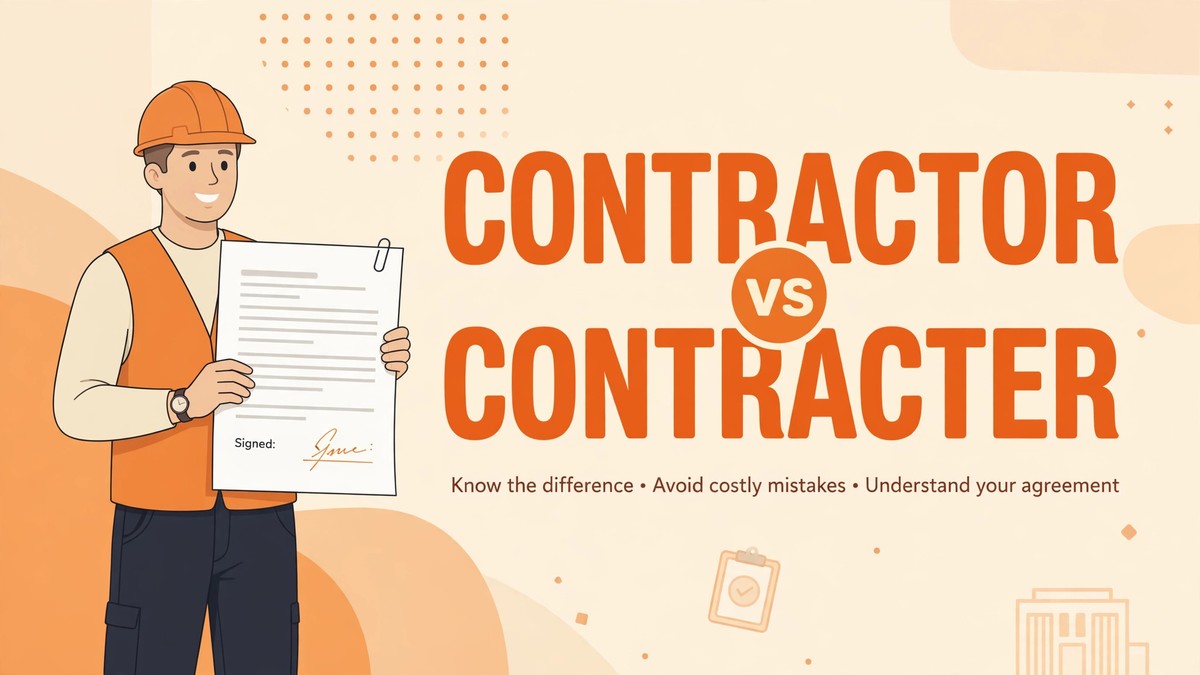
  • Contractor or Contracter: Which Spelling Is Correct?

    Contractor or Contracter: Which Spelling Is Correct?

    Contractor or Contracter: Which Spelling Is Correct?

    The contractor or contracter question has only one correct answer, and it is good news for anyone who has ever hesitated over it: contractor is correct in every variety of English, and contracter is not a word at all. A contractor is a person or company that enters into a contract to do a job or provide a service, from building a house to consulting on a project. The -or ending comes from Latin, and it is the reason the -er spelling never works here. Check any sentence with the free Grammar Checker on the KnowsVista homepage.

    โšก Quick answer

    Always use contractor: We hired a contractor to renovate the kitchen. Never use contracter, it appears in no dictionary and will be flagged as a misspelling in American, British, and every other variety of English.

    ๐Ÿง  Memory trick: Contractor belongs to the Latin -or family: act-or, direct-or, creat-or, contract-or. If the word came from Latin, it keeps its -or. Think: contractOR does the contract, and or rhymes with the Latin ending it kept.

    When to use contractor

    Contractor is a noun for a person or business that agrees, under a formal contract, to perform work or provide services for another party. Merriam-Webster’s contractor entry defines it as one that contracts to perform work or provide supplies, and as a person who contracts to do work. It is spelled the same way in American and British English, and its plural is contractors.

    โœ“ We hired a contractor to renovate the kitchen.

    โœ“ The general contractor managed the whole building project.

    โœ“ She works as an independent contractor, not a full-time employee.

    โœ“ The government awarded the contractor a three-year service deal.

    โœ“ Subcontractors report to the main contractor on site.

    โœ— The firm hired a skilled contracter for the repairs. โ†’ โœ“ The firm hired a skilled contractor for the repairs.

    Use contractor in every register, emails, contracts, job ads, and essays alike. There is no informal version of this word. The same Latin-root logic appears in our precede vs proceed guide.

    When to use contracter

    Never. Contracter is not an accepted variant, a British spelling, or an informal form, it is simply a misspelling. It shows up only because English has so many genuine -er agent words (teacher, builder, writer, runner) that writers guess the pattern by sound. Sound is a bad guide here: contractor and contracter are pronounced almost identically, but only one is in the dictionary. If you see contracter on a business website or a job posting, treat it as a red flag for careless proofreading.

    โœ— Looking for a reliable contracter near you? โ†’ โœ“ Looking for a reliable contractor near you?

    โœ— The contracter finished the roof on Friday. โ†’ โœ“ The contractor finished the roof on Friday.

    โœ— Our team of contracters is ready to help. โ†’ โœ“ Our team of contractors is ready to help.

    โœ“ The contractor signed the agreement before work began. (Always -or, in every country.)

    โœ“ A good contractor gives a written quote first. (No exception for casual writing.)

    โœ— Spellcheck accepted contracter because it looks like teacher. โ†’ โœ“ Spellcheck should flag contracter; the correct form is contractor.

    The key point: this is not a US-vs-UK choice or a matter of preference. Unlike realise/realize, there is no second correct form to pick from. This “one correct form” pattern also appears in our putting or puting guide.

    The tricky exceptions

    “-or” vs “-er” is about word history, not a fixed rule

    As a rough guide, Latin-derived agent words take -or (actor, director, contractor, creator, inventor), while Germanic-rooted or newer words take -er (teacher, builder, writer, plumber). But it is only a rough guide: adviser and advisor are both accepted, and sailor keeps -or despite its Germanic roots. So do not guess from the rule alone, for contractor, memorize the word itself. It is always -or.

    โœ“ The actor thanked the director and the contractor. โœ“ The teacher praised the builder. Both families are correct, just not interchangeable.

    “Contractor” is not “constructor”

    A contractor is defined by the contract, the agreement to do the work. A constructor is defined by the building itself, one who constructs. In construction, a firm is called a contractor because its first job is entering into the agreement, even if it then builds. Use contractor for the business role and constructor only when you mean the act of building in a technical or legal sense.

    โœ“ The contractor signed the deal to build the bridge. โœ“ The bridge’s steel constructor supplied the beams. (Different words, different jobs.)

    Related words keep the “-or” too

    The whole word family keeps the Latin ending: contractor, contractors, subcontractor, contractual. The verb is contract (contracted, contracting), and the noun for the agreement itself is contract. None of these ever takes an -er agent ending, there is no subcontracter either.

    โœ“ The subcontractor signed a contractual agreement. โœ— The subcontracter signed the deal. โ†’ โœ“ The subcontractor signed the deal.

    Contractor vs contracter at a glance

    ContractorContracter
    StatusCorrect, standard wordMisspelling, not in dictionaries
    Used inUS, UK, Canada, Australia, everywhereNowhere standard
    OriginLatin contractor, “one who makes a contract”False pattern from -er words like teacher
    Pluralcontractors,
    Related wordssubcontractor, contractual, contract,
    ExampleWe hired a contractor.We hired a contracter. โœ—

    Quick practice

    Fill in the blank with contractor or contracter:

    1. We hired a __________ to remodel the bathroom.
    2. The __________ finished the roof on Friday. (US)
    3. The __________ finished the roof on Friday. (UK, same answer!)
    4. Our team of __________ is ready to help. (plural)

    Answer key:

    • 1. contractor (the only correct spelling)
    • 2. contractor (US standard)
    • 3. contractor (UK standard too, no regional difference here)
    • 4. contractors (plural adds s to contractor)

    Frequently Asked Questions

    Is contracter a real word?

    No. Contracter is not listed in Merriam-Webster, Oxford, or Cambridge dictionaries. It is a common misspelling of contractor, caused by the many genuine -er words in English.

    Which is correct: contractor or contracter?

    Contractor is correct, always, in every variety of English. Contracter is never correct.

    Is contracter the British spelling?

    No. British English also uses contractor. This word has no US-vs-UK split at all.

    What is the plural of contractor?

    Contractors, just add s. There is no contracters form.

    What is the difference between a contractor and a subcontractor?

    A contractor holds the main contract with the client; a subcontractor is hired by that contractor to handle part of the work. Both words end in -or.

    Final thoughts

    Contractor is the word, full stop: Latin root, -or ending, same spelling in every country and every register. Contracter is a sound-alike trap built from teacher and builder, convincing to the ear, wrong on the page. Remember the -or family, actor, director, contractor, and you will never misspell it again. Lock the rule in with the free Spelling Quiz.

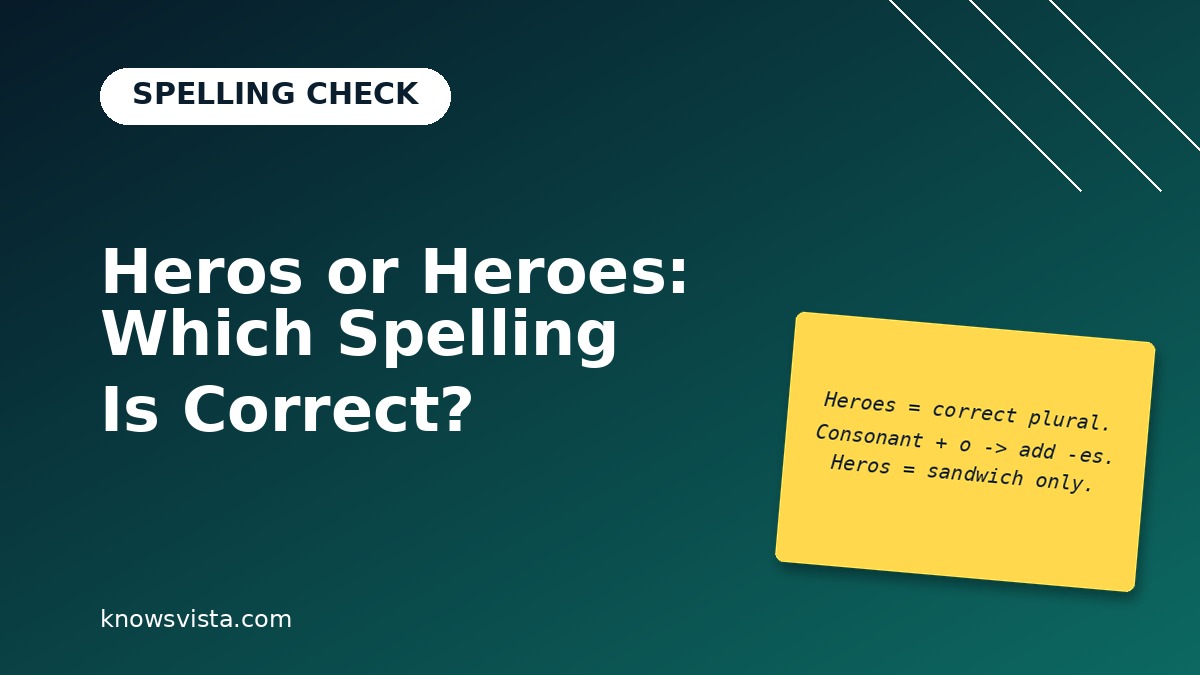
  • Heros or Heroes: Which Spelling Is Correct?

    Heros or Heroes: Which Spelling Is Correct?

    Heros or Heroes: Which Spelling Is Correct?

    Is the plural of hero spelled heros or heroes? “Heros or Heroes: Which Spelling Is Correct?” has a clear answer: heroes is the correct plural, heros is a misspelling in standard English.

    The rule behind it is simple: nouns ending in a consonant plus -o usually add -es, not just -s. This guide shows you the rule, the examples, and the one tricky case where heros actually appears. Find more plain-English spelling guides on the KnowsVista homepage.

    Below you’ll see when to use heroes, why heros looks tempting, the tricky exceptions that catch writers out, a quick practice quiz, and answers to the most common questions.

    โšก Quick answer

    Heroes is the correct plural of hero. Heros is a misspelling. Rule: nouns ending in a consonant + o add -es, hero โ†’ heroes, potato โ†’ potatoes, tomato โ†’ tomatoes.

    ๐Ÿง  Memory trick: Heroes are extraordinary, so they get an extra letter. Consonant + o โ†’ add -es, not just -s.

    When to use heroes

    Always write heroes when you mean more than one hero, real-life heroes, comic-book heroes, sports heroes, or everyday heroes. It also covers superheroes (one word, with the -es at the very end) and hero characters in books and films. There is no context in standard English where heros is the correct plural of the noun hero.

    • The firefighters were honored as local heroes.
    • Her childhood heroes included Marie Curie and her grandmother.
    • The movie’s heroes saved the city in the final act.
    • Frodo and Sam are the heroes of The Lord of the Rings.

    Why “heros” looks right but isn’t

    Never write heros as the plural of hero in finished writing. The mistake comes from English’s most common plural habit: just add -s.

    That works for most nouns, but nouns ending in a consonant plus -o are the special case that needs -es. The same instinct causes mistakes like potatos or tomatos. For another plural-rule puzzle, see wifes or wives.

    • โŒ The heros of the story were celebrated. โ†’ โœ… The heroes of the story were celebrated.
    • โŒ They dressed as their favorite superheros. โ†’ โœ… They dressed as their favorite superheroes.
    • โŒ Our heros wear scrubs, not capes. โ†’ โœ… Our heroes wear scrubs, not capes.
    • โŒ Two heros emerged from the crowd. โ†’ โœ… Two heroes emerged from the crowd.

    The tricky exceptions

    When “heros” is actually correct: the sandwich

    Here is the one real exception. A hero is also a type of large sandwich (called a sub in other regions), and the regional plural of the sandwich is often spelled heros. So “we ordered three heros for the meeting” can be correct, but only when you mean sandwiches, never brave people.

    Capitalized Heros is also a genus of South American fish and an occasional proper name. The plural rules for nouns like this are mapped out in Grammar Monster’s guide to the plural of hero, which lists the full table of -o endings.

    • heroes = more than one hero (brave person), the standard plural
    • heros = more than one hero sandwich (regional food term)
    • Heros (capital H) = a genus of fish, or a proper name
    • superheroes = compound word; the -es goes at the very end

    Not every -o word takes -es

    English is inconsistent here, so memorize the common ones. Nouns ending in a vowel + o just add -s: radio โ†’ radios, patio โ†’ patios. Modern or shortened words also take -s: photo โ†’ photos, piano โ†’ pianos, memo โ†’ memos.

    But hero, potato, tomato, echo, and volcano take -es. When in doubt, check a dictionary, guessing is exactly how heros spreads. Irregular plurals follow their own logic, as freshman or freshmen shows.

    • -es: hero โ†’ heroes, potato โ†’ potatoes, echo โ†’ echoes
    • -s only: photo โ†’ photos, piano โ†’ pianos, radio โ†’ radios
    • vowel + o: patio โ†’ patios, studio โ†’ studios
    • no rule to save you: zero โ†’ zeros or zeroes (both accepted)

    “Heros or Heroes: Which Spelling Is Correct?”, at a glance

    HeroesHeros
    StatusCorrect plural of heroMisspelling (except the sandwich)
    MeaningMore than one brave personMore than one hero sandwich (regional)
    ExampleThey are real heroes.We ordered three heros. (sandwiches)
    RuleConsonant + o โ†’ add -esNever use for brave people

    Quick practice

    Fill in the blank with heroes or heros:

    1. The ________ of the story were celebrated for their bravery.
    2. Which is the correct plural of “hero”: “heros” or “________”?
    3. We ordered three ________ for the lunch meeting. (sandwiches)
    4. The children’s favorite ________ wore capes and masks.
    5. ________ (brave people) get the -es ending, following the same rule as potatoes.

    Answer key:

    • 1. heroes (brave people always take -es)
    • 2. “heroes” (heros is the misspelling)
    • 3. heros (the one real exception: the sandwich)
    • 4. heroes (fictional heroes too)
    • 5. Heroes (capital H at the start of the sentence)

    Frequently Asked Questions

    Is “heros” ever correct?

    Only as the regional plural of the hero sandwich (a sub). For brave people, real, fictional, or comic-book, the only correct plural is heroes. Capitalized Heros is also a genus of fish, but that’s a proper name, not a plural.

    Why do words ending in -o add -es?

    Nouns ending in a consonant + o traditionally add -es to keep the pronunciation smooth: hero โ†’ heroes, potato โ†’ potatoes, echo โ†’ echoes. The pattern goes back centuries, though modern shortened words like photo โ†’ photos break it.

    What is the difference between “hero’s” and “heroes’”?

    Hero’s is the singular possessive: “the hero’s bravery” (one hero owns it). Heroes’ is the plural possessive: “the heroes’ awards” (many heroes own them).

    Never use an apostrophe to make a plain plural, hero’s as a plural is always wrong. For another possessive puzzle, see Chris’s or Chris’.

    How do you spell the plural of “superhero”?

    Superheroes. It’s one compound word, so the -es goes at the very end, following the same consonant + o rule as hero โ†’ heroes.

    Final thoughts

    So, “Heros or Heroes: Which Spelling Is Correct?”, the answer is heroes, every time you mean brave people. Consonant + o takes -es: heroes, potatoes, tomatoes. Save heros for the sandwich shop.

    It’s the same “learn the real rule” lesson as payed or paid. One rule learned, dozens of typos avoided.

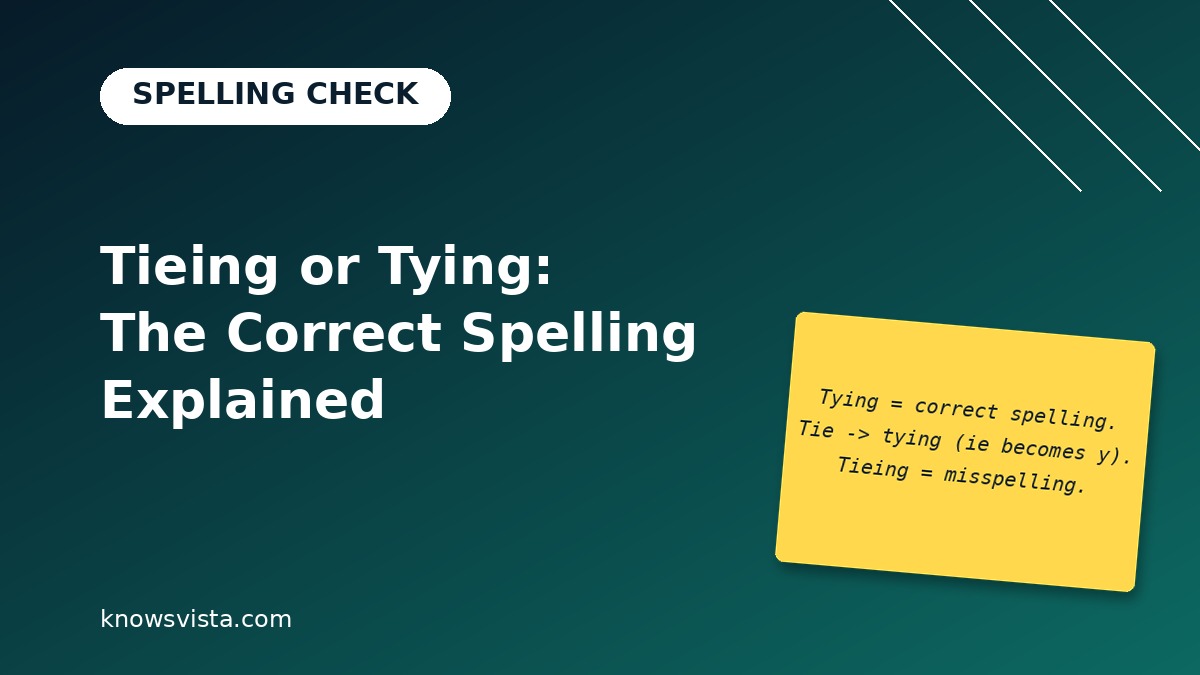
  • Tieing or Tying: The Correct Spelling Explained

    Tieing or Tying: The Correct Spelling Explained

    Tieing or Tying: The Correct Spelling Explained

    Should you write tieing or tying when someone is fastening their shoelaces? “Tieing or Tying: The Correct Spelling Explained” answers this once and for all: tying is the correct spelling, and tieing is a misspelling with no place in modern English.

    The confusion comes from a real rule, verbs ending in -ie change their spelling before -ing, and this guide walks you through it. Find more plain-English spelling guides on the KnowsVista homepage.

    Below you’ll see when to use tying, why tieing looks tempting but is wrong, the tricky exceptions that catch writers out, a quick practice quiz, and answers to the most common questions.

    โšก Quick answer

    Tying is the correct spelling, the present participle of tie. Tieing is a misspelling. Rule: verbs ending in -ie change the i to y before adding -ing (tie โ†’ tying, lie โ†’ lying, die โ†’ dying).

    ๐Ÿง  Memory trick: “IE becomes Y.” When you see -ie and -ing coming, swap the i for a y, tiey + ing never survives contact with the dictionary.

    When to use tying

    Always write tying for the present participle of tie. It covers fastening knots, securing laces, binding things together, and all the figurative uses like tying up loose ends or tying the knot (getting married).

    • She is tying her shoelaces before the race.
    • The sailors spent the morning tying knots at the dock.
    • We’re tying up loose ends before the launch.
    • Tying the package tightly keeps it from falling apart.

    Why “tieing” looks right but isn’t

    Never use tieing in finished writing. The mistake comes from the simplest instinct in English spelling: just add -ing to the verb.

    Tie + ing looks logical, but verbs ending in -ie are a special case, and skipping the i โ†’ y change marks the word as wrong instantly. This is the same trap as putting or puting, where a real rule beats a tempting shortcut.

    • โŒ He was tieing his shoes. โ†’ โœ… He was tying his shoes.
    • โŒ She is tieing the balloons. โ†’ โœ… She is tying the balloons.
    • โŒ They’re tieing the knot next June. โ†’ โœ… They’re tying the knot next June.
    • โŒ Tieing ends together makes a strong join. โ†’ โœ… Tying ends together makes a strong join.

    The tricky exceptions

    The whole -ie family follows the same rule

    The i โ†’ y change is not special to tie, it applies to every verb ending in -ie. Lie becomes lying, die becomes dying, and vie becomes vying.

    Learn the family once and you never have to guess. The spelling guides at eslbuzz.com’s tieing-or-tying page explain the -ie to -y change with the same step-by-step rule: drop the i, write y, then add -ing.

    • lie โ†’ lying (“He was lying on the sofa,” not lieing)
    • die โ†’ dying (“The phone battery is dying,” not dieing)
    • vie โ†’ vying (“Three teams are vying for the title,” not vieing)
    • tie โ†’ tying (the word that started this whole question)

    Watch out: -ee verbs keep both e’s

    Don’t over-apply the rule. Verbs ending in -ee, where the second e follows a vowel, keep both letters: free โ†’ freeing, see โ†’ seeing, agree โ†’ agreeing.

    The i โ†’ y change only happens when the ending is -ie (consonant sound + ie). And a plain silent-e verb just drops the e: bake โ†’ baking, write โ†’ writing. Knowing which pattern a verb belongs to removes every guess.

    • -ie verbs: tie โ†’ tying, lie โ†’ lying (i becomes y)
    • -ee verbs: see โ†’ seeing, free โ†’ freeing (nothing changes)
    • silent-e verbs: make โ†’ making, drive โ†’ driving (drop the e)
    • short-vowel verbs: put โ†’ putting, run โ†’ running (double the consonant, see seperate or separate for another classic doubling trap)

    “Tieing or Tying: The Correct Spelling Explained”, at a glance

    TyingTieing
    StatusCorrect standard spellingMisspelling, obsolete form
    MeaningFastening, securing, knottingNo meaning in modern English
    ExampleShe is tying her shoes.She is tieing her shoes. โŒ
    Rule-ie โ†’ -y before -ingAdding -ing without the change

    Quick practice

    Fill in the blank with tying or tieing (one of these is always wrong!):

    1. He was ________ his tie in front of the mirror.
    2. “________” is not a word, use the correct form.
    3. The climbers are ________ their ropes to the anchor.
    4. ________ a Windsor knot takes a little practice.
    5. Which is correct on a wedding invitation: “tieing the knot” or “________ the knot”?

    Answer key:

    • 1. tying (present participle of tie)
    • 2. “tieing” (it’s the misspelled form, that’s the point)
    • 3. tying (the i always becomes y)
    • 4. Tying (capital T at the start of the sentence)
    • 5. “tying” (the idiom is tying the knot)

    Frequently Asked Questions

    Is “tieing” ever correct?

    No. Tieing is an obsolete variant that appears only in very old texts; it is not accepted in modern standard English. Always write tying in finished writing, whether British or American English.

    What is the rule for verbs ending in -ie?

    Change the i to y before adding -ing: tie โ†’ tying, lie โ†’ lying, die โ†’ dying, vie โ†’ vying. This keeps the pronunciation clear and the spelling consistent across the whole -ie verb family.

    Why do spellcheckers sometimes miss “tieing”?

    Some older or limited dictionaries still list tieing as a rare variant, so a weak spellchecker may not flag it. Never trust the checker on this one, memorize the -ie โ†’ -y rule instead.

    Is it “tying” in British English too?

    Yes. Unlike words such as totaling/totalling, the spelling tying is identical in British and American English. There is no regional variation for this one.

    Final thoughts

    So, “Tieing or Tying: The Correct Spelling Explained” comes down to one rule: tying is correct, tieing is not. Change the i to y whenever an -ie verb meets -ing, and the whole family, lying, dying, vying, falls into place.

    It’s the same “learn the real rule, skip the shortcut” lesson as payed or paid. One rule learned, dozens of typos avoided.

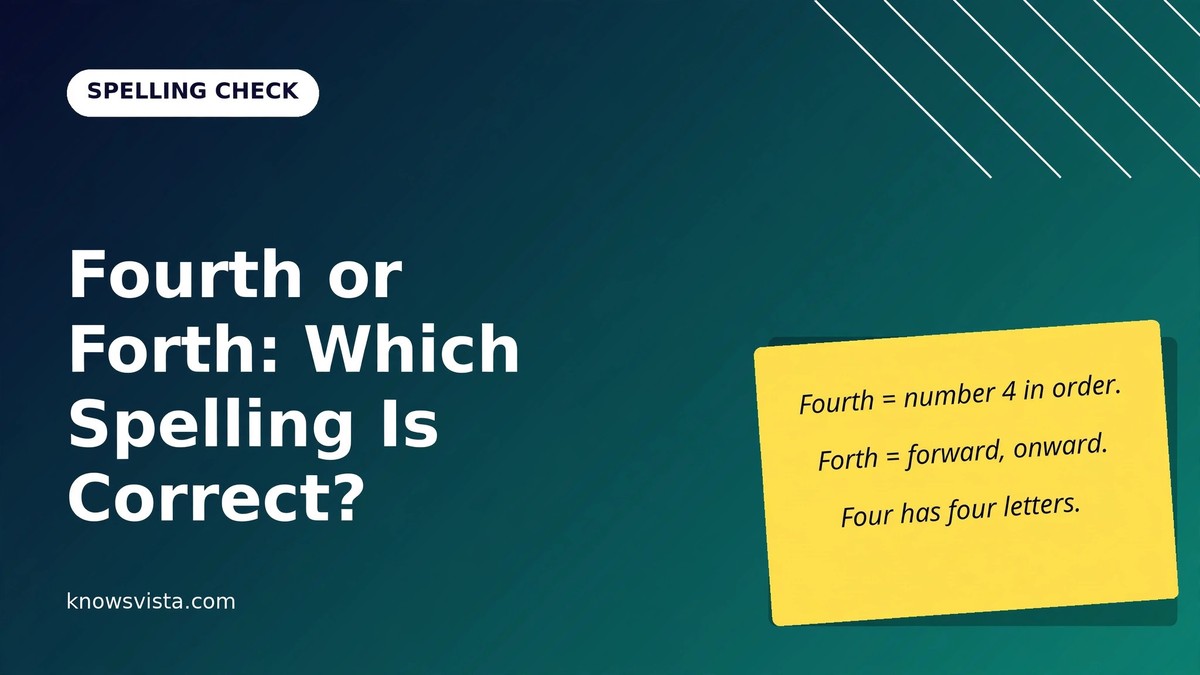
  • Fourth or Forth: Which Spelling Is Correct?

    Fourth or Forth: Which Spelling Is Correct?

    Fourth or Forth: Which Spelling Is Correct?

    One letter, u, separates these two words, and they sound identical in American speech. “Fourth or Forth: Which Spelling Is Correct?” trips writers because your ear offers no help at all: the answer depends entirely on whether a number is involved. Get it wrong and “she finished forth in the race” quietly breaks your sentence. This guide shows you which spelling means what, the set phrases that always take forth, and the exceptions that catch people out. Find more plain-English spelling guides on the KnowsVista homepage.

    โšก Quick answer

    Fourth is the ordinal number 4th, position in a sequence. Forth is an adverb meaning forward or onward. Both are correct words; they are never interchangeable.

    ๐Ÿง  Memory trick: FOURth has FOUR in it, if the number 4 fits, write fourth. Forth = forward without the w, if movement fits, write forth.

    When to use fourth

    Use fourth whenever the number 4 is involved: rank in a race, dates, chapters, or a quarter of something. It is the ordinal form of four, just as third is the ordinal of three. Spell it out or write 4th; both are fine.

    • She finished fourth in the state championship race.
    • The permit expires on the fourth of November.
    • This is the fourth time I have explained the rule.
    • About one-fourth of the staff called in sick.

    When to use forth

    Use forth for movement forward, outward, or into view, and inside fixed expressions. It never carries a number. If you can swap in forward or onward without breaking the sentence, forth is the spelling you want.

    • He stepped forth and introduced himself.
    • The judge asked the bailiff to bring forth the prisoner.
    • The sun broke forth from behind the clouds.
    • They argued back and forth for an hour.

    The tricky exceptions

    Fixed phrases that always take “forth”

    English keeps forth alive mostly inside set expressions, and these are non-negotiable. And so forth (etc.), back and forth, set forth, bring forth, and hold forth never take the u. Memorize the short list and the most common errors disappear. Writer’s Digest’s forth vs fourth grammar guide states the same test: if you know how to spell the number four, the ordinal is easy, fourth contains four, while forth is directional.

    • and so forth, “packets, envelopes, and so forth” (and more of the same)
    • set forth, “the report sets forth the new policy” (to state in detail)
    • hold forth, “he held forth on taxes for an hour” (to talk at length)

    Proper nouns: the Forth and the Fourth

    Two famous names override the rule. The Forth is a river in south-central Scotland, always without the u. The Fourth is shorthand for American Independence Day, July 4th, always with the u, because it is the ordinal. Copy proper names exactly; never “correct” them to fit the pattern. The same look-alike logic applies to other word pairs like farther vs further.

    • The Forth Bridge spans the Firth of Forth. (river, no u)
    • We watched the fireworks on the Fourth. (July 4th, with u)

    “Fourth or Forth: Which Spelling Is Correct?”, at a glance

    FourthForth
    StatusOrdinal number 4thAdverb, forward/onward
    Meaning4th in a sequenceForward, onward, into view
    ExampleShe finished fourth in the race.He stepped forth and spoke.
    TrickFOURth has FOUR in itForth = forward without the w

    Quick practice

    Fill in the blank with fourth or forth:

    1. He brought ________ his favorite idea for the project.
    2. She was ________ in line to buy a ticket.
    3. We packed sandwiches, drinks, fruit, and so ________.
    4. The ________ of July is a national holiday in the US.
    5. The witness came ________ with new evidence.

    Answer key:

    • 1. forth (bring forth = bring forward, fixed phrase)
    • 2. fourth (position 4 in a line, the number fits)
    • 3. forth (and so forth, fixed phrase, never “fourth”)
    • 4. Fourth (July 4th, the ordinal; capital F)
    • 5. forth (came forth = came forward into view)

    Frequently Asked Questions

    Are fourth and forth pronounced the same?

    In American English, essentially yes, both sound like /fษ”rฮธ/. That is why the ear cannot help: you must decide from the meaning. If the number 4 fits, it is fourth; if forward fits, it is forth.

    Is “forth” ever an ordinal?

    No. Forth is an adverb meaning forward or onward, never a number. The ordinal is always fourth. Writing “the forth chapter” is a spelling error.

    What does “and so forth” mean?

    It means “and more of the same”, it works exactly like etc. Example: “Bring pens, notebooks, folders, and so forth.” It is a fixed phrase and always takes the forth spelling.

    Why is the river spelled “Forth”?

    Because it is a proper name, and proper names keep their own spellings. The Forth is a river in Scotland; the spelling has nothing to do with the number four. Never “correct” a name to fit a grammar rule.

    Final thoughts

    “Fourth or Forth: Which Spelling Is Correct?” comes down to one question: is a number involved? Fourth holds the number four and marks 4th place; forth moves forward, onward, and into view inside phrases like and so forth. Learn the two memory tricks, FOURth has FOUR, forth = forward without the w, and the pair is solved. The same careful look separates other close pairs, like therefor or therefore. One question asked, two words placed.

  • Cue or Queue: Which Spelling Is Correct?

    Cue or Queue: Which Spelling Is Correct?

    Cue or Queue: Which Spelling Is Correct?

    They sound exactly like the letter Q, they share three letters, and they are spelled almost nothing alike. “Cue or Queue: Which Spelling Is Correct?” is really two questions in one: which word means what, and which spelling matches the meaning you want. The answer never depends on pronunciation, it depends on whether someone is waiting or being signaled. This guide shows you when to use each spelling, the meanings most people miss, and the exceptions that catch writers out. Find more plain-English spelling guides on the KnowsVista homepage.

    โšก Quick answer

    Cue is a signal or prompt to act. Queue is a waiting line, or an ordered sequence of things waiting their turn. Both are correct words; they are never interchangeable.

    ๐Ÿง  Memory trick: CUE = CLUE, a cue gives you a clue about what to do. QUEUE = waiting, the long spelling is a long line of people.

    When to use cue

    Use cue for anything that signals, hints, or prompts an action: a director’s signal, an actor’s line prompt, a subtle hint in conversation. As a verb, cue means to give that signal. The spelling is the short one, and the meaning is the active one.

    • The stage manager gave the cue, and the lights came up.
    • Her raised eyebrow was my cue to stop talking.
    • She cued the band to begin the final song.
    • His resignation was a cue for intense speculation.

    When to use queue

    Use queue for a line of people or things waiting in order: a checkout line, a support call queue, a print queue. It is especially common in British English, where queue is what Americans call a line. As a verb, queue means to arrange or form in a line.

    • There was a long queue at the checkout counter.
    • We had to queue for almost half an hour at the hotel.
    • The printer kept switching the items in the queue.
    • Top companies will be queuing up to hire her.

    The tricky exceptions

    Cue sticks, print queues, and “que”

    Both words have bonus meanings that do not fit the signal/line rule. A cue is also the long stick used in pool and billiards. A queue is also a braid of hair hanging down the back of the head, and in computing it is the standard word on both sides of the Atlantic (print queue). Meanwhile que is Spanish, not an English word, never use it as a shortcut. Merriam-Webster’s cue vs queue usage guide lists all these senses and repeats the core rule: cue for hints and prompts, queue for things arranged in lines.

    • Cue stick: “He picked up his cue and lined up the shot.” (sports equipment)
    • Print queue: “The document is stuck in the queue.” (computing)
    • Not English: โŒ que, a Spanish word, never a substitute

    Verb forms: cueing or cuing, queuing or queueing

    The present participles of both verbs come in two spellings, and both are recorded in dictionaries. Cueing and cuing are both correct; queuing and queueing are both correct. Pick one and stay consistent in the document. Note the substitution test that always works: if signal or prompt fits the sentence, write cue; if line fits, write queue. Same idea as other sound-alike pairs like peek or peak.

    • “She is cueing (or cuing) the next speaker.”, giving a prompt
    • “They are queuing (or queueing) outside.”, forming a line

    “Cue or Queue: Which Spelling Is Correct?”, at a glance

    CueQueue
    UsuallySignal, hint, or promptWaiting line or ordered sequence
    NounThat bell is our cue.The ticket queue moved.
    VerbCue the lights. (to prompt)Queue outside. (to line up)
    TrickCUE = CLUE (a hint)The long word = the long line

    Quick practice

    Fill in the blank with cue or queue:

    1. The sound of the gunshot is your ________ to come on stage.
    2. There was a long ________ for the rollercoaster.
    3. The director gave the actor a subtle ________ before his entrance.
    4. We ________ up for movie tickets every Friday night.
    5. Fix the sentence: “I was waiting for my cue at the supermarket.”

    Frequently Asked Questions

    Are cue and queue pronounced the same?

    Yes. Both are pronounced like the letter Q (/kjuห/). They are homophones, same sound, different spelling, different meaning. Listening alone will never tell you which spelling belongs, so check the meaning first.

    Is “que” a correct spelling of either word?

    No. Que is a Spanish word, not an English substitute for cue or queue. It is one of the most common search-level mistakes, never use it in English writing.

    Which is correct: “cueing” or “cuing”?

    Both. Dictionaries record cueing and cuing as participle spellings of the verb cue, just as they record queuing and queueing for queue. Use one consistently within each document.

    What does “on cue” mean?

    On cue means happening at exactly the expected signal or moment: “The dog barked on cue.” It always takes the cue spelling, because the meaning is a prompt, not a waiting line.

    Final thoughts

    “Cue or Queue: Which Spelling Is Correct?” always comes down to meaning: cue signals, queue waits. Run the substitution test, signal fits, write cue; line fits, write queue, and the homophone stops being scary. Keep que out of English entirely. The same meaning-first habit fixes other tricky pairs, like add vs ad. One test learned, two words handled.

  • Aunty or Auntie: Which Spelling Is Correct?

    Aunty or Auntie: Which Spelling Is Correct?

    Aunty or Auntie: Which Spelling Is Correct?

    You type “happy birthday, aunty” in a family chat, then freeze before sending the work email: is it aunty or auntie? “Aunty or Auntie: Which Spelling Is Correct?” is a friendlier question than most spelling debates, because here there is no villain. Both spellings are real words with the same meaning, but they are not used in exactly the same places. This guide shows you when each spelling fits, which one dictionaries list first, and the exceptions that can make either choice awkward. Find more plain-English spelling guides on the KnowsVista homepage.

    โšก Quick answer

    Both are correct. Auntie is the standard dictionary spelling of the affectionate form of aunt, and aunty is a widely used variant, especially common in British, Indian, and Australian English. Pick the spelling the person prefers and stay consistent.

    ๐Ÿง  Memory trick: Think auntIE = dIE-ctIonary standard, and auntY = Your family’s spelling. When in doubt, copy what the family writes.

    When to use auntie

    Use auntie as your default in formal writing, international contexts, and anywhere you want the safest choice. Cambridge and Merriam-Webster both list auntie as the headword spelling, with aunty shown as the variant. It carries the same warm, affectionate tone and is understood everywhere.

    • The children were happy to see their Auntie Mary.
    • Thank you for the birthday present, Auntie Louise.
    • We are visiting Auntie Sarah this weekend.
    • She baked cookies with her auntie every Sunday.

    When to use aunty

    Use aunty when it is the spelling the person or family already uses, or when writing in a regional voice, it is very common in India, Malaysia, Singapore, Australia, and the UK. In South Asian English it can also address any respected older woman, not just a relative. Match the person’s own spelling on cards, invitations, and family posts.

    • The friendly aunty at the food stall waved at us.
    • “Call Aunty and tell her we’re running late.”
    • This is Aunty Mei Ling, she’s like family.
    • The shop aunty gave me an extra serving.

    The tricky exceptions

    Formal writing wants plain “aunt”

    Neither auntie nor aunty belongs in formal or neutral writing, both are informal, affectionate forms. In reports, legal documents, and news articles, use plain aunt: “The child’s aunt attended the meeting.” The informal spelling is not wrong, it is simply too familiar for the tone. This works the same way as other accepted variant pairs, like theatre or theater, where context, not correctness, decides. The Cambridge Dictionary lists auntie as informal, with aunty as the variant spelling, which confirms the register point.

    • Formal: “Her aunt signed the school forms.” (neutral)
    • Informal: “Her auntie signed the school forms.” (warm, personal)

    Names, nicknames, and cultural landmines

    Three cases do not follow the “both are fine” rule. First, Auntie Beeb is a fixed nickname for the BBC, do not modernize it. Second, some adults dislike being called auntie or aunty by unrelated people, and in some communities the word can land as a comment on age, so ask before using it with non-relatives. Third, never “correct” someone else’s spelling: if a family writes Aunty on every card, that is the right spelling for them.

    • Nicknames: “Auntie Beeb” (the BBC), fixed, keep the spelling
    • Respect: ask before calling an unrelated adult aunty/auntie
    • Preference: copy the person’s own spelling, it is always “correct” for them

    “Aunty or Auntie: Which Spelling Is Correct?”, at a glance

    AuntieAunty
    StatusStandard dictionary spellingAccepted variant spelling
    MeaningAffectionate form of auntAffectionate form of aunt
    ExampleMy auntie and uncle are visiting.My aunty and uncle are visiting.
    TrickauntIE = dIE-ctIonary standardauntY = Your family’s spelling

    Quick practice

    Choose auntie or aunty (both are spelled correctly, pick the better fit):

    1. The kids ran to hug ________ Maya at the airport.
    2. In the formal report: “The child’s ________ attended the meeting.” (which word is too informal?)
    3. Your Malaysian friend’s family writes “________” on every birthday card. Keep or change it?
    4. ________ Beeb is the old nickname for the BBC.
    5. A stranger at the market calls an older vendor “________” in Mumbai. Is that normal there?

    Answer key:

    • 1. Auntie (safe default for a relative; either would work)
    • 2. aunt (both “auntie” and “aunty” are too informal for a report)
    • 3. Keep “aunty”, copy the family’s own spelling
    • 4. Auntie (fixed nickname: Auntie Beeb)
    • 5. Aunty is normal in Indian English as a respectful address

    Frequently Asked Questions

    Is “aunty” a real word?

    Yes. Aunty is a legitimate English spelling, listed by Cambridge and Merriam-Webster as a variant of auntie. It means the same thing and is not a typo.

    Which is more common, aunty or auntie?

    It depends on where you are. Auntie is the standard dictionary form and the safer choice internationally. Aunty is very common in Indian, Malaysian, Australian, and British English. Follow local and family usage.

    Can I call someone’s mother “aunty” if I’m not related?

    In many South and Southeast Asian cultures, yes, it is a respectful, warm address for an older woman. In other cultures it can feel presumptuous or age-focused. When in doubt, ask what they prefer to be called.

    What’s the difference between aunt and auntie?

    Aunt is the neutral, formal noun: a parent’s sister, or an uncle’s wife. Auntie/aunty is the informal, affectionate version, used mostly by children and close family. Use aunt in formal writing.

    Final thoughts

    “Aunty or Auntie: Which Spelling Is Correct?” has the friendliest possible answer: both. Use auntie as the safe default, aunty when the family or region prefers it, and plain aunt in formal writing. Copy people’s own spellings, respect the cultural context, and stay consistent. It is the same kind of accepted pair as cosy or cozy. No wrong answer, just the right one for the room.

  • Ninety or Ninty: Which Spelling Is Correct?

    Ninety or Ninty: Which Spelling Is Correct?

    Ninety or Ninty: Which Spelling Is Correct?

    That missing e trips up more writers than you’d expect. Type the number 90 in words and your fingers want to write ninty, because it sounds right and it looks like nine with a -ty ending. But is “Ninety or Ninty: Which Spelling Is Correct?” The answer is simple, and once you learn the reason behind it, you’ll never hesitate again. This guide shows you the correct spelling, why the confusion happens, and the exceptions that catch people out. Find more plain-English spelling guides on the KnowsVista homepage.

    โšก Quick answer

    Ninety is the correct spelling of the number 90. Ninty is a misspelling, it appears in no standard dictionary. Rule: keep the e from nine when you add -ty.

    ๐Ÿง  Memory trick: Think NINE-ty. Write the word nine first, then add -ty. The e never leaves.

    When to use ninety

    Always write ninety when you spell out the number 90. It works for ages, percentages, prices, counts, and temperatures. There is no context where the e-less spelling is accepted in standard English.

    • My grandmother turned ninety last weekend.
    • The car reached a top speed of ninety miles per hour.
    • Over ninety percent of the class passed the exam.
    • The recipe serves ninety guests with room to spare.

    When you might be tempted to write “ninty”

    Never use ninty in finished writing, but it helps to know why the mistake happens. When spoken quickly, ninety can sound like ninty, so people write what they hear. Also, the base word nine looks like it should become ninty by simple pattern-matching. In drafts, texts, and notes, the error slips in most often when you type fast.

    • โŒ The sale lasts ninty days. โ†’ โœ… The sale lasts ninety days.
    • โŒ Ninty workers attended the meeting. โ†’ โœ… Ninety workers attended the meeting.
    • โŒ It’s ninty degrees outside. โ†’ โœ… It’s ninety degrees outside.
    • โŒ We counted ninty tickets. โ†’ โœ… We counted ninety tickets.

    The tricky exceptions

    The e survives in the whole “nine” family

    The e in ninety is not random, it carries through the entire family of nine-based words. Nineteen and ninth both keep the e, and so does every compound like ninety-one. The spelling guides at writingtips.org explain why ninety keeps the e from nine with the same rule: write nine first, then add -ty, and the e stays put. English number words can be inconsistent, compare forty, which drops the u from four, so memorizing each one beats guessing. This is the same class of mistake as seperate or separate.

    • nineteen (19), keeps the e, just like ninety
    • ninth (9th), keeps the e before -th
    • ninety-nine (99), hyphenated compound, e intact
    • nineties (the decade), keeps the e before -ies

    Digits vs words, and the hyphen rule

    The spelling ninety is always right, but style guides differ on when to use words instead of digits. AP style says spell out numbers under 10 and use digits for 10 and above, so a news article would usually write 90. Starting a sentence with a number, though, always takes the word form: “Ninety workers walked out.” And compound numbers from 21 to 99 are hyphenated when spelled out, so write ninety-two, not ninetytwo or ninety two.

    • Sentence start: “Ninety percent of voters agreed.” (spell it out)
    • Mid-sentence, AP style: “The bill passed with 90 votes.”
    • Compounds: “ninety-eight students enrolled” (hyphenated)
    • Decades: “the music of the nineties” (no hyphen, no apostrophe)

    “Ninety or Ninty: Which Spelling Is Correct?”, at a glance

    NinetyNinty
    StatusCorrect standard spellingMisspelling, not in dictionaries
    MeaningThe number 90No meaning; a typo of ninety
    TrickNINE + ty = the e staysIf it looks like nine minus the e, flag it

    Quick practice

    Fill in the blank with ninety or ninty (one of these is always wrong!):

    1. The museum celebrated its ________ anniversary last year.
    2. He wrote “________” on the check, then fixed the spelling.
    3. ________ percent of the earth is covered by ocean. (start of sentence)
    4. Their baby took her first steps at ________ weeks old.
    5. Which is correct in a job application: “ninty” or “________”?

    Answer key:

    • 1. ninety (“ninty” is never correct)
    • 2. ninety (always the e-form in finished writing)
    • 3. Ninety (spell out the number at the start of a sentence; capital N)
    • 4. ninety (the e from nine never leaves)
    • 5. ninety (job applications demand the standard spelling)

    Frequently Asked Questions

    Is “ninty” ever correct?

    No. Ninty is a misspelling of ninety and does not appear in Merriam-Webster, Cambridge, or any other standard dictionary. Always write ninety in finished writing.

    Why does “ninty” look right?

    Two reasons: pronunciation and pattern-matching. Said quickly, ninety can sound like ninty, and the base word nine makes ninty look logical. But English number spellings keep the e, just compare nineteen and ninth.

    Should I write 90 or ninety?

    Follow your style guide. AP style uses digits for numbers 10 and above (90), while many academic and literary styles spell out round numbers. Always spell out the number when it starts a sentence: “Ninety guests arrived.”

    How do you spell ninety-nine?

    Hyphenate it: ninety-nine. All compound numbers from twenty-one to ninety-nine take a hyphen when spelled out. The e from nine stays in every compound: ninety-one, ninety-eight, and so on.

    Final thoughts

    So, “Ninety or Ninty: Which Spelling Is Correct?”, the answer is ninety, every time. Write nine, add -ty, and the e stays. Remember the pattern with the “nine” family (nineteen, ninth), hyphenate compounds like ninety-two, and you have this word locked. It belongs to the same family of common misspellings as payed or paid. One rule learned, dozens of typos avoided.